Cockroach Janata Party: From Viral Protest To Strong Political Force?
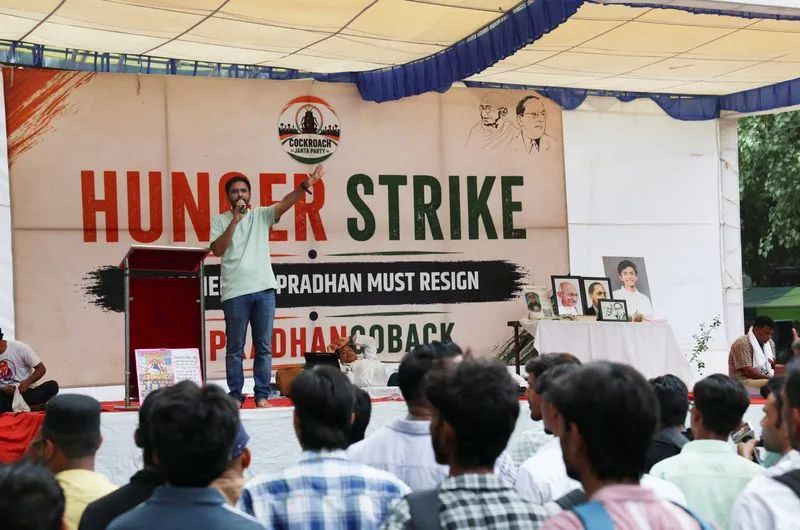
A hunger strike by CJP in progress at Delhi's Jantar Mantar. It would be premature to dismiss the CJP as a passing internet trend. Its continuing protests, legal victories and ability to attract prominent public figures indicate that it still resonates with sections of India's youth (Image: YahooNews)
When the Cockroach Janata Party (CJP) emerged in May 2026, it was widely dismissed as a satirical social media campaign born out of public anger over remarks comparing unemployed youth to “cockroaches.” Yet within days, what began as online humour transformed into one of India’s fastest-growing youth-led political movements. Millions of young people identified with the symbolism of the cockroach—not as a sign of weakness but as one of resilience in the face of unemployment, rising education costs and political neglect.
The movement’s initial growth was extraordinary. Its social media accounts attracted millions of followers within weeks, while its website claimed over one lakh registered members and presented a five-point charter centred on accountability, electoral reforms, media independence and greater political representation. The party described itself as “a party for the people the system forgot to count,” reflecting the frustration of many young Indians who felt excluded from mainstream politics.
The question now is whether the Cockroach Janata Party continues to enjoy the overwhelming public support that marked its emergence.
The answer appears to be mixed. Although the explosive social media momentum of its early weeks has naturally slowed, there is little evidence that the movement has disappeared. Instead, it seems to be evolving from a purely digital phenomenon into a more organised pressure group focused on specific public issues. Recent protests, legal challenges and continued public engagement suggest that its support base, while perhaps less sensational than before, remains active.
One of the clearest signs of this transition is the party’s campaign around education reforms. The CJP has shifted its focus from symbolic online protest to sustained demonstrations demanding accountability over examination irregularities and governance issues. Rather than relying solely on memes and viral campaigns, it has attempted to build physical protests and citizen participation, although observers note that converting millions of online followers into large street mobilisations remains a challenge.
Sonam Wangchuk’s hunger strike and government response
The movement gained renewed national attention after climate activist Sonam Wangchuk joined the CJP-led protests and began an indefinite hunger strike at Jantar Mantar. As the protest continued into its third week, reports indicated that Wangchuk had lost nearly six kilograms, highlighting both the seriousness of his protest and the growing concern among supporters.
The hunger strike also broadened the movement beyond social media. Opposition leaders, civil society members and activists expressed solidarity with Wangchuk, arguing that the protest represented wider concerns about governance, accountability and the future of young people. Among those extending support was Trinamool Congress MP Mahua Moitra, who criticised the government’s silence and called for greater accountability in public institutions.
The government’s attitude towards the Cockroach Janata Party has been marked largely by caution and resistance rather than engagement. Soon after the movement went viral, the party’s X account was withheld in India following a government order, while its online platforms faced repeated disruptions. The founders described these actions as attempts to suppress dissent, whereas authorities cited legal and security concerns.
However, the judiciary has taken a different view. In July 2026, the Delhi High Court directed that the CJP’s X account be restored, holding that the reasons originally advanced for blocking the account were no longer sustainable. The judgment was widely seen as an important affirmation of freedom of expression and digital political participation.
Despite the ongoing protests and Wangchuk’s hunger strike, the central government has shown little inclination to directly engage with the movement’s demands. CJP founder Abhijeet Dipke publicly wrote to Prime Minister Narendra Modi asking, “How long will the government ignore our voices?” The letter reflected the movement’s growing frustration over what it viewed as official silence despite weeks of demonstrations.
Whether the Cockroach Janata Party can sustain itself over the long term remains uncertain. Viral popularity alone rarely translates into lasting political influence. The movement will need to build local organisations, maintain public trust and expand beyond digital activism if it hopes to become a durable force in Indian public life.
Yet it would be premature to dismiss the CJP as a passing internet trend. Its continuing protests, legal victories and ability to attract prominent public figures indicate that it still resonates with sections of India’s youth. Even if it never contests elections as a conventional political party, the Cockroach Janata Party has already succeeded in forcing conversations about unemployment, education, democratic accountability and the space available for peaceful dissent in contemporary India.