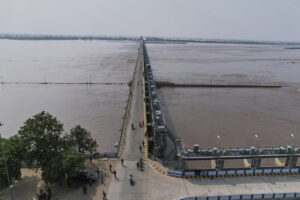
Solar Project Near Gujarat Ramsar Site Triggers Conservation Worries
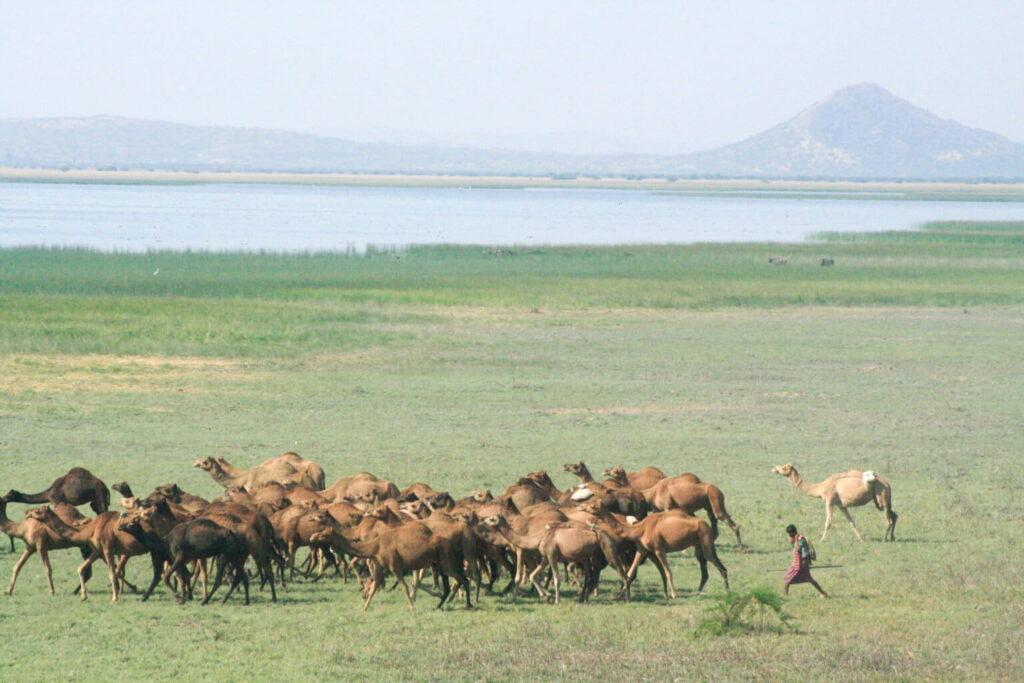
A herder with camels in the lush grasslands bordering the Chhari Dhandh wetland in Kachchh, Gujarat, which received Ramsar site status in January this year. A solar energy project has been proposed near the wetland, sparking concerns of irreversible damage to ecology (Image by Ronak Gajjar)
- A proposed solar project in Kachchh has sparked a conflict between renewable energy development and conservation.
- Experts warn the project could affect migratory birds, wildlife and grassland ecology in this landscape.
- The dispute highlights broader concerns over classifying grasslands as “wastelands” and ensuring a just, ecologically sensitive energy transition.
The proposed 900 MW solar power project near the Chhari Dhandh Ramsar site in Gujarat’s Banni grasslands has sparked strong opposition from conservationists, ecologists and the local Maldhari pastoral community, who fear it could irreversibly alter one of India’s most fragile grassland-wetland ecosystems.
The Banni grasslands in Kachchh represent a unique ecological landscape where wildlife and the traditional Maldhari pastoralists have coexisted for centuries. The region received international conservation recognition earlier this year when Chhari Dhandh was designated Gujarat’s fifth Ramsar site, acknowledging its significance as a wetland supporting rich biodiversity and migratory birds.
Despite this recognition, NTPC Renewable Energy Limited has proposed setting up a solar power plant spread over nearly 4,500 acres close to the wetland. A public notice issued by the Fulay Juth Gram Panchayat on May 12 stated that land across 11 villages under the Fulay group panchayat in Nakhatrana taluka had been proposed for the project. Documents indicate that the process of securing No Objection Certificates (NOCs) began in 2024, while local conservationists and forest officials say groundwork, including site surveys, fencing and the management of Prosopis juliflora, has already started.
The proposal has drawn widespread resistance from local residents. After the public notice, the Fulay group gram panchayat wrote to the Kachchh District Collector objecting to the project. On May 14, Abdasa MLA P.M. Jadeja urged the Gujarat Chief Minister to order a fresh survey of the project site. The protests culminated on May 22, International Day for Biological Diversity, when more than 500 Maldharis and residents from over 16 villages gathered near Fulay to oppose the project.
“Our community is opposing this solar project because it threatens our grazing pastures, revenue land and the animal husbandry livelihoods that sustain our families. We are also concerned about its impact on local tourism near the Chhari Dhandh Ramsar site,” said Begmamad Mutva, a resident of Fulay. According to him, people from Fulay, Motichur, Vedhar Moti, Chhari Paiya and neighbouring villages are united against the proposal.
Forest officials maintain that the proposed project does not fall within the Ramsar site. Dheeraj Mittal, Conservator of Forests for Kachchh, said, “The land identified for the solar project is entirely revenue land, outside the notified Ramsar site area. The forest department remains committed to the conservation and scientific management of the Chhari Dhandh Ramsar site and continues to take all necessary efforts for conservation of migratory birds.”
However, researchers argue that administrative boundaries fail to reflect ecological realities.
Scientists warn of landscape-level impacts on biodiversity
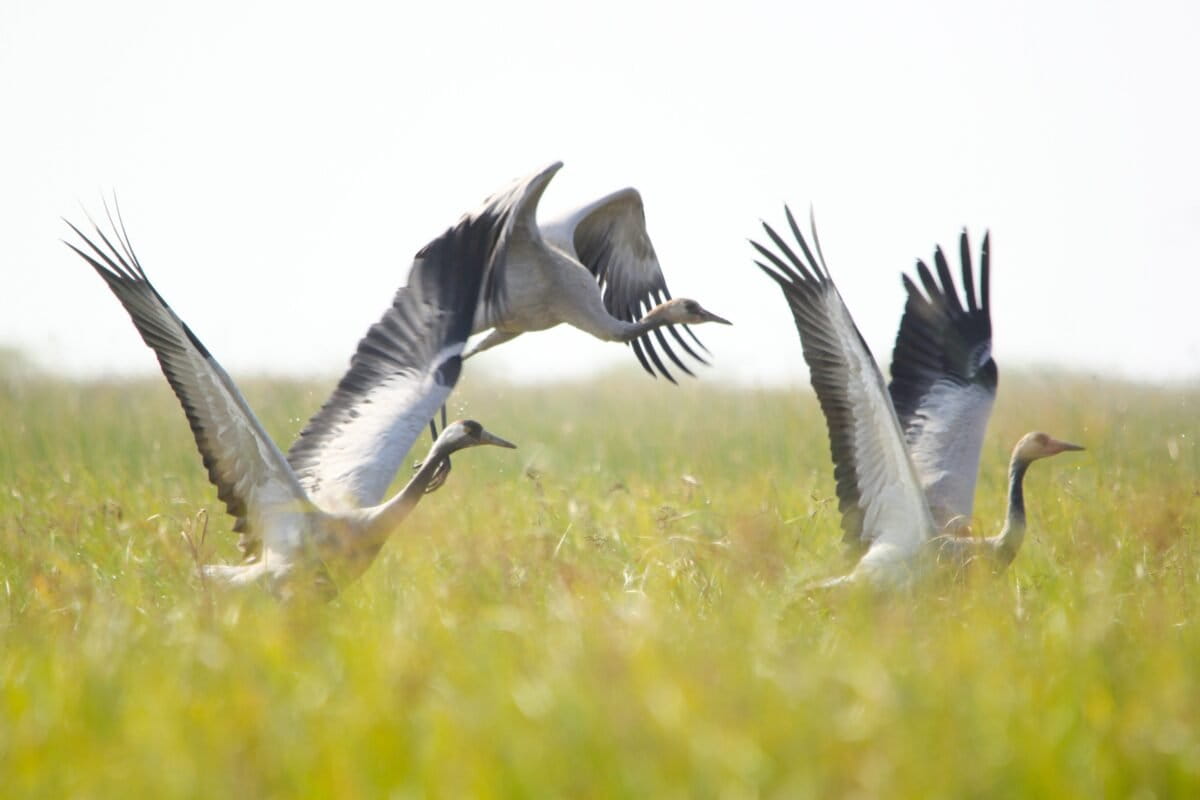
Literally meaning “saline shallow lake,” Chhari Dhandh covers about 227 square kilometres and serves as one of western India’s most important wintering grounds for migratory birds. Every winter, hundreds of thousands of birds representing nearly 250 species, including thousands of common cranes, depend on the wetland and its surrounding grasslands.
Ecologist and wildlife biologist Chetan Misher argued that environmental assessments often overlook the broader ecological processes that sustain wetlands. “Chhari Dhandh cannot be treated as an isolated wetland. It is not a tank or a reservoir,” he said. “It is the product of several climatic and ecological processes that operate across a much wider catchment. Water reaches it from the surrounding high ground and seasonal drainage. Its filling, salinity and productivity all depend on what happens upstream and across the larger grassland mosaic. The wetland and its catchment are one functional system.”
Summing up his concern, Misher added, “A wetland cannot be conserved while the system that creates it is dismantled around it.”
Scientists note that the surrounding Banni grasslands support remarkable biodiversity beyond the wetland itself. According to Misher, the landscape is among the few places in India where four wild canid species—the Indian wolf, golden jackal, Indian fox and desert fox—coexist within a contiguous habitat.
Wildlife photographer Ashok M. Chaudhary, who has documented Kachchh for nearly three decades, described the area as “one of the most remarkable natural areas in Kachchh,” adding that “places like Chhari Dhandh are not merely habitats; they are living ecological systems that connect distant continents through migratory bird routes.”
Ecologist Ritesh Pokar of Sahjeevan highlighted the area’s geological and ecological significance. He noted that nearby Kiro Dungar preserves Jurassic fossils dating back 135-150 million years, while Chhari Dhandh supports nearly 40,000 common cranes each winter—around 40% of India’s wintering population—which feed on Cyperus grass as monsoon waters recede.
Another major concern is the potential impact of large solar arrays on migratory birds. Researchers warn of the “lake effect,” where solar panels reflect polarized light that resembles water, causing exhausted birds to mistake them for wetlands and collide with the installations.
Ornithologist Asad Rahmani, former director of the Bombay Natural History Society, said, “Recent studies have shown that solar panel farms confuse migratory birds, and they mistake them as shimmering water bodies. A solar panel farm, so close to Chhari Dhandh, will be fatal for birds.”
Rahmani also emphasised that the proposed site is not barren land but a critical feeding area for common cranes. “The area identified for the solar plant is an important foraging area of the migratory Common Cranes, which dig out the tubers of Cyperus rotundus,” he said. “No one is against the development of green energy. Solar projects are not site-specific and, in my view, can be easily be planned somewhere else in the district.”
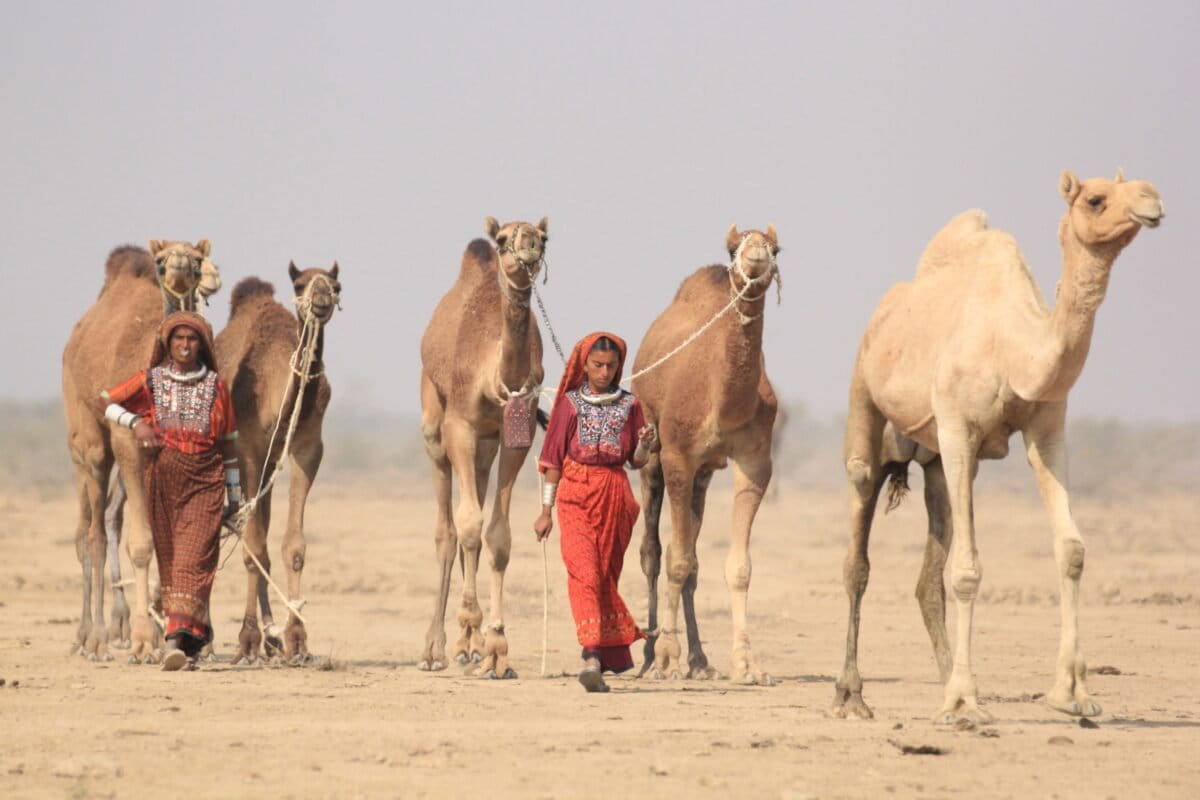
The dispute has also revived concerns over the official classification of grasslands as “wastelands,” a term critics argue ignores their ecological and economic value. The Banni landscape sustains thousands of Maldharis and an estimated 25,000-30,000 Banni buffaloes in the Chhari Dhandh region alone.
“Grasslands are too often classified as wastelands. That label makes them appear empty, and therefore suitable for green energy and other large projects. This is a misreading of the ecology. These are productive, living systems,” Misher said.
Abi Vanak, Director of the Centre for Policy Design at ATREE, framed the issue as one of climate justice. “They have to pay the price for the loss of livelihoods because we want to transition to a low-carbon economy. We should not deprive these people of their livelihoods simply because we don’t have a better imagination of where we can put our power generation,” he said.
Vanak argued that solar energy’s flexibility allows projects to be located closer to demand centres rather than ecologically sensitive grasslands. “Green energy is a decentralised form of energy. You don’t have to put it where there is open space… This kind of putting up solar power plants in these open landscapes, especially grasslands, should be completely avoided as much as possible,” he said.
Mongabay-India emailed NTPC on June 5 seeking its response to concerns regarding biodiversity and livelihoods associated with the proposed project. The company had not responded at the time of publication.
(Published under Creative Commons from Mongabay-India)