The Importance & Exploitation Of Indian Forests Down The Ages
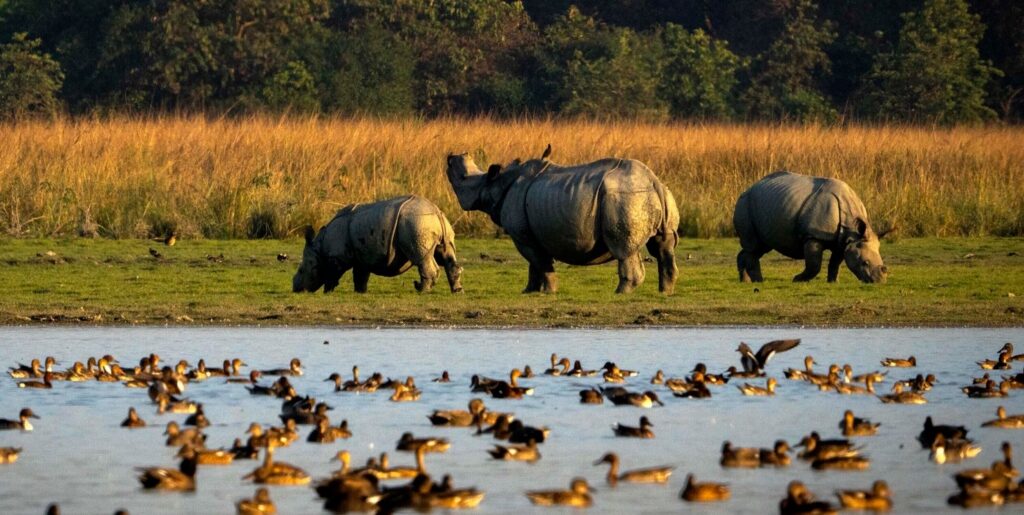
One-horned rhinoceros graze at the Pobitora Wildlife Sanctuary in Assam (AP Photo/Anupam Nath)
- Forests and wildlife in India continue to be fraught with the pressures of change and the historical legacies of hunting and decimation.
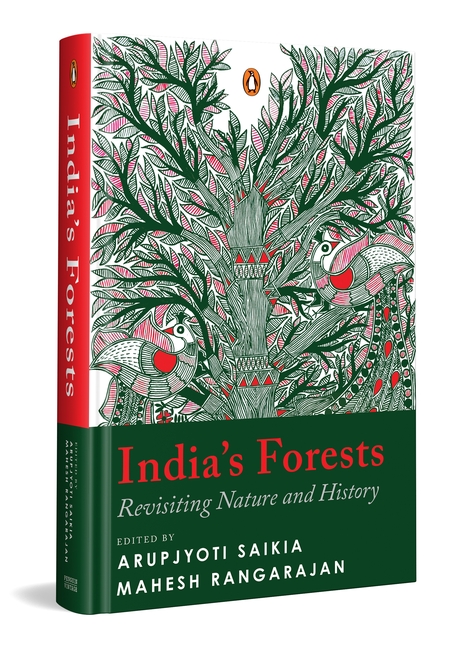
- A compilation of essays from some of the foremost and tireless voices in Indian conservation, edited by environmental historians Arupjyoti Saikia and Mahesh Rangarajan, revisits these important grounds, highlighting their past and present status.
- The essays highlight that while the forests and wildlife have changed and dwindled, the issues of overexploitation and lack of preservation have remained the same in practice.
India’s forests have long shaped the subcontinent’s ecology, economy, and culture. In India’s Forests: Revisiting Nature and History, 11 scholars examine how forests evolved from spaces where communities lived in balance with nature into landscapes increasingly exploited for economic gain during the industrial era. The book expands discussions begun by environmental historians such as Ramchandra Guha in The Unquiet Woods and later works on colonial forestry and ecological change.
Historian Shekhar Pathak, in the foreword, describes forests as “green glaciers and diverse lands,” stressing that “oxygen, water and food are essential for the survival of life forms and forests are connected with both directly and indirectly.” He reminds readers that India’s myths, deities, ancestors, and community memories are deeply rooted in forests. According to him, saving forests also means preserving soil, water systems, and civilizations themselves.
The essays cover diverse regions including the western Himalayas, central Indian highlands, Rajasthan, Jharkhand, the Deccan, and the Western Ghats. Several contributors explore how forests shaped ancient Indian society. Archaeologist Shibani Bose traces evidence of long-distance forest trade dating back thousands of years. Deodar wood from the Himalayas reached Harappan settlements in the third millennium BCE, while bhojpatra travelled into the Gangetic plains centuries later. Rock art from Chibbar Nullah in present-day Madhya Pradesh depicts humans confronting wildlife, showing that interactions between people and megafauna were central even in ancient times.
Kumkum Roy examines forests in the Arthashastra, which classified forests according to their economic and strategic value. Elephant forests (gaja vana) were vital state resources, while deer forests (mriga vana) served recreational and royal purposes. Roy notes that forests were seen as spaces of wealth where taxes were imposed on meat, timber, tusks, hides, and other products. At the same time, rulers sought alliances with forest dwellers in times of war and political instability.
The book also highlights the importance of sacred groves and forest-based traditions. Mukul Sharma’s chapter on Jharkhand examines the Sarna faith and the politics surrounding sacred groves. These groves historically symbolized resistance to overexploitation and reflected community efforts to distinguish “need and greed.” However, Sharma argues that many sacred groves today have lost ecological richness and increasingly mirror social hierarchies of caste and gender. Despite these transformations, they remain culturally significant and continue to preserve fragments of biodiversity.
 Another recurring theme is the pressure exerted by expanding agriculture and trade networks. Mayank Kumar writes that “expansion of agrarian landscapes was mostly at the expense of forests, grasslands and the erstwhile tribal settlements.” Yet forests remained central to social and political life in pre-modern India. They were spaces for hunting, elephant capture, horse breeding, and refuge for rebels resisting imperial authority. Kumar memorably describes India as “a land with islands of cultivation in a sea of forests.”
The essays on Kerala’s forests reveal the global importance of Indian forest products. Meera Anna Oommen and Kathleen Morrison describe how pepper, cardamom, ivory, honey, aromatic woods, gums, and resin from Kerala were traded with Rome, Egypt, and Iran over 2,000 years ago. After the Visigoth king Alaric I sacked Rome in 410 CE, the Romans reportedly paid part of the ransom in pepper. The authors also discuss how Vasco da Gama’s arrival in Calicut intensified European demand for spices between 1400 and 1700, drawing India’s coastal trade more deeply into the global economy.
Colonialism emerges as a turning point in the history of Indian forests. British policies accelerated deforestation, extraction, and environmental decline. Pathak warns against modern society’s “blindness to the difference between renewable and non-renewable resources,” arguing that traditional peasant and pastoral knowledge systems have steadily eroded. Chipko and similar environmental movements represented attempts to restore balance between conservation and human use of natural resources.

Wildlife conservation forms one of the book’s most compelling discussions. Divyabhanusinh Chavda’s essay on lions and rhinoceroses traces the dramatic decline and partial recovery of these iconic species. The Asiatic lion once ranged from the Arabian Peninsula to India but is now largely confined to Gujarat’s Gir forests. Hunting by royalty and colonial elites nearly drove it to extinction before conservation efforts reversed the decline. Lion numbers rose from 284 in 1990 to 674 by 2020.
The greater one-horned rhinoceros followed a similar trajectory. Rhino imagery appears on Harappan seals, and rulers from Kumargupta to Mughal emperors hunted them. British hunters and Indian princes also slaughtered rhinos in large numbers during the nineteenth century. Conservation initiatives beginning in the early twentieth century eventually stabilized populations. By 2022, India’s rhino population had risen to over 3,200.
Yet the book warns that conservation remains vulnerable to politics and regional pride. Gujarat has resisted relocating lions to other states, while Assam has opposed sharing rhinos. Scientists have already noted signs of inbreeding among Gir lions, raising fears that a disease outbreak could devastate the population.
Ultimately, India’s Forests: Revisiting Nature and History demonstrates that forests are not merely natural resources but living spaces deeply tied to India’s history, economy, religion, and identity. Even though dependence on forest products has declined in some sectors, forests remain vital as biodiversity reserves and carbon sinks in an era of climate change. The contributors collectively argue that protecting forests is inseparable from protecting both ecological balance and human civilization itself.