‘Now, The BJP Will Decide Who Can Vote And Who Cannot’
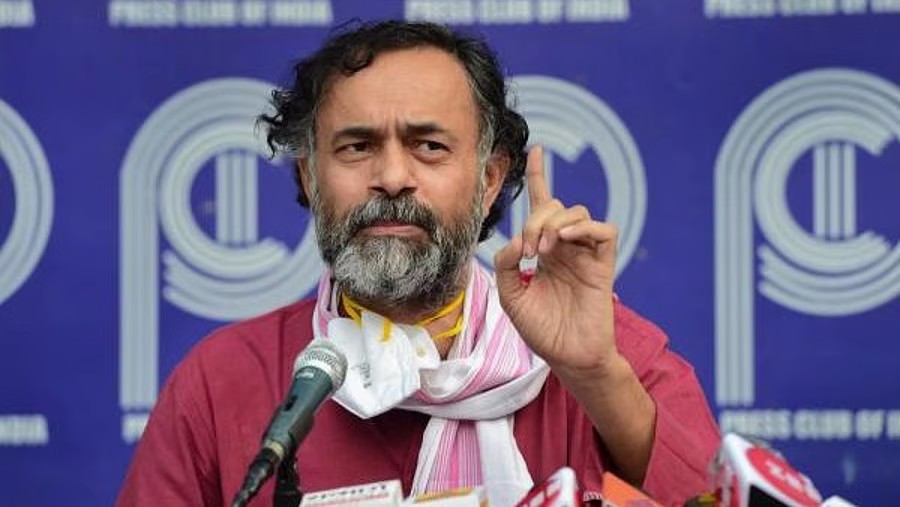
Political activist Yogendra Yadav has criticised the SC verdict on SIR, describing it as a grave blow to Indian democracy and alleging that it effectively gives the ruling BJP the power to determine “who can vote and who cannot" (Image: PTI)
Political activist and psephologist Yogendra Yadav launched a scathing attack on the Supreme Court on Wednesday after it upheld the Election Commission’s Special Intensive Revision (SIR) of electoral rolls, describing the verdict as a grave blow to Indian democracy and alleging that it effectively gives the ruling BJP the power to determine “who can vote and who cannot.”
Yadav, who was among the petitioners challenging the SIR exercise, reacted sharply within hours of the judgment being delivered. In a series of posts on X, he argued that the outcome had become predictable long before the court formally pronounced its verdict and accused the judiciary of abandoning its constitutional responsibility.
“As a litigant in this case, and as someone who was given the honour of addressing the court, I should have been hopeful, anxious or at least curious. I was not. The case was decided long ago,” Yadav wrote.
The Supreme Court bench headed by Chief Justice of India Surya Kant had upheld the Election Commission’s authority to carry out the SIR process, observing that the exercise strengthened the constitutional framework of free and fair elections by ensuring accurate electoral rolls. The court held that maintaining clean and updated voter lists was central to democratic integrity and constitutional governance.
‘Court Shifted From Constitutional Scrutiny to Grievance Redressal’
Yadav, however, claimed the proceedings took a troubling turn when the court allegedly stopped examining the constitutional validity of the exercise itself and instead focused on procedural complaints arising from implementation.
“The court moved away from examining the constitutionality of SIR and effectively converted itself into a Consumer Forum, focused on grievance redressal and arbitration, rather than constitutional principles,” he said.
According to Yadav, the challenge became practically meaningless once the Election Commission was permitted to continue the revision process in Bihar while the constitutional challenge remained unresolved. He argued that allowing the process to proceed created a situation in which the court was reviewing an exercise that had already substantially taken effect.
“The continuation of the SIR process during the hearings rendered the challenge largely ineffective. SIR had become a fait accompli,” he said.
The activist further alleged that the verdict effectively legitimised large-scale voter exclusion and handed sweeping powers to the Election Commission over electoral rolls.
“The simple truth is that the verdict has authorised the disenfranchisement of millions of citizens, at least 59 million so far, that could go up eventually to 100 million,” Yadav claimed.
He also accused the court of granting unchecked authority to the poll body.
“A carte blanche has been handed over to the EC to do what it pleases with the voters’ list,” he wrote.
The SIR exercise has remained politically contentious ever since it was introduced, with critics arguing that intensive revisions can disproportionately affect vulnerable populations, including migrant workers, marginalised communities, rural voters and economically weaker citizens who may struggle to furnish documentation or navigate bureaucratic procedures.
Comparison With ADM Jabalpur Case and Warning for Democracy
In one of his strongest remarks, Yadav compared the verdict to the infamous Emergency-era Supreme Court ruling in ADM Jabalpur v. Shivkant Shukla, a judgment widely criticised for upholding suspension of fundamental rights during the Emergency imposed by then Prime Minister Indira Gandhi in 1975.
“ADR vs Union of India (2026) is to our times what ADM Jabalpur vs Shivkant Shukla (1976) was to the previous assault on our democracy,” Yadav wrote.
The ADM Jabalpur judgment has often been cited by constitutional scholars as one of the darkest chapters in Indian judicial history because it endorsed sweeping state powers during the Emergency. By invoking that precedent, Yadav suggested that the present verdict could similarly come to symbolise judicial endorsement of democratic erosion.
He expressed hope that history would eventually judge the ruling harshly and that it would one day be overturned.
“It will eventually be recognised for what it was. And reversed,” he said.
In a separate post, Yadav broadened his criticism beyond the legal implications of the verdict and framed it as a political turning point with consequences for the future of Indian democracy.
“The news is not that the Supreme Court has today declared the Election Commission’s SIR to be constitutional. The real news is that now in this country, the BJP will decide who can vote and who cannot,” he wrote.
He also claimed that the judgment represented a collapse of one of the last institutional safeguards protecting democratic norms.
“Parts of the Constitution, perhaps the last pillar safeguarding democratic institutions, have broken and fallen today,” he said.
The ruling is likely to intensify the national debate over electoral transparency, institutional independence and the balance of power between constitutional bodies and judicial oversight.
The political and constitutional implications of the verdict are expected to remain a major point of contention in the months ahead, particularly as opposition parties and civil society groups continue to raise concerns about electoral integrity and democratic accountability in India.