Sonam Wangchuk’s Health Worsens As Hunger Strike Enters Fifth Day
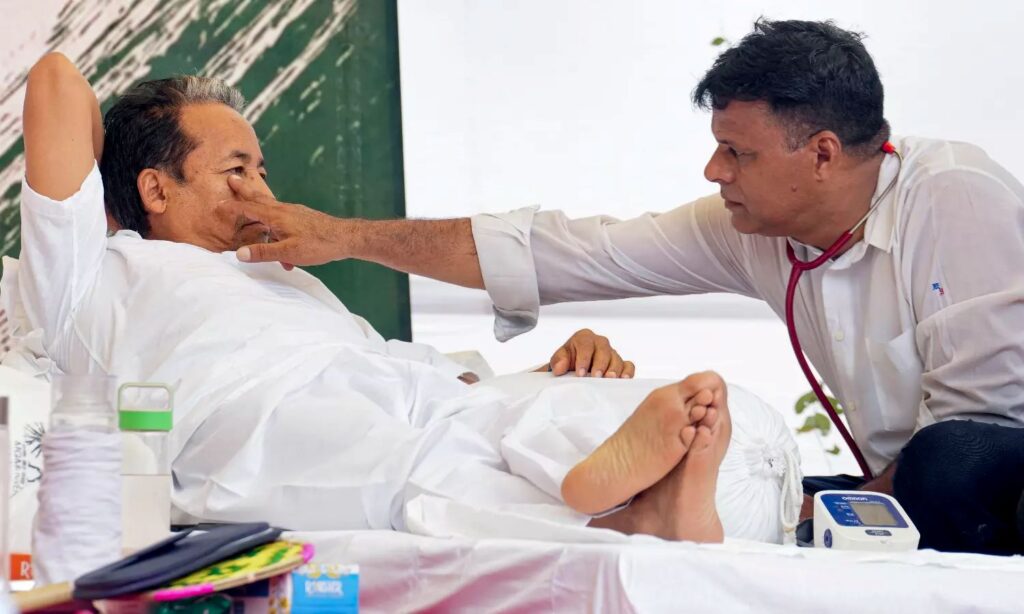
A medical professional attends to activist Sonam Wangchuk, whose hunger strike entered the fifth day on Thursday, July 2 (Image: PTI)
Climate activist Sonam Wangchuk’s health has deteriorated on the fifth day of his hunger strike at Delhi’s Jantar Mantar, with supporters claiming his blood sugar level has dropped to 60 and his blood pressure remains low. The fast is part of an ongoing protest led by the Cockroach Janata Party (CJP), which entered its 13th day on Thursday.
Sharing an update on social media platform X, CJP founder Abhijeet Dipke expressed concern over Wangchuk’s condition and held the government accountable for his well-being.
“Sonam Wangchuk’s health is continuously deteriorating. His sugar level has dropped to 60 and blood pressure is also very low. If anything happens to Sonam sir, the government will be responsible for it,” Dipke said.
Dipke also repeated his demand for the resignation of Union Education Minister Dharmendra Pradhan, accusing the government of failing to address concerns raised by the protesters.
As part of efforts to expand the movement, Dipke announced a new public outreach initiative titled “Chai Pe Charcha with Cockroaches.” He said the campaign aims to involve more people in the agitation by encouraging discussions and collecting suggestions from participants.
“We want to know how this movement can become better and bigger,” Dipke said while introducing the initiative.
The protest, launched on June 20, initially focused on alleged irregularities in the country’s examination system, particularly the National Eligibility-cum-Entrance Test (NEET). According to the organisers, the campaign has since expanded to include broader issues of public accountability.
Dipke has also said that concerns surrounding the Special Intensive Revision (SIR) of electoral rolls will remain one of the key issues raised during the agitation.
Student hunger strike and opposition support
Alongside Wangchuk’s fast, six students affiliated with the All India Students’ Association (AISA) have continued their own indefinite hunger strike from a separate stage at the protest venue.
On Wednesday, AISA expressed concern over the worsening health of the fasting students. The student organisation said doctors had advised several participants to end their fast due to medical complications.
According to AISA, Jawaharlal Nehru University Students’ Union (JNUSU) Joint Secretary Danish recorded a blood sugar level of 61 mg/dL, while fellow protesters Aameen and Deepak Kumar Verma were also advised to discontinue their hunger strike because of declining health.
Despite these concerns, the students have continued their protest.
The agitation has also received support from several political leaders, activists and members of civil society over the past few days.
Communist Party of India (Marxist) General Secretary M.A. Baby, senior CPI(M) leader Brinda Karat, Communist Party of India General Secretary D. Raja, social activist Yogendra Yadav, senior advocate Prashant Bhushan, CPI leader Annie Raja, transparency activist Anjali Bhardwaj and Trinamool Congress MP Sagarika Ghose have all visited the protest site to express solidarity with the demonstrators.
The protest continues to demand greater transparency and accountability in public institutions, with organisers maintaining that concerns over examination reforms and electoral processes require urgent attention. As Wangchuk’s health remains under close watch, the focus is increasingly shifting toward the government’s response to the protesters’ demands and the growing concerns surrounding the ongoing hunger strikes.