India May Be A Rich Nation But Has Poor Sanitation Performance: SC
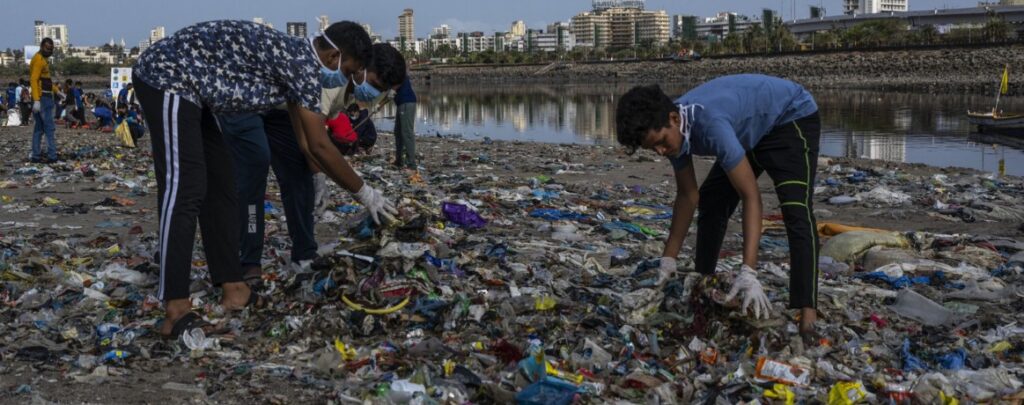
FILE PHOTO: Volunteers clear plastic and other garbage littered on the shores of Mumbai (AP Photo/Rafiq Maqbool)
- The Supreme Court says India continues to have poor sanitation performance despite its economic growth and available resources.
- It urges district collectors to take the lead in enforcing solid waste management rules through coordinated local action.
- The bench flags gaps in monitoring, public-private participation and the use of corporate social responsibility funds to improve waste management infrastructure.
The Supreme Court has criticised India’s poor sanitation performance despite its economic growth, saying the failure to effectively implement solid waste management rules has undermined the country’s progress. It has called on district collectors to take the lead in enforcing the rules, while flagging gaps in monitoring, public-private participation and the use of corporate social responsibility (CSR) funds to strengthen waste management infrastructure.
Hearing appeals arising from National Green Tribunal orders on municipal corporations’ compliance with environmental norms under the Solid Waste Management (SWM) Rules, a bench of Justices SVN Bhatti and NV Anjaria said the basic administrative mechanisms for monitoring implementation were already in place. The problem, it observed, lay in the failure of different stakeholders to work together and translate these provisions into results.
“The court notes that Bharat is now a rich country but has poor sanitation performance. The growth achieved in other fields is completely negated by the negative impact from this manageable dereliction by all the stakeholders,” the bench said in its November 17 order.
The court said poor sanitation and inadequate waste management damaged both society’s quality of life and the country’s image. It pointed out that economies of comparable size, in India and elsewhere, had managed to meet their sanitation and hygiene objectives.
“Our existing resources make it possible, albeit through unwavering implementation by the statutory enforcing authorities and adherence by the citizens,” it said.
District collectors asked to lead implementation
Reviewing reports submitted by the Supreme Court Monitoring Committee (SCMC), the bench observed that different organs of the State were functioning independently instead of working towards a shared goal.
“The cogs (citizens) that connect them must work towards the objective for realising good results,” it said, stressing that effective waste management required coordination between government authorities, local bodies, businesses and citizens.
The bench noted that Parliament had enacted the Environment (Protection) Act, 1986, and the executive had framed the SWM Rules, but implementation of both the 2016 and 2026 rules remained inadequate.
“Therefore, this court, as a repository of the constitutional right to a pollution-free environment, through SCMC, has taken the arduous task of issuing continuing mandamus (court order) to the local bodies,” the order said.
The court clarified that its intervention through the SCMC was not intended to take over the responsibilities of existing institutions, but to ensure that statutory obligations were fulfilled. It said the committee’s efforts should eventually lead to local bodies and other stakeholders regulating themselves.
“As already noted in our earlier orders, it is now or never. The SCMC’s efforts will sunset into self-regulation by the contributors,” the bench said.
Expressing confidence in the SCMC and district collectors, the court said it had seen effective implementation by two or three collectors in different states. Their work, it said, demonstrated the role district administrations could play in improving compliance.
The bench described its order as a reminder of the Supreme Court’s expectations from district collectors and their capacity to deliver results. It warned that continued inaction could worsen the situation and make the consequences potentially irreversible.
It directed collectors to develop strategies suited to local conditions and work dynamically with chief secretaries and the SCMC to implement the 2026 rules and the court’s directions. They were also asked to identify all bulk waste generators in their jurisdictions in coordination with local bodies.
Gaps in monitoring and infrastructure
The court also identified shortcomings in the SCMC’s monitoring process. Recalling its August 18 observations, it said unorganised residential, commercial and business establishments accounted for a significant part of the waste management problem.
However, the latest report did not provide details of notices served on such establishments or identify additional areas where temporary disconnection of water and electricity could be considered to enforce compliance.
The bench also flagged the absence of a clear plan for public-private participation, which had been proposed as a way to reduce the financial burden of expanding and improving waste management infrastructure.
It further said the report did not adequately address the statutory framework required to channel CSR funds towards strengthening waste management facilities.
The court said industries could not justify their approach by arguing that pollution was generated in one location while their CSR contributions were directed elsewhere. The observation underlined the need for businesses to take responsibility for the environmental consequences of their operations.
Issuing additional directions to address these gaps, the bench posted the matter for further hearing on January 12.
The proceedings have their origins in a challenge by the Bhopal Municipal Corporation against directions concerning its obligations in managing municipal solid waste. The Supreme Court subsequently expanded the scope of the case nationwide, citing the broader failure to develop a culture of compliance with waste management rules.
On August 18, the court had issued a series of directions to improve the management and disposal of solid waste, stressing that infrastructure needed to be expanded to meet the standards prescribed under the SWM Rules, 2026.
It had also criticised public attitudes towards waste generation, observing that the prevailing mindset appeared to be: “I am entitled to generate but not to cooperate and control the impact of solid waste management at the threshold”.
The SCMC was constituted following an earlier direction of the Supreme Court and includes several Union government secretaries and the secretary of the Central Pollution Control Board.
The latest order makes clear that legislation and monitoring mechanisms alone cannot resolve the crisis. Their success, the court indicated, will depend on coordinated enforcement, accountable local administration and greater cooperation from citizens and industries.