Himalayan Floods, Climate Crisis & The Need For Disaster Diplomacy
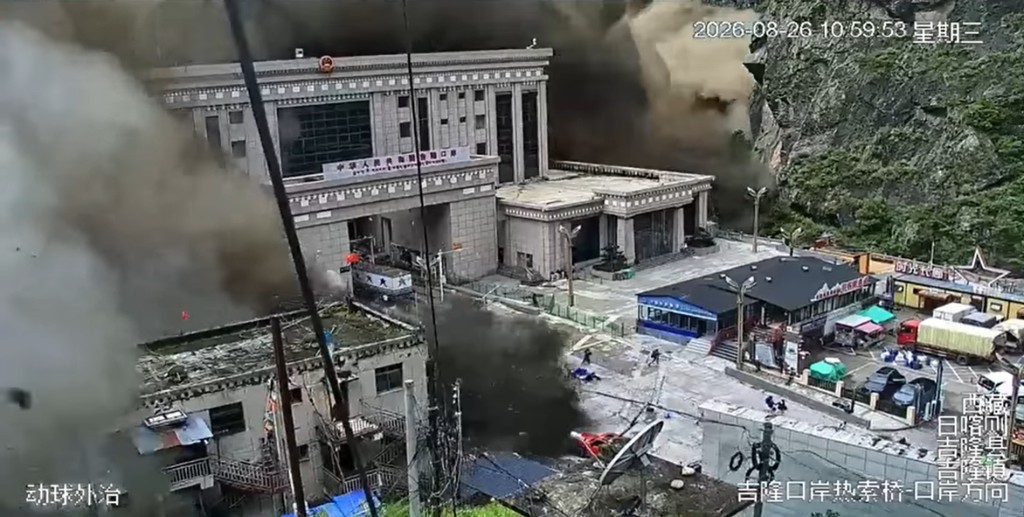
Screenshot of the CCTV footage of the August 26, 2026 Nepal flash flood hitting Gyirong Port border crossing between China and Nepal (view to the south, downstream)
On 8 July 2025, the rapid outburst of a supraglacial lake on the Purugu Glacier in Tibet caused widespread devastation along the Trishuli River in Nepal.
The flood claimed more than 900 lives, left an estimated 4,000 missing, and damaged critical infrastructure, including roads, hydropower plants, schools, bridges and electricity supply systems. Estimated losses amount to billions of rupees. According to the International Red Cross, at least 93,000 people may have been affected by the flash floods.
Remote-sensing analysis shows that the glacial lake was located about 35 km from the Nepal border. Marks on the glacier’s surface indicated that at least some water escaped across the ice, suggesting that drainage followed a complicated route that may have intensified the flash flood downstream.
The unexpected flash flood entered Nepal’s Rasuwa district from Tibet at around 9:15 am on 10 August 2026, quickly affecting Timure, Rasuwagadhi and Syabrubesi. It damaged private houses, public offices, including schools and police stations, border check posts, local businesses and hydropower projects.
Scientists have suggested that an ice avalanche may have blocked the Lhende River upstream, causing a sudden release of water.
An earthquake of magnitude 4.4 was recorded at 8:37 am, shortly before the flood. It is assumed that this led to the outburst in a supraglacial lake, displacing a large volume of water that swept away fragile mud, pebbles and stones along the river.
People received the early warning only 15 minutes before the flood. As most people had already started their usual activities and it was peak working time for public officials, labourers and farmers, the flood caused a significant impact. It also affected downstream areas of Rasuwa, Dhading, Gorkha and Chitwan.
An overall rise in temperature, due to climate change and human activities in an ecologically fragile zone,seems to have contributed to the flood.
Scientists have been continuously studying temperature changes in the Himalayan regions. A study conducted between 1980 and 2020 shows that mountain regions have been, on an average, 0.21 degrees Celsius faster per century, than surrounding lowlands.
There is also more precipitation compared to snowfall in mountain regions. Moreover, human activities, including the burning of oil, gas and coal, are contributing to rising global temperatures and increasing the risk of such disasters. This risk is particularly significant in the Himalayas, which are warming considerably faster than many other parts of the world. These changes indicate increasing climate-related hazards and more frequent disasters.
Most hydropower electricity in Nepal depends on rivers flowing downstream from Tibet (China). The recent flood also impacted 12 hydropower electricity projects based on the Trishuli River, generating about 430 megawatts of electricity. The flash flood also damaged distribution lines and other infrastructure.
The pressure for extraction of natural resources has also increased in Nepal’s mountain regions. Road expansion, the extension of markets, sand mining in the Trishuli River and increased vehicle movement have contributed to rising temperatures in the Himalayan regions.
In addition, there are reports that China has also significantly increased human activities in this Himalayan region, focusing on urban expansion, including the development of Gyirong Port, road construction and transport corridors, dry ports, a proposed rail link to Nepal and hydropower projects.
China, however, describes this as a disaster being converted into ‘disinformation’.
Information about ongoing development projects inside Chinese territory has not been publicly shared with Nepal or the outside world.These activities are believed to have significantly contributed to global warming in the region. Besides, the damage downstream was further compounded by lack of information sharing between China and Nepal. Environmental experts say that more than 25 glacial lakes on the Chinese-side could directly affect Nepal and the wider region. This underlines the need for the Chinese government to cooperate and share information about the condition of these glacial lakes.
Nepal and China need to develop a mechanism for sharing information and establish an effective early-warning system to help reduce casualties and damage to infrastructure. In 2019, the government of Nepal and the Ministry of Emergency Management of the People’s Republic of China did agree on cooperation in disaster risk reduction and emergency response in 2019.
However, till date, cooperation on the ground and information sharing remain minimal.
Major Nepali political parties have expressed their commitment to work together in addressing the crisis and issued ten-point commitments. They have highlighted the existing high-risk glacial lakes on the Chinese-side and have proposed a joint study and technical mechanisms to reduce risks.
They have also proposed disaster diplomacy and setting up early-warning systems, with Nepal and China institutionalising real-time data sharing and developing reliable, technology-based early-warning systems that take transboundary river systems into account.
Finally, Nepali parties want to raise the issue of climate justice and seek support at the global level.
Nepali civil society members have also demanded international accountability for the climate crisis.These incidents have increased in frequency over the years, with similar low-intensity floods in Rasuwa and the floods in Thame and the Melamchi River among recent disasters. It is the people of Nepal who have had to bear the cost of the climate crisis.
While Nepal has been committed to the global framework on climate justice, it is time to demand accountability and justice in addressing global commitments from the developed world, particularly Europe and North America.
In addition, China needs to limit its large-scale infrastructure development activities in the region, which can contribute to further deterioration of the situation across the region.
Climate change and climate disasters are not only Nepal’s problem. South Asia is home to 2.11 billion people, many of whom depend on the fresh water originating in the Himalayan region.
As temperatures rise and snow starts melting earlier than usual, seasonal distribution of water supply will be affected — initially, water supply will increase, but in the longer-term, it will decline in summer and winter season, even as the increased intensity of monsoons leads to heavy flooding and damage.
(Published under Creative Commons from 360info.org)