Audit Exposes Fundamental Flaws In Green India Mission’s Execution
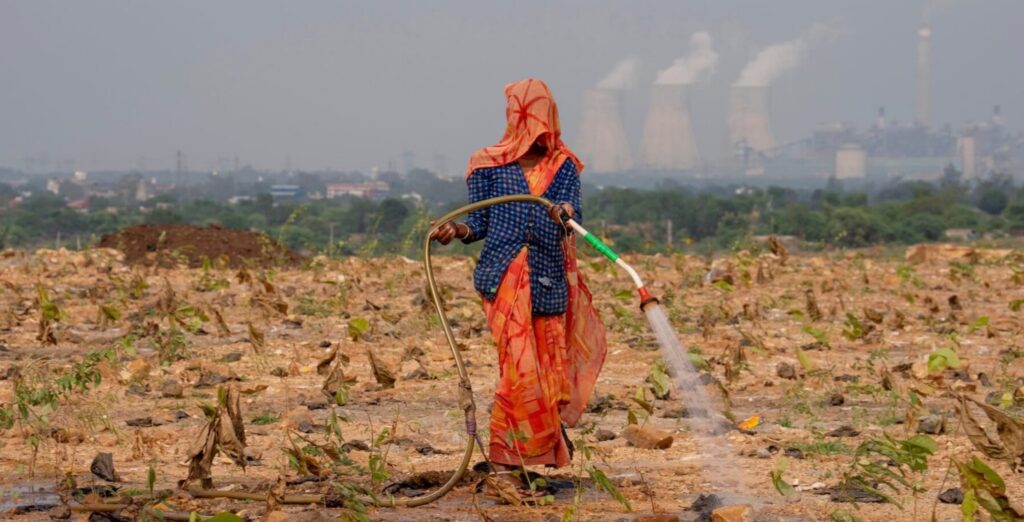
A woman waters saplings planted as part of a government tree planting campaign in Uttar Pradesh, against the backdrop of thermal power plants (Representative image, AP Photo/Rajesh Kumar Singh)
- A CAG audit found India’s Green India Mission achieved only around 5% of its afforestation target and missed more than 97% of its ecosystem-restoration goal, citing poor planning and weak monitoring.
- Convergence funding largely failed to materialise, leaving billions in direct central contributions over a decade.
- States misreported plantation data and neglected ecologically vulnerable landscapes like grasslands and scrublands, while almost no carbon sequestration assessments were conducted nationwide.
An audit report of the Green India Mission, one of the eight missions under the National Action Plan on Climate Change, found that funds were consistently underutilised and that progress under the mission “remains negligible.”
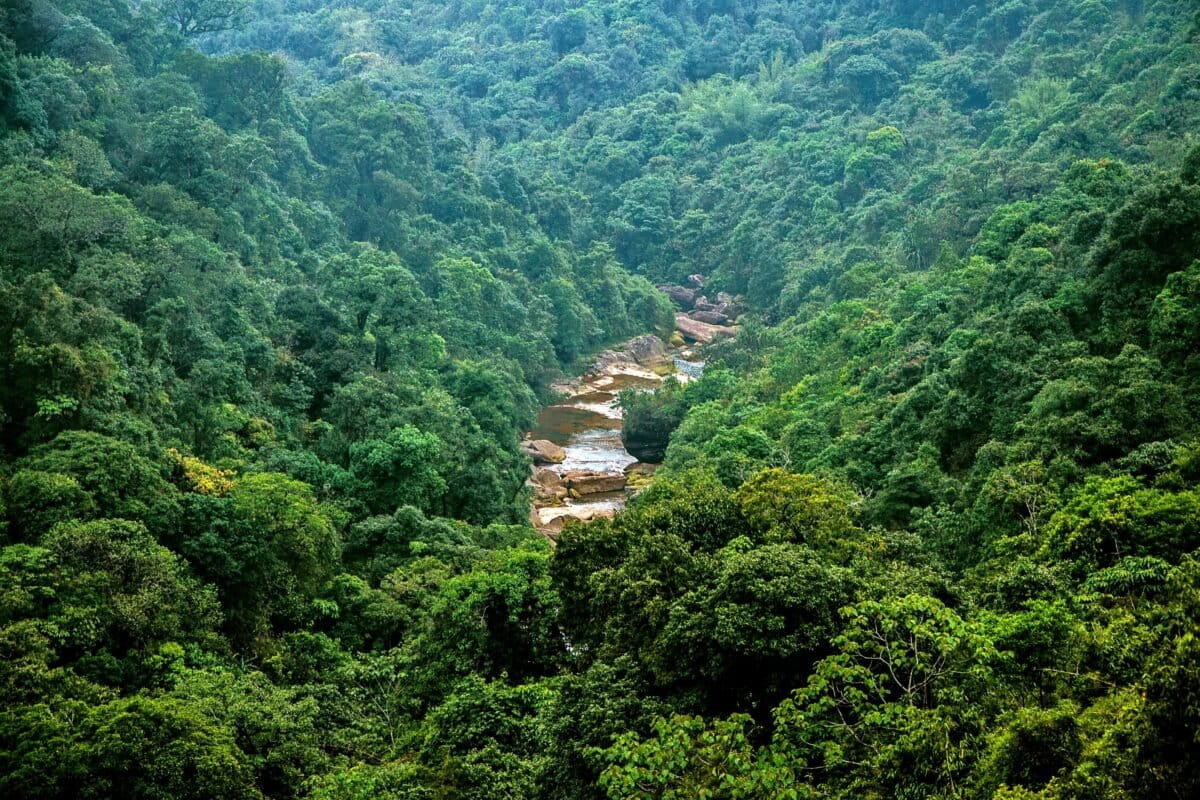
The Green India Mission aims to enhance forest cover, improve the quality of forest cover and ecosystem services, and scale carbon sequestration in India. In 2011, the mission aimed to fulfil these goals in 10 million hectares (mha) of land over a period of 10 years. In 2014, the Mission included afforestation on 2.8 mha of land by 2018 to its goals.
But the mission’s performance has been set back by “fundamental weaknesses in planning and design as well as deficiencies in execution and monitoring,” says an audit report by the Comptroller Auditor General of India (CAG), submitted to Parliament on August 12. According to the audit, out of the targeted 2.8 million hectares, afforestation interventions were made in approximately 0.15 million hectares, which is just about 5% of the goal area.
Pooja Choksi, an ecologist and founder of Ficus Research Consulting said the CAG’s report was a timely “wake up call.”
“It is an indication that we need to do things radically differently if we want to achieve our land use and forestry related targets, especially in an ecologically and socially meaningful way that ensures the longevity of these plantation efforts,” she said.
Apart from poor implementation, the CAG found that activities carried out eroded the mission’s core objectives of restoring ecosystems at a landscape level. “Plantation activities were largely confined to low-vulnerability sites, while ecologically critical landscapes, despite being identified in multiple studies and present across several States, were largely ignored,” the report says.
Ecologists have long warned against plantation schemes that aim to increase tree and forest cover without considering a region’s biogeography and ecological niche. An investigation by Mongabay-India found that the wrong tree in the wrong place could cost states dozens of crores of rupees in wasteful plantations.
The CAG’s report also presents the challenge India faces in achieving its climate goals. In 2025, the government committed to creating a carbon sink capable of absorbing 3.5 to 4 billion tonnes of carbon dioxide equivalent by 2035, compared to 2005 levels. The CAG’s report reveals, however, that between 2015 and 2025, none of the states assessed conducted any assessments on carbon sequestration, with the exception of Madhya Pradesh and Chhattisgarh.
Lack of convergence funding
The CAG carried out its assessment in 15 states and one Union Territory, and covered the period from 2015 to 2025.
Initially, the government allocated ₹130 billion for the mission, and proposed that funding be raised in convergence with other schemes like Mahatma Gandhi National Rural Employment Guarantee Act (up to ₹40 billion), the National Afforestation Policy (₹6 billion), and the compensatory afforestation scheme (₹60 billion). However, the CAG audit notes that neither institutions at the national level, nor those at the state and district level were able to guide the convergence process successfully.
In the absence of any convergence, the central government made direct contributions of just ₹11.49 billion throughout the entire 10 year audit period. The lack of convergence funding for the mission also compromised its execution at the district and sub-district level, the report said. The lack of functional forest district authorities meant that sites already saturated with dense forest cover were selected for afforestation, and that only 54% of village-level microplans had been approved by their gram sabhas.
In one instance, the CAG found a possible misappropriation of funds by authorities in Mizoram. A sum of ₹91 million had been released by the state to the forest district authority of Kolasib for afforestation activities. While the entire amount was withdrawn, no documentary evidence was produced supporting its utilisation for afforestation. “Cash withdrawal of such a large amount and the lack of supporting documents for the funds’ utilisation is a risk area for misappropriation of funds,” says the report.
Lack of transparency, data availability, and poor data quality have hindered the outcomes of such schemes from being peer reviewed, said Choksi. She contributed to research which found that most public programmes targeting afforestation failed to increase tree cover.
“If district and sub-district expenditure data was made available to the public, we could have much more accurate independent evaluations of these programs. Given there were irregularities in the expenditures under the Green India Mission and lack of actual plantation data, we need a lot more transparency in the implementation of these schemes,” she said.
Vulnerable landscapes not identified
A key objective of the Mission was improving ecosystem services and restoration on 1.4 million hectares of land, but the CAG’s site inspections found a shortfall of 97.57% in this target.
Several states reported inconsistencies in their own records, with issues ranging from misreporting the heights of saplings to inflating the area covered by plantations.
For example, in Uttarakhand’s Chakrata division, the Dabala Sagwa Tok plantation site was reported as having 2,000 plantations, but the CAG found only 30 to 40 saplings on the ground, none of which had survived. In Odisha, afforestation plantation activities from five joint forest management divisions were carried out on “dense forests with canopy density ranging from 40 to 70% , rendering them ineligible for undertaking plantation activity.”
The CAG recommended the Ministry conduct “test-checks to ascertain that the sites selected for plantation activities have sufficient space and need for plantations, so as to prevent wastage of resources in terms of time, money and labour on unsuitable sites.”
The CAG also attributed the Mission’s failure to inadequate site selection by the states and centre. Grasslands, ravines, scrub forests, and abandoned mines were consistently left out of interventions despite being a stated objective of the scheme.
Only seven states had set targets of restoring scrublands in their plans. “Despite the presence of significant area of scrublands amounting to 2.11 mha in eight other States, no targets were set by these States under this Sub Mission,” said the CAG report, adding, “No efforts were made by the Ministry as well to get the States to include the aforesaid ecosystem for GIM.”
This analysis revealed little to no improvement in nearly 70% of the locations assessed. “The Ministry may ensure that the ‘bottom-up planning’ envisaged under the Mission is followed by all States so that the physical targets as well as suitability of the areas for interventions are communicated from the (bottom) village level to the (top) State level,” says the report.
“For starters, we can move away from only aiming for ‘greening’, and focus more on ecosystem restoration and resilience,” said Choksi, adding, “In fact, the Ministry just launched the Guide to Grasslands and Other Open Natural Ecosystems, which could be a great resource to conserve, manage and restore other non-forested ecosystems that are equally important for carbon sequestration, biodiversity conservation and livelihoods.”
(Published under Creative Commons from Mongabay India)