The Himalayas Warn Us: Rethink Development Before Disaster
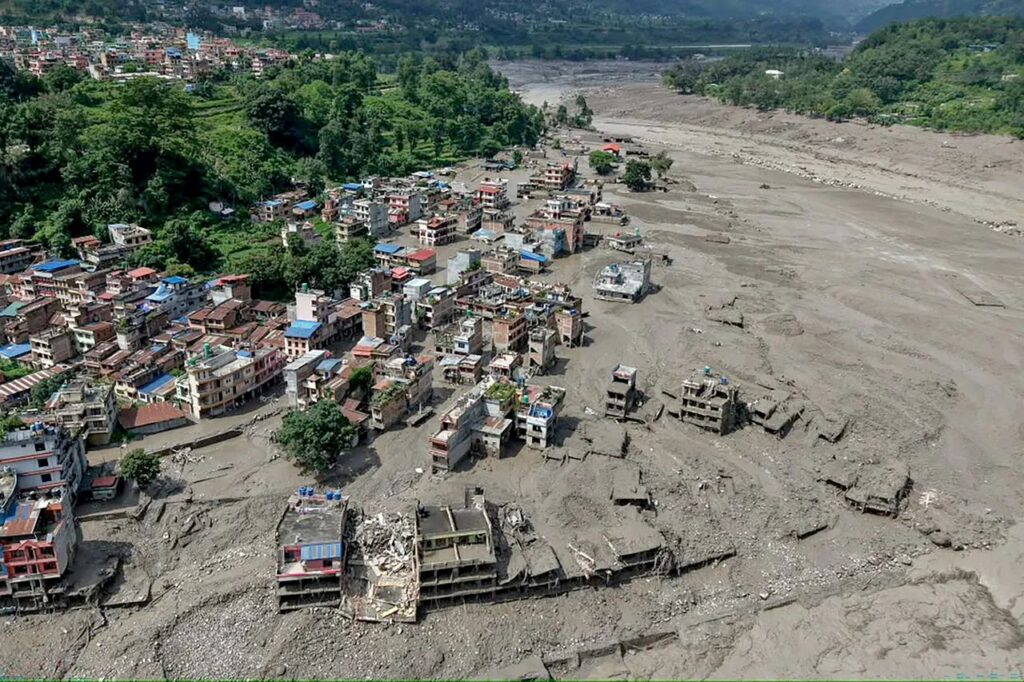
On August 26, a massive ice-and-rock collapse near the Nepal-China border triggered a catastrophic flood that swept through the Bhote Koshi valley. At least 160 people were reported dead initially, with hundreds missing, while roads, bridges, homes and critical infrastructure were destroyed (Image: Prabin Ranabhat)
This year, it is Nepal. Last year, it was Himachal Pradesh. Before that, Uttarakhand. The locations change, but the pattern is becoming disturbingly familiar: cloudbursts, flash floods, glacier-related disasters, landslides and debris flows striking mountain communities with devastating speed.
The latest disaster in Nepal is a particularly stark warning. On August 26, a massive ice-and-rock collapse near the Nepal-China border triggered a catastrophic flood that swept through the Bhote Koshi valley. At least 160 people were reported dead initially, with hundreds missing, while roads, bridges, homes and critical infrastructure were destroyed. Satellite observations indicate that a large section of glacier collapsed, although scientists are still investigating the precise chain of events and the contribution of climate change.
The tragedy is not an isolated event. In August 2025, Himachal Pradesh suffered a series of rain-triggered disasters, including cloudbursts, flash floods and landslides. By early August, the state had already reported 184 deaths during that monsoon season, including 103 directly attributed to rain-related causes. In September, official figures showed that rain-related disasters that year included deaths from landslides, drowning, cloudbursts and flash floods.
Uttarakhand has provided even more painful reminders. The February 2021 flash flood in Chamoli killed more than 200 people, while the 2013 Kedarnath disaster remains one of India’s worst Himalayan catastrophes. Official figures from the 2013 disaster put the death toll at more than 4,400, with many people still missing; independent estimates have been considerably higher. The 2023 Sikkim glacial lake outburst flood killed 179 people, while the 2023 Uttarkashi tunnel collapse trapped 41 workers for days.
The lesson should be obvious: these are not simply unfortunate natural events. They are disasters produced by the interaction of natural hazards, a rapidly changing climate and human vulnerability.
The warning signs are already here
The Himalayas are warming and changing rapidly. The International Centre for Integrated Mountain Development’s 2026 assessment found that glaciers across the Hindu Kush Himalaya lost about 12% of their area between 1990 and 2020, while ice loss has accelerated since 2000. Rising temperatures cause glaciers to retreat, alter snow and rainfall patterns and contribute to the thawing of permafrost that helps stabilise high mountain slopes. The result can be a dangerous combination of unstable rock, melting ice, intense rainfall and sudden floods.
Cloudbursts themselves are not new. The India Meteorological Department defines a cloudburst as rainfall of at least 100 millimetres in an hour over a relatively small area. What has changed is the vulnerability of the landscape and the scale of human activity in areas exposed to such events.

Mountain valleys are increasingly crowded with roads, tunnels, hotels, settlements, hydropower projects and tourism infrastructure. Roads are cut into unstable slopes, riverbanks are occupied and construction sometimes proceeds without adequately accounting for drainage, geology or changing climate risks. When an extreme event occurs, there are simply more people and more infrastructure in harm’s way.
Development is not the enemy. The Himalayas need roads, electricity, communications, healthcare, tourism and economic opportunities. The question is whether development can be designed around the limits of a fragile mountain ecosystem.
Too often, the approach has been to build first and assess risk later. That must change.
Infrastructure in the Himalayas should be subjected to rigorous cumulative environmental and geological assessments rather than project-by-project approvals. Construction should avoid high-risk floodplains, unstable slopes and natural drainage channels. Roads and hydropower projects must account for landslides, seismic activity, extreme rainfall, glacier-related hazards and changing river behaviour.
Just as importantly, disaster preparedness cannot remain an afterthought. Early-warning systems need to combine rainfall, river-level, seismic, satellite and glacier monitoring. Villages, tourists and workers must receive warnings in language and formats they can immediately understand. Evacuation routes and safe shelters need to be identified before an emergency, not after one.
The Nepal disaster demonstrates why this matters. A hazard that unfolds within minutes cannot be prevented by announcing relief packages after the event. Lives are saved beforehand—through monitoring, planning, evacuation and resilient infrastructure.
The Himalayas are not merely a backdrop for development. They are a living, dynamic ecosystem whose forests, glaciers, rivers and slopes perform essential functions for millions of people. Their degradation ultimately threatens not only mountain communities but also downstream agriculture, water supplies, cities and economies.
The choice, therefore, is not between development and conservation. It is between reckless development and resilient development.
Nature has been sending us warnings—from Kedarnath to Chamoli, Sikkim, Himachal Pradesh and now Nepal. If each tragedy is treated as an isolated “natural disaster”, we will continue repeating the same mistakes.
The real measure of development should not be how quickly we build a road, tunnel, dam or resort. It should be whether that infrastructure can withstand the environment in which we have chosen to build it—and whether the people living around it are safer because of it.
The Himalayas are warning us repeatedly. We should stop waiting for the next disaster to listen.