Amnesty Evidence Questions Police Account Of July Protest Crackdown
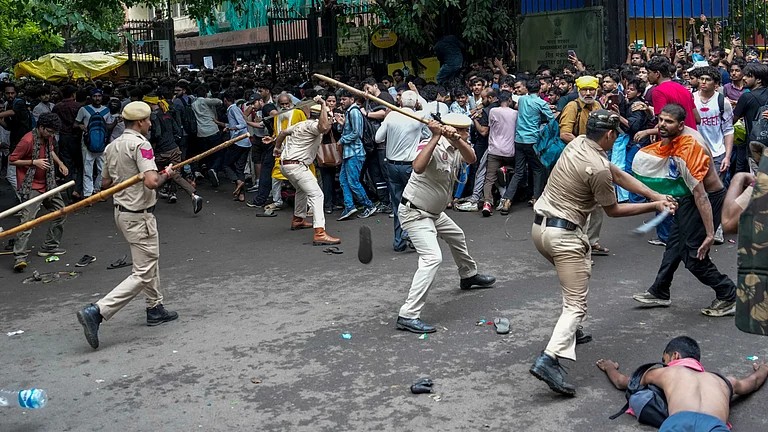
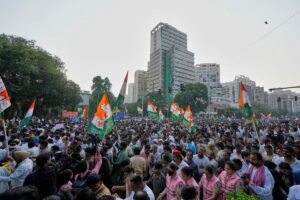
Delhi Police resorted to lathicharge and firing tear gas shells to disperse protestors from the Cockroach Janata Party as they attempted to march to Parliament on July 20
Amnesty International has alleged that police used excessive and, in some cases, potentially unlawful force against protesters in Delhi and Bihar in July, contradicting official claims that the response to demonstrations was “professional” and proportionate.
In a recent statement, Amnesty India said videos and photographs from protests at Jantar Mantar in Delhi and in Siwan, Bihar, between July 20 and 24 had been verified by Amnesty International’s Evidence Lab. According to the organisation, the material points to violations of domestic policing guidelines and international standards governing the use of force.
The allegations directly challenge the Delhi Police’s public response to reports of excessive force at Jantar Mantar. The police had denied using disproportionate force and, in its submissions before the Supreme Court, described its handling of the protest as “professional”. It had also dismissed reports of protesters suffering pellet injuries through a “Fake News Alert” on X, describing them as “completely false and misleading” and warning that “appropriate legal action” could be taken against those allegedly spreading rumours.
Amnesty, however, says its independently verified evidence presents a different picture.
“Witness testimony and video and photographic evidence verified by Amnesty International’s Evidence Lab confirm that police used weapons including pellet-firing shotguns, tear gas launchers, grenades, batons and electric shock devices against protesters between July 20 and 24 in Delhi and Siwan town in Bihar state,” the organisation said.
Evidence of Force
Amnesty said its Evidence Lab verified 17 videos filmed in central Delhi on July 20, covering areas around Jantar Mantar, Sansad Marg and Connaught Place, along with two videos recorded in Siwan on July 24. The footage identified personnel from the Delhi Police, Rapid Action Force (RAF) and Central Reserve Police Force (CRPF).
Among the evidence, Amnesty said, was footage showing an RAF officer firing a shotgun into a crowd near the intersection of Connaught Place and Sansad Marg. Two other verified videos reportedly showed protesters with wounds consistent with injuries caused by birdshot.
Birdshot ammunition consists of numerous small metal pellets and is generally designed for hunting rather than law enforcement. Amnesty said its widespread dispersal makes it inherently inaccurate and increases the risk of serious injury to both intended targets and bystanders. The organisation also pointed to previous cases in countries including Egypt, Iran and Jammu and Kashmir, where such ammunition has been associated with deaths and severe injuries, including blindness.
The use of such weapons is particularly significant because India’s Bureau for Police Research and Development has issued Standard Operating Procedures for dealing with public agitations using non-lethal measures. These procedures recommend that security forces warn protesters before resorting to force.
According to a victim interviewed by Amnesty, no warning was given before the pellet-firing shotgun was used. The organisation said this was inconsistent with international standards, which require law enforcement agencies to use non-violent methods wherever possible and, when force is unavoidable, provide a clear warning and sufficient time for people to respond.
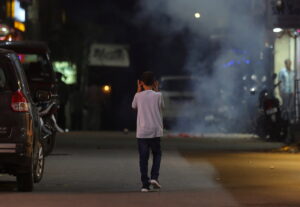
Amnesty also raised concerns about the use of tear gas. Eyewitnesses reportedly told the organisation that grenades were fired directly towards protesters rather than launched at an angle above their heads. This, Amnesty said, was inconsistent with UN guidance on less-lethal weapons.
The organisation argued that tear gas should generally be restricted to situations involving widespread and serious violence. Although there were isolated reports of protesters throwing stones, Amnesty said it had found no evidence suggesting violence on a scale that would justify such a response.
The verified footage also allegedly shows men in plain clothes, including individuals wearing black helmets marked “Delhi Police”, beating protesters with lathis. Uniformed officers can reportedly be seen accompanying the men but not intervening.
Amnesty said the apparent absence of visible identification, such as name tags or badge numbers, raised additional accountability concerns. International policing standards require officers involved in the use of force to be identifiable.
The organisation said the allegations extended beyond Delhi. Two videos filmed in Siwan on July 24 reportedly show a state police officer firing an AK-type assault rifle at protesters.
Amnesty stressed that firearms designed to kill can only be used during assemblies in circumstances involving an imminent threat of death or serious injury to a specific person, and only as an absolute last resort. “Amnesty International has found no evidence that any such threat existed,” the organisation said.
Aakar Patel, chair of the board of Amnesty International India, described the police response as an attempt to suppress rather than facilitate the right to protest.
“Instead of facilitating the right to protest, Indian authorities suppressed it first with a communication blackout, barricades and transport disruption,” Patel said. He alleged that authorities then attempted to “crush it with unnecessary or excessive use of force against peaceful protesters, including children.”
Patel also criticised what he described as the absence of accountability weeks after the incidents. “Despite the body of evidence, Indian authorities have made no public commitment to investigate or prosecute any officer involved,” he said.
Amnesty has called for a “prompt, impartial and effective investigation” into the reported use of firearms, birdshot ammunition, tear gas, lathis and electric shock weapons. It has also urged authorities to publish the findings and immediately end the use of birdshot ammunition and direct-contact electric shock devices.