Is The Gen Z In India Being Blamed For Simply Speaking Up?
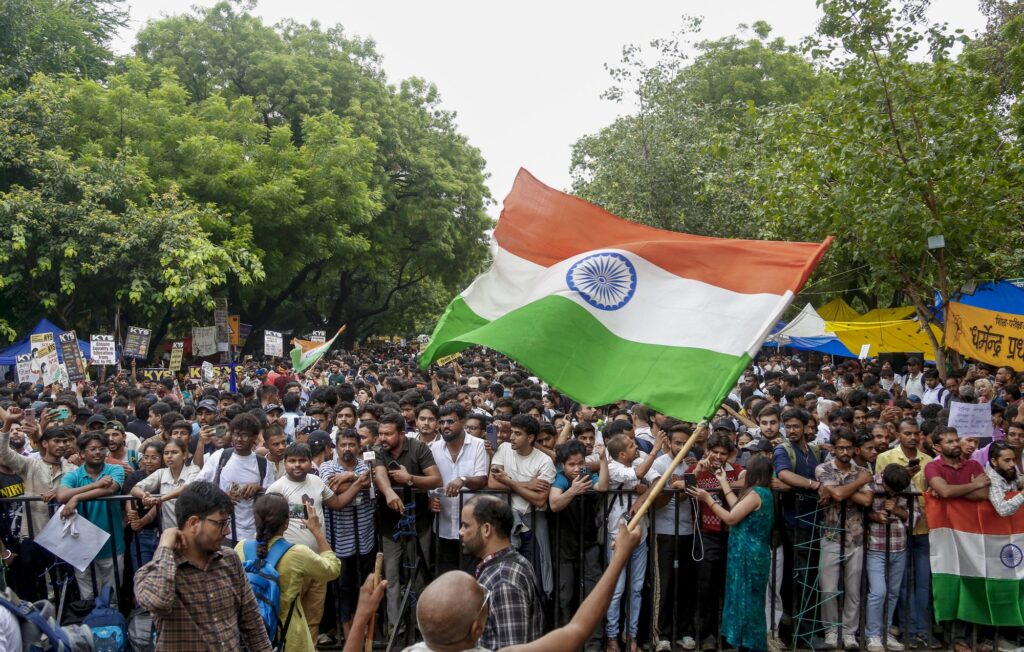
Protesters carrying placards and Indian national flags gather behind metal barricades during a demonstration against the country's flawed examination system in New Delhi (PTI Photo)
India’s Gen Z is increasingly finding itself at the centre of public debate—from exam reforms and unemployment to social-media behaviour and political protests. But as recent incidents have shown, a more uncomfortable question is emerging: is a generation facing structural problems being unfairly blamed for them?
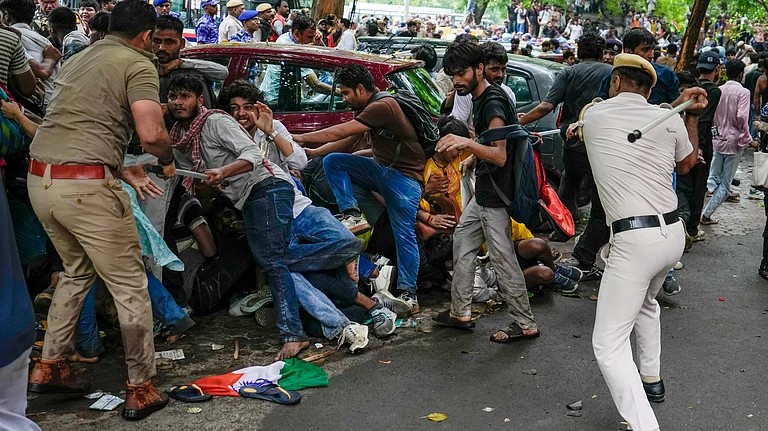
The question has gained urgency after youth-led protests in 2026 over examination irregularities and unemployment. A movement driven largely by young people gathered momentum after a national medical entrance examination affecting around 2.3 million students became embroiled in a paper-leak controversy. The protests eventually contributed to the resignation of Union education minister Dharmendra Pradhan, underlining the political influence of young Indians.
The anger did not emerge in a vacuum. India’s young population faces intense competition for education and employment. Recent reporting has highlighted how roughly 40% of young graduates remain unemployed, while government jobs attract extraordinary numbers of applicants. In one example, more than 500,000 people competed for just 583 government positions in Jharkhand.
At the same time, headline unemployment figures can obscure the particular difficulties faced by young people. India’s overall unemployment rate for people aged 15 and above fell to 5.1% in July 2026, according to recent labour-force data, but youth unemployment remains considerably higher than the overall rate.
A generation facing pressure from every direction
For many Gen Z Indians, the traditional pathway—study hard, secure a degree, obtain a stable job and build a middle-class life—has become increasingly uncertain. Competitive examinations can involve years of preparation, expensive coaching and repeated attempts. When examinations are cancelled, delayed or affected by alleged malpractice, the financial and emotional costs fall heavily on students and their families.
Yet young people are sometimes portrayed as impatient, entitled or unwilling to work. That criticism overlooks the changing nature of the economy. A degree no longer guarantees secure employment, while many available jobs offer low wages, limited stability or few opportunities for advancement.
The result is a generation that is simultaneously more educated, more digitally connected and more vocal about institutional failures.
Social media has amplified that voice. Young Indians can organise protests, expose alleged wrongdoing and build communities within hours. The same platforms, however, expose them to misinformation, harassment, unrealistic lifestyles and constant comparison. Research has linked heavy social-media use among young people with mental-health concerns, although the relationship is complex and social platforms can also provide support and access to information.
This duality matters. It is easy to blame Gen Z for being “addicted” to phones while ignoring that smartphones have become essential tools for education, employment, communication, entertainment and political participation.
Young Indians also face a rapidly evolving digital-risk environment. Cybersecurity incidents in India increased from 10.29 lakh in 2022 to 22.68 lakh in 2024, according to government data. More than 9.42 lakh SIM cards and 2.63 lakh device identifiers linked to cyber fraud had been blocked.
That does not mean Gen Z is uniquely vulnerable or uniquely responsible. In fact, digital fraud affects people across age groups. The larger lesson is that growing up online creates both opportunities and risks that previous generations did not encounter at the same scale.
There is also a danger in treating Gen Z as a single, homogeneous group. A 20-year-old urban professional, a rural student preparing for government examinations, a young woman outside the workforce and a gig worker may have radically different experiences. Caste, gender, geography, family income and access to education continue to shape opportunity.
So, are Indian Gen Z youngsters being targeted unfairly? In many cases, yes—but that does not mean every criticism is unjustified. Concerns about excessive screen time, online hostility, declining attention spans or irresponsible behaviour deserve discussion. What is unfair is turning those issues into a generational verdict.
The recent protests offer a different interpretation of Gen Z. Rather than evidence of an irresponsible generation, they can be viewed as evidence of young citizens demanding accountability from institutions that directly determine their futures. Their use of memes, satire and social media may look unconventional, but the underlying demands—fair examinations, jobs, transparency and dignity—are hardly frivolous.
India is approaching a demographic crossroads. If young people are treated primarily as a problem to be managed, the country risks deepening alienation. If they are treated as stakeholders whose concerns deserve serious policy attention, the same demographic energy could become an enormous economic and civic asset.
The real question, therefore, may not be whether Gen Z needs to change. It is whether India’s institutions are changing quickly enough for the generation that will inherit them.