Can India Turn Its Mangroves Into Climate Assets?
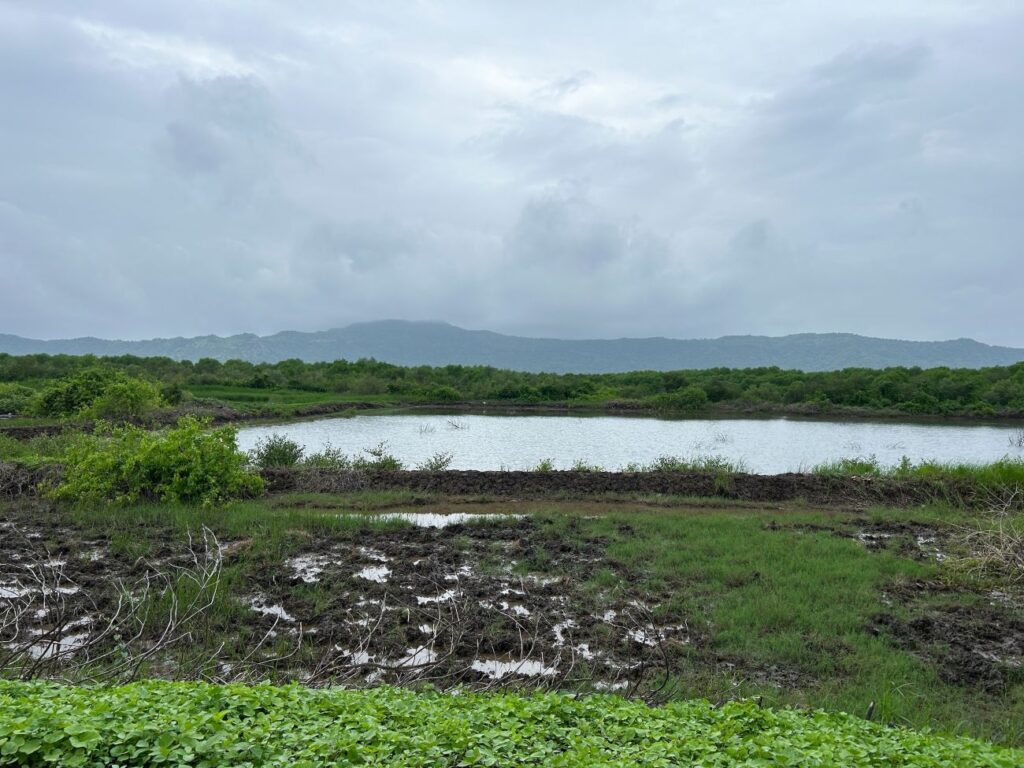
In Mankule, a village in Maharashtra's Raigad district, land became unsuitable for cultivation after saltwater intrusion. Mangroves have taken root in many plots locally and been protected under conservation agreements (Image: Shalinee Kumari / Dialogue Earth)
It is mid-July, and heavy monsoon rains are lashing Maharashtra’s coast. In Mankule, four kilometres from his village of Hashiware, farmer Kailas Gawand points towards a landscape largely submerged by rainwater. During the monsoon, much of the area becomes difficult to reach.
Gawand remembers a coastal bund failing in 1990, allowing seawater to flood farmland that was once highly productive. Yet the intrusion also transformed the landscape. Saltwater mangroves began colonising abandoned fields, including Gawand’s two-hectare plot.
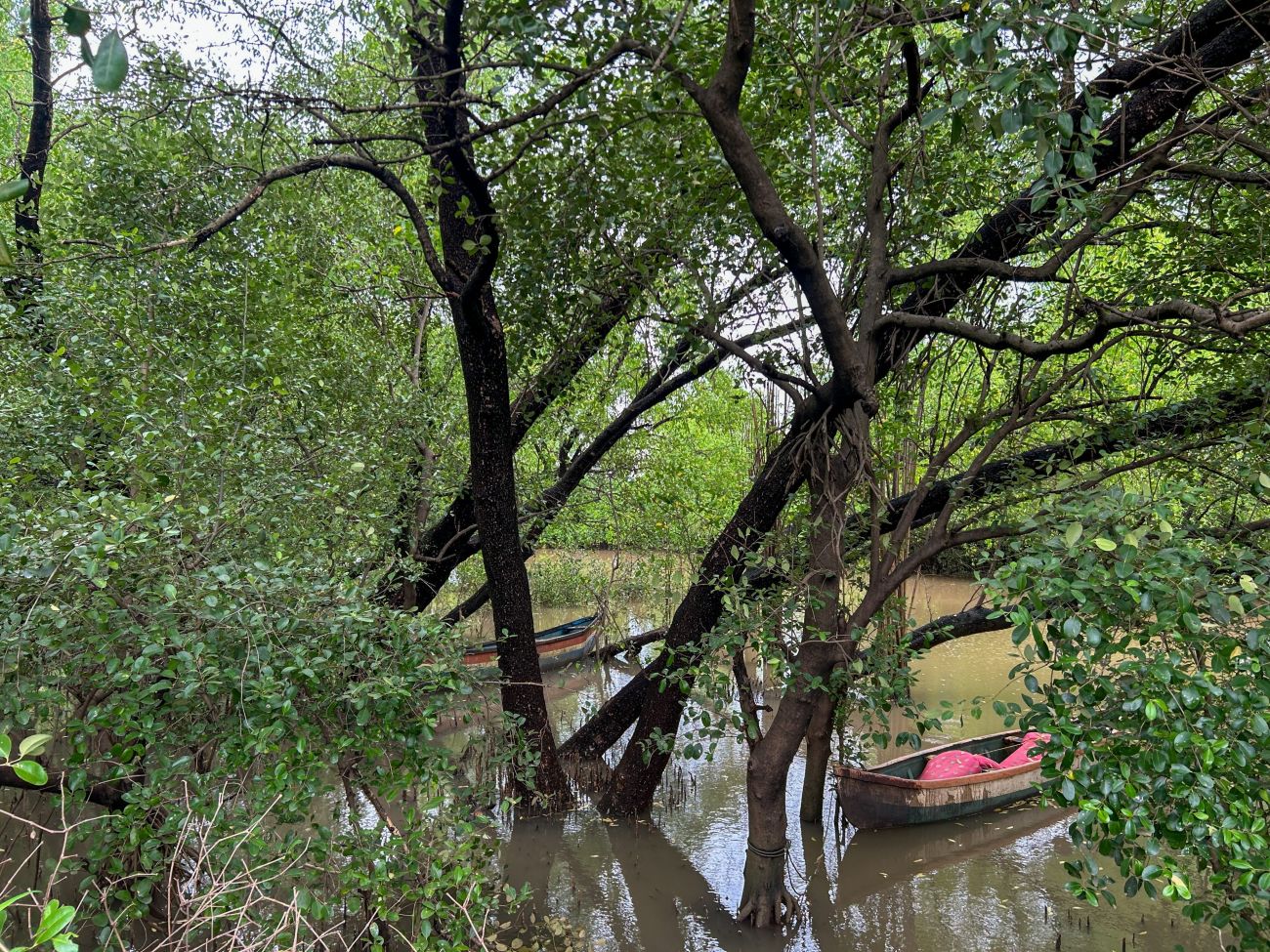
Those mangroves have since become a natural defence for Hashiware and surrounding villages, which have withstood powerful cyclones including Nisarga in 2020 and Tauktae in 2021.
“Mangroves have been a blessing for our village,” the 50-year-old says.
In 2021, Gawand was offered financial incentives to protect the mangroves on his land through a conservation programme run by Pune-based Applied Environmental Research Foundation (AERF), with support from Apple’s Indian operations. He was the first person in Hashiware to sign an agreement, while retaining ownership of his land. Since then, around 100 similar agreements have been signed in the village, according to Gawand and AERF.
The model is part of a wider rise in corporate funding for mangrove conservation in India. Godrej Enterprises Group has invested in protecting mangroves around Mumbai’s Vikhroli township for decades, while Amazon allocated USD 1.2 million in 2025 to mangrove protection and flamingo habitat restoration in Maharashtra and Gujarat. Apple, meanwhile, deployed USD 200 million globally through its Restore Fund to support nature-based carbon removal projects, including mangrove conservation in Maharashtra.
Yet there is a striking similarity between these projects: none currently generates carbon credits.
Conservation before carbon credits
Mangroves are among the most carbon-efficient ecosystems, with studies estimating that they can sequester 6-8 tonnes of CO2 equivalent per hectare. They also reduce flood risks, buffer coastlines from storms, support biodiversity and sustain communities dependent on coastal ecosystems.
For Godrej Enterprises Group, mangrove conservation predates the emergence of carbon markets as a major climate-finance tool. Its Vikhroli programme began in 1985, and the company estimates that its mangroves currently hold around 23,000 tonnes of sequestered carbon.
Despite measuring that carbon, the company has not used it to make carbon-neutrality claims.
For Tejashree Joshi, the company’s head of environmental sustainability, conservation is fundamentally about “a long-term survival, a long-term climate priority, and… a long-term stewardship”.
Godrej conducted its first carbon assessment of its mangroves in 2013 and another in 2025 using methodologies approved under the UN climate framework. Joshi says a carbon project would require a much longer commitment than conventional conservation.
“These would be high-quality credits. [But they] need time to generate,” she says. “It’s patient capital.”
Carbon-market lawyer Avadhi Jain says that long-term commitment is precisely where carbon finance could complement conservation. While corporate social responsibility funding is frequently reviewed through annual budgeting cycles, carbon projects require sustained investment to establish baselines, monitor ecosystems and verify results over decades.
“A carbon market brings longevity – you make sure the impact you’re creating today lasts for a while,” Jain says.
For companies, conservation projects can also serve as learning grounds before they enter the carbon market. “Many times, they learn from a conservation project as a case study and then build something similar somewhere else,” Jain adds.
Amazon’s investment illustrates another approach. Its project, implemented with non-profit Hasten Regeneration, focuses on mangrove protection and flamingo habitat restoration in Mumbai and Gujarat. Co-founder Sheeba Sen describes it as a “philanthropic investment”, with no carbon credits involved.
But Sen argues that philanthropy and CSR alone cannot deliver restoration at the scale India needs. “Right now, it’s very fragmented,” she says. “It’ll be a CSR grant for two, three years, and some other grant for two, three years.”
Long-term private finance, she believes, is essential. “Private capital is a non-negotiable element of climate financing.”
At the same time, Sen cautions against viewing mangroves only through the lens of carbon. Biodiversity, livelihoods and coastal resilience, she says, must remain central to conservation finance.
The Apple-supported AERF programme similarly prioritises conserving existing mangroves rather than planting them in degraded areas. AERF has signed more than 500 agreements across Maharashtra’s Ratnagiri, Sindhudurg and Raigad districts, protecting more than 1,100 hectares of privately owned mangroves, according to Apple.
Turning such conservation into carbon projects, however, is not straightforward.
Developers must establish scientific baselines, monitor carbon storage over time, demonstrate that the climate benefits are additional and undergo independent verification. AERF joint director Jayant Sarnaik says existing blue-carbon methodologies do not always suit the organisation’s approach.
“You have to prove that if you do not do this, they will be wiped out,” he says. “We don’t want anything to be destroyed.”
India’s launch of its carbon-market portal in March 2026 could mark an important step towards creating a domestic carbon market and potentially a framework for blue-carbon projects.
Manish Dabkara, chairperson and managing director of EKI Energy Services, expects many initiatives currently presented as CSR, biodiversity or coastal-resilience programmes to eventually become structured blue-carbon projects.
But experts stress that credibility will be crucial. Weak methodologies, inadequate monitoring or poor community agreements could expose companies to greenwashing and reputational risks.
The future of India’s mangroves may therefore depend not simply on putting a price on the carbon they store, but on building a system in which communities, companies and regulators share responsibility for protecting them.
“Unless communities understand and accept the need to conserve and become partners in the whole process, we are not going to do anything,” says Archana Godbole, director of AERF.
As development pressures and climate risks intensify along India’s coast, the challenge is to turn private finance into lasting conservation rather than another short-term sustainability commitment.
“We are far away from the reality where nature is protected simply on principle,” Jain says.