Jharkhand Students’ Protest: Why The Exam Row Won’t End
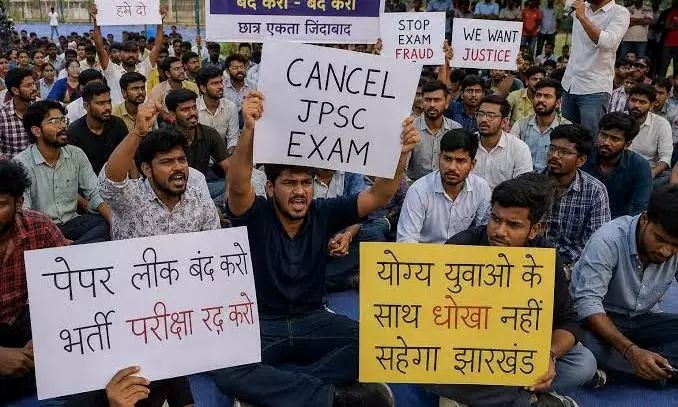
The student agitation in Jharkhand, which began in late July, has continued for 17 days
Jharkhand is witnessing a major student and job-aspirant movement over alleged irregularities in government recruitment examinations. What began with demands for action against suspected malpractice has grown into a wider campaign for transparency, accountability and reform of the state’s recruitment system.
The agitation, which began in late July, has continued for 17 days. Thousands of aspirants gathered in Ranchi on Monday, August 10, and marched towards the Jharkhand Assembly, demanding cancellation of disputed examinations and an independent investigation into alleged irregularities, including paper leaks. The protesters have also called for a complete overhaul of the recruitment system.
At the centre of the controversy are examinations conducted by the Jharkhand Public Service Commission (JPSC) and the Jharkhand Staff Selection Commission (JSSC). Students have raised questions over the 14th JPSC Preliminary Test and the JSSC Combined Graduate Level (CGL) examination, among other recruitment tests.
The controversy intensified in July when the Jharkhand CID began investigating allegations of malpractice. Several people were arrested, including former JPSC deputy controller of examinations Shweta Gupta and officials linked to TSR Data Processing Private Limited, a company involved in examination-related work. The CID also searched the residence of former JPSC chairperson L Khiangte.
The latest development has further increased pressure on the authorities. On August 10, the CID arrested L Khiangte in connection with the investigation. Three serving JPSC members — Ajeeta Bhattacharya, Anima Hansda and Jamal Ahmad — had also resigned amid the controversy.
What are the students demanding?
The protesters’ demands go beyond the cancellation of a single examination. They want a Central Bureau of Investigation (CBI) probe into alleged irregularities, cancellation of examinations they believe were compromised, reforms in the recruitment process and a predictable examination calendar.
The JSSC-CGL examination has become a major sticking point. Students insist that it should be cancelled, while the state government says it cannot unilaterally scrap the examination because it was conducted under court directions and appointments have already been made. The government has instead offered a monitoring mechanism headed by a retired judge.
The government says it has accepted most of the students’ demands. It has agreed to cancel the 14th JPSC Preliminary Test and two backlog recruitment examinations. It has also proposed a fast-track court, promised action based on investigations and said it would recommend an Enforcement Directorate probe into alleged financial irregularities. A panel involving experts from IIT-ISM, IIM Ranchi and XLRI is also expected to suggest reforms to the examination system.
The Enforcement Directorate has now taken note of an FIR filed by the Jharkhand CID and complaints concerning alleged irregularities in several recruitment examinations, including the JSSC-CGL. The agency is examining the matter under the Prevention of Money Laundering Act.
But the students remain unconvinced. They have rejected the government’s claim that 98% of their demands have been met, arguing that only a small number of the examinations they want cancelled have actually been scrapped. Their insistence on a CBI investigation reflects a deeper distrust of the state-level inquiry.
The protest has also taken a physical toll. At least six protesters were on hunger strike, while student leader Devendra Nath Mahto joined Monday’s march despite having fasted for nine days.
The government had imposed restrictions around the Assembly and deployed heavy security in Ranchi ahead of the march. Police used barricades and water cannons as demonstrators moved towards the Assembly, and reports said tear gas and batons were also used when the situation escalated.
The dispute is therefore no longer simply about individual examinations. For thousands of young people preparing for government jobs, recruitment exams represent years of study and a crucial route to employment. Allegations of paper leaks, irregular selection procedures or institutional failure can undermine confidence in the entire system.
The Jharkhand government now faces the challenge of rebuilding that trust. Cancelling disputed examinations may address immediate concerns, but long-term credibility will require transparent investigations, clear recruitment rules, reliable examination schedules and institutions that students believe are independent and accountable.
The protests have shown that the demand is not merely for jobs. It is for a recruitment system in which hard work, rather than alleged malpractice or influence, determines who gets an opportunity.