‘Every 6th BJP MP In Lok Sabha Has Won Through Vote Chori’
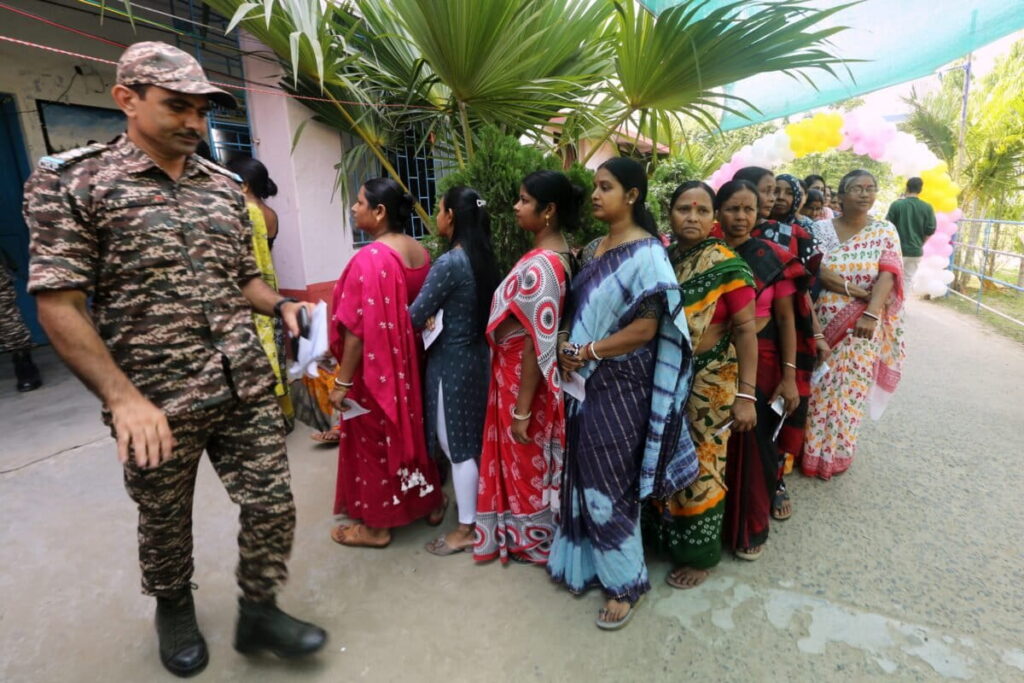
Women voters stand in a queue at a polling booth in Nandigram during the first phase of voting in West Bengal state elections on April 23 (AP Photo/Bhaskar Mallick)
Leader of Opposition in the Lok Sabha Rahul Gandhi on Wednesday launched a sharp and expansive attack on the Bharatiya Janata Party (BJP), accusing it of electoral manipulation and questioning the legitimacy of a significant number of its Members of Parliament. In a strongly worded post on X, Gandhi alleged that “every sixth” BJP MP in the Lok Sabha had secured victory through what he termed “vote chori” (vote theft).
“Through vote theft, sometimes individual seats are stolen, and at other times, an entire government,” Gandhi wrote. “Of the 240 BJP MPs in the Lok Sabha, roughly every sixth MP secured seat through vote chori.” His remarks suggest that, in his view, electoral malpractice is not isolated but systemic.
Taking a swipe at the BJP using its own political rhetoric, Gandhi added, “They are not hard to identify — should we, in the BJP’s own parlance, label them ‘ghuspethiya’?” The term, often used by BJP leaders to refer to “infiltrators,” was repurposed by Gandhi to question the moral and democratic standing of those he accuses of benefiting from alleged irregularities.
Gandhi further escalated his criticism by asserting that the ruling party’s political strength would significantly diminish if elections were conducted fairly. “The real fear is the truth,” he said. “If fair elections were to be held, they would not be able to win even 140 seats today.” This claim underscores the Congress leader’s broader narrative that democratic institutions are being undermined.
The BJP had not officially responded to these specific allegations at the time of writing.
‘Threat to Democracy’: Allegations Extend to States
Gandhi did not limit his criticism to national politics. Extending his allegations to state-level governance, he accused the BJP of orchestrating large-scale electoral manipulation in Haryana. “What of Haryana?” he asked. “There, the entire government itself is a ‘ghuspethiya’.” He went on to claim that democratic institutions were being compromised to influence electoral outcomes.
“The very institutions they keep in their pockets — the ones they manipulate to distort voter lists and the electoral process — are themselves ‘remote-controlled’,” Gandhi said, suggesting a deep erosion of institutional independence. These remarks reflect a recurring opposition charge that constitutional bodies are being misused for political gain.
In a separate post, Gandhi also addressed the political developments in eastern India, particularly the recent assembly elections in West Bengal and Assam. He described the BJP’s victories in these states as a “theft” of the people’s mandate, framing them as part of a broader and more concerning trend.
“Some… are gloating about TMC’s loss,” Gandhi wrote, referring to reactions within opposition circles following the defeat of the All India Trinamool Congress in West Bengal. He cautioned against such responses, urging unity among opposition parties. “They need to understand this clearly — the theft of Assam and Bengal’s mandate is a big step forward by the BJP in its mission to destroy Indian democracy.”
Calling for a collective political response, Gandhi emphasized that the issue transcends party lines. “Put petty politics aside. This is not about one party… this is about India,” he said. His appeal signals an attempt to consolidate opposition voices against what he portrays as a systemic threat to democratic norms.
The BJP, meanwhile, has celebrated its electoral successes, highlighting its decisive mandate in West Bengal, where it ousted the Trinamool Congress, and its continued dominance in Assam, where it secured a third consecutive term in office. These victories have significantly reshaped the political landscape and intensified the ongoing war of words between the ruling party and the opposition.
Gandhi’s remarks are likely to further sharpen political polarization, as they directly challenge the credibility of electoral outcomes and institutions. With no immediate signs of de-escalation, the exchange underscores the deepening divide in Indian politics, where questions of democratic integrity are increasingly taking center stage.