Reaching For Urban Prosperity: A Public Space Opportunity
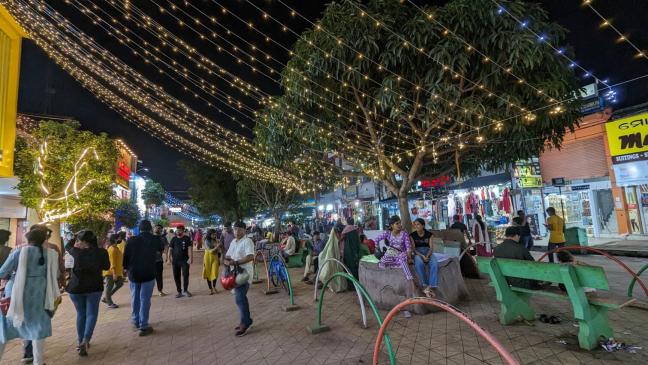
The UN Habitat defines public spaces as places “that are publicly owned or are freely accessible and enjoyed by all without a profit motive”. Public spaces serve multiple functions, offering space for social connections, cultural activities, recreation and even economic opportunities (Photo: WRI-India)
Cities serve as the engines and drivers of economic growth. They sit at the nexus of infrastructural and human resources, generating economic opportunity by providing economies of scale, infrastructure, attracting talent and skilled labor. However, these economic growth trajectories are primarily mapped by demand and supply – based on consumption and extraction. This extractive, non-regenerative model of growth is turning urban regions into key contributors to climate change and the epicenter of our most pressing social, economic and environmental challenges.
In the face of climate change-led extreme weather events, these trajectories are indicating widescale disruption in global economic stability. Thus, there is a pressing need for a new economic model that is greener, inclusive, equitable and centered around sustainable and circular patterns of life and overall well-being.
In 2012, the UN-Habitat presented the idea of urban prosperity, where economic success is measured not just by infrastructural development and economic investment but also through overall well-being, quality of life, social inclusion, environmental sustainability and cultural vibrancy. The notion of urban prosperity requires an enabling environment. Well-designed, equitable and accessible public spaces can serve as the foundation of urban prosperity. In fact, UN-Habitat unequivocally reiterates that prosperous cities are those that recognize the relevance of public spaces.
The UN Habitat defines public spaces as places “that are publicly owned or are freely accessible and enjoyed by all without a profit motive”. Public spaces serve multiple functions, offering space for social connections, cultural activities, recreation and even economic opportunities. In many ways, public spaces are amongst some of the most significant public goods, with the potential to cater to our social, physical and mental well-being.
In this blog, we look at four ways in which public spaces contribute to urban prosperity.
1. Fostering Informal Economies
Public spaces provide important avenues for livelihoods and contribute to overall urban prosperity. Sustainable Development Goal 11 (SDG 11) recognizes the centrality of the relationship between public spaces and economies when it commits to providing, “Universal access to safe, inclusive, and accessible public spaces that are multi-functional areas for economic exchange, social inclusion and human health and well-being by 2030”.
Nearly 75% of people in urban Asia make their living from the informal sector. This demographic comprises of street vendors, waste pickers, mechanics, taxi drivers, etc., with public spaces functioning as their extended workspace and often even their living space. In fact, many sectors of informal economies, depend on public space systems to make a living. The International Labour Organization also specifies the need for “Regulated access to quality public spaces for subsistence livelihoods”.
2. Defending against Climate Extremes
When public spaces embed climate resilient infrastructure, they become spaces of innovation where engineered solutions are blended with natural processes. These effectively transform green spaces into sponges that absorb runoff from rainfall, minimizing damage to urban spaces due to extreme hydro-meteorological events. Ensuring green cover and creating public spaces that are accessible, especially for underserved communities, make cities more livable and improve the overall health of residents. A network of well-designed, green public spaces can function as the city’s lungs, protecting residents from heat and air pollution by trapping pollutants and cooling cities. The Nagar Van Scheme focusing on creating forests in cities and the Jal Shakti Abhiyan aimed at lake rejuvenation apply the same principle by focusing on fortifying cities against climate extremes.
3. Serve as Nodes of Spatio-Technological Interfaces
Spatio-technological interfaces are points where physical spaces are intertwined with technology to create new experiences and deliver new services. Public spaces offer opportunities to provide accessible and equitable platforms toward designing technology that can (re)shape user experience of cities and spaces. Such a design approach for technology-led interaction between humans and spaces could expand the experience of public spaces to newer communities and allow for people with varied disabilities to participate meaningfully and independently within the public realm. Some examples of such interfaces are sensory benches, audio systems embedded along walking paths, and holographic light and shadow information systems for the hearing impaired. Another example of public spaces serving as spatio-technological interfaces is when they become access points for digital public infrastructure, especially to access public benefits by facilitating the use of devices such as smart mobility devices, digital recharge points to access public transportation, etc.
By bringing the delivery of these services into the public realm, public spaces create newer and more equitable economic opportunities and means through which policy-benefits can be accessed. Besides the utilitarian, when this interaction between humans and technology within public spaces moves into the realm of art, it can create newer and more immersive experiences that can then provide impetus for creating new communities, enhance local/community strengths and open up newer avenues for employment.
4. Catalyzing Social Change
Public spaces create the physical frame within which the social life of a city plays out. When designed well, public spaces encourage civic participation, create a sense of belonging and encourage residents to walk more and partake in informal, non-transactional social interaction. Public markets are examples of public spaces that support small-scale economic activities besides acting as magnets that draw in people from all walks of life. Neighborhood green spaces act as community mainstays, spaces where people can interact in safe, non-transactional environments. Public spaces become assemblages of varied art forms, places where various artists can connect with audiences from all walks of life, each enriching the other. Such spaces are lynchpins of democracy, making space for people from diverse walks of life to come together for a cause. Thus, vibrant, well-designed public spaces catalyze social well-being and recharge the spirit of community within urban lives.
With India paving the way to becoming a $10 trillion economy, Indian cities have an opportunity to discard traditional models of profit and loss to design a shared urban future that is inclusive and equitable. Appreciating the integral role that well-designed public spaces play in promoting the urban economy will fundamentally alter not just how the urban fabric is shaped, but also how individuals live their lives and by extension the course that humanity takes.
(Published under Creative Commons from World Resources Institute-India. Read the original article here)