Extreme Weather Events Struck India On 235 Of 273 Days In 2023
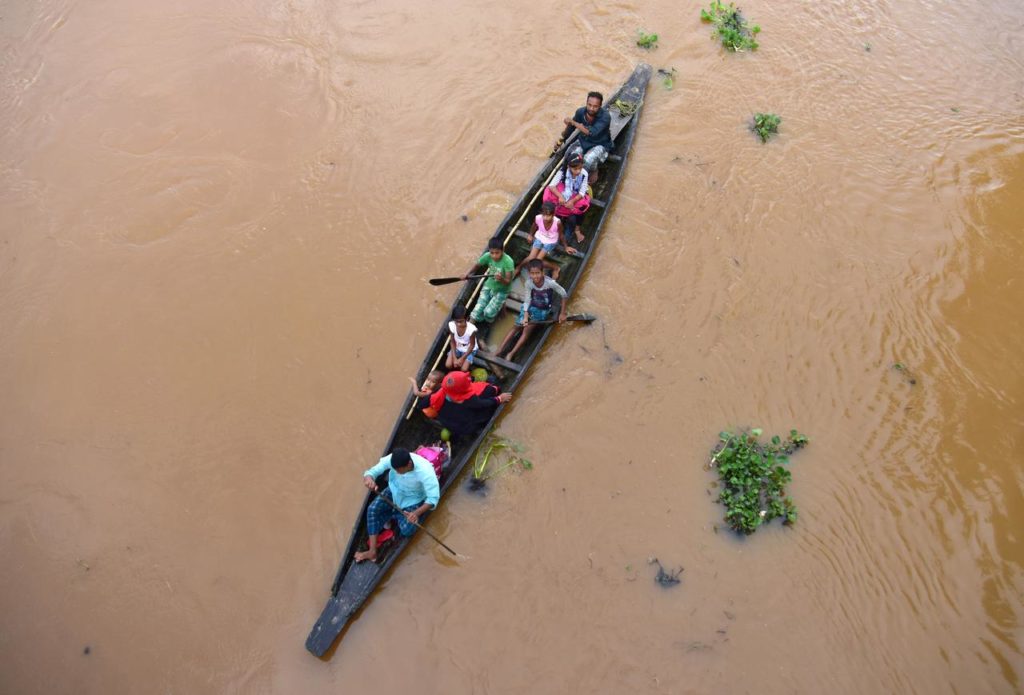
Flood-affected villagers are transported by boat to safety at Kachua village in Nagaon district of Assam
The recently-released Climate India 2023 report by Down to Earth paints a grim picture of the nation grappling with extreme weather events for most of the year. It presents a sobering assessment of India’s climate landscape. India faced extreme weather events on 235 out of 273 days in the first nine months of 2023, a slightly lower count than the 241 recorded during the same period last year.
The impact was, nevertheless, widespread; it affected all 36 states and Union Territories, up from 34 the previous year. A toll of 2,923 fatalities was reported this year, compared to 2,755 last year. The devastation has spread across 20 states and Union Territories this year, compared to 15 last year. This is despite the total cropland damaged remaining relatively stable at 1.84 million hectares.
The states of Punjab and Haryana, in the country’s north-west, bore the brunt of the crop losses. This is a notable shift from last year, when Assam, Karnataka and Uttar Pradesh were the most affected.
If we dissect the numbers, Bihar recorded the highest number of human casualties at 642. It was followed by Himachal Pradesh with 365 and Uttar Pradesh with 341. It also reveals another concerning trend — extreme weather events occurred on 28 out of the 59 days in the winter months of 2023. This affected 21 states/UTs, with Haryana and Punjab being the worst-hit on 15 days.
The anomalies in temperature have been alarming — they broke records in February and reached unprecedented levels in August and September. The report also drew attention to the changing frequency of extreme weather events. While they were once considered rare occurrences happening every 100 years, they now strike every five years of less.
The increasing frequency of such events, combined with the compounding impact on vulnerable communities, stresses upon the urgent need for global cooperation in reducing greenhouse gas emissions and adapting to a changing climate.
The report highlights the need for more robust measures. These include investing in renewable energy sources, adopting sustainable practices and enhancing energy efficiency. This is despite India’s steps towards a cleaner energy future. Building resilience to extreme weather events and strengthening early warning systems are deemed essential for safeguarding livelihoods and communities.
The report reminds us all — sternly — that addressing the global challenge of climate change requires not only individual efforts but a collective, international commitment to secure a sustainable future. Down to Earth’s Climate India 2023 report serves as a clarion call for immediate, impactful action as India grapples with the revenge of nature.
Extreme weather includes unexpected, unusual, severe, or unseasonal weather; weather at the extremes of the historical distribution—the range that has been seen in the past. Extreme events are based on a location’s recorded weather history. They are defined as lying in the most unusual ten percent (10th or 90th percentile of a probability density function). The main types of extreme weather include heat waves, cold waves and heavy precipitation or storm events, such as tropical cyclones. The effects of extreme weather events are economic costs, loss of human lives, droughts, floods, landslides.
Climate change is increasing the periodicity and intensity of some extreme weather events. Confidence in the attribution of extreme weather and other events to anthropogenic climate change is highest in changes in frequency or magnitude of extreme heat and cold events with some confidence in increases in heavy precipitation and in the intensity of droughts. Current evidence and climate models show that an increasing global temperature will intensify extreme weather events around the globe, thereby amplifying human loss, damages and economic costs, and ecosystem destruction.
Extreme weather has significant impacts on human society as well as natural ecosystems. Some human activities can exacerbate the effects, for example poor urban planning, wetland destruction, and building homes along floodplains.