Melting Glaciers: Who Is Responsible?
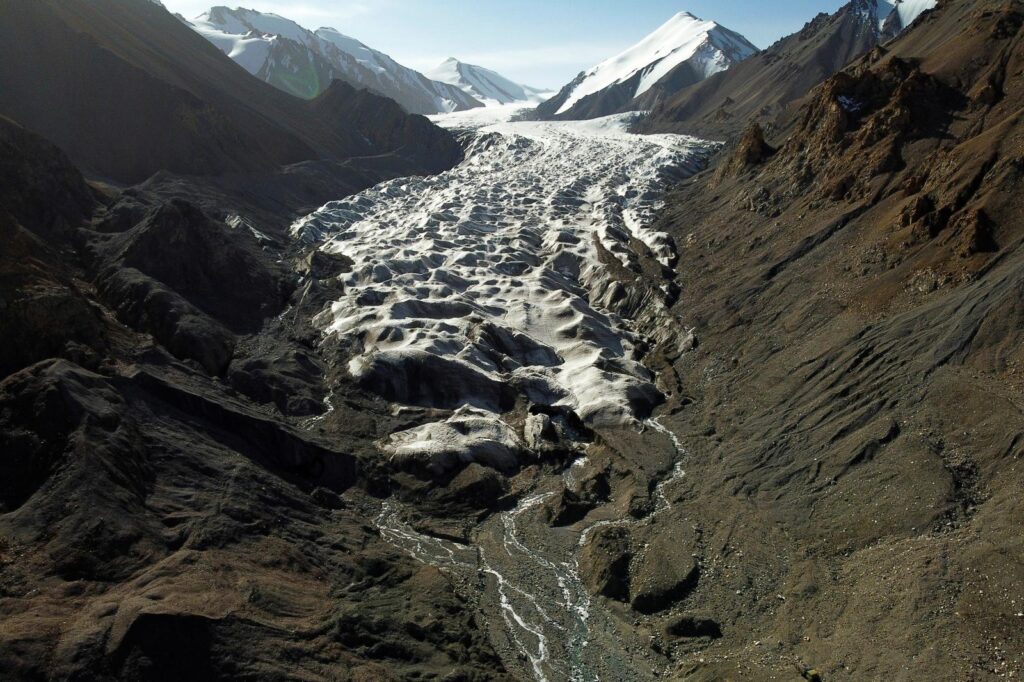
Human pressures, such as dam construction, large-scale irrigation and global warming, have altered freshwater resources to such an extent that their capacity to regulate vital ecological and climatic processes is at risk
As the world’s glaciers melt rapidly, almost without exception, the global response to this existential threat is worryingly lethargic. This begs the question: where does responsibility for action lie? Should the communities experiencing the immediate dangers caused by melting glaciers be left to face these threats on their own?
Sadly, this is what is happening. Even as global declarations are signed and platitudes spoken, USD 100 billion-dollar promises are being broken and glaciers continue to melt. As glaciers melt, lakes can form from the meltwater, which may be released suddenly in a glacial lake outburst flood with catastrophic effects on communities downstream. Eventually, the runoff from the glacier decreases, the river discharge shrinks, and downstream communities are left with too little water. Rivers run dry or run riot.
In the face of such challenges, mountain and downstream communities have had to work together. They have taken a polycentric approach. This concept, advanced by Nobel Prize-winning economist Elinor Ostrom, means dividing the challenges of climate change into manageable components. It theorises that if multiple groups undertake many activities at different scales, then the sum of these activities makes a difference.
A Polycentric Approach To Himalayan Glaciers
Addressing the impacts of melting glaciers collectively is complicated. Glaciers are often located at the highest elevations in a region, and this is also often where national borders are drawn. What happens when upstream and downstream communities are in different countries? Sending information through official channels can take too long.
Many communities have learned that it is more efficient to act collectively, and at a local, informal level. For example, in Bhutan community groups use WhatsApp to share information about cloudbursts and high river levels with people across the border in Assam, India. In fact, Bhutan and India already cooperate at the governmental level too, with flood-warning stations in Bhutan sending information to stations in West Bengal and Assam.
In northern Pakistan, despite repeated glacial lake outburst floods since 2018, communities and local authorities have managed to avoid fatalities using their early warning system.
These are polycentric solutions: approaches at different scales, aimed at different facets of the same problem, with different governing centres and mechanisms for mutual monitoring, learning, innovation and adaptation. The sum of such (relatively) micro-scale activities could also bring about big-picture behaviour change. As communities and governments cooperate and learn by sharing information and adaptation strategies, this can encourage people to consider more seriously the need for efforts on a larger scale. If global efforts are framed as an extension of these smaller scale and two- or three-country efforts, perhaps it will lead to more understanding of larger-scale efforts.
The socio-economic and technological transformation and the integrated system of action and communication that are required by the Paris Agreement are almost like a global WhatsApp group – a group where the members don’t just warn their neighbours about coming dangers, but see the origins of the danger and are able to act on it collectively and decisively.
Until that happens, however, there is a limit to how much communities can do to combat a global collective-action problem. How long can mountain communities maintain a buffer against depleting freshwater sources by changing their livelihoods and lifestyles, or protect themselves from floods by evacuating and relocating? When we’re talking about climate change issues of this scale and magnitude, this polycentric approach of compartmentalising action can only go so far. Ostrom herself emphatically pointed out that polycentric systems are not a panacea.
As glaciers melt, the suffering caused is global. More water flowing from the glaciers eventually ends up in the ocean, raising global sea levels. This affects coastal communities and ecosystems across the world, from Bangladesh to the Netherlands. Melting glaciers also disrupt ocean circulation patterns – in turn leading to extreme weather events. The impacts of melting glaciers are not localised, and it is only reasonable that responsibility and action be shared too.
Shared Responsibility For Reducing Emissions
In a cruel irony, those who are most at risk from the impacts of melting glaciers (whether mountain communities or small island nations) are generally those who have made the smallest contribution to the greenhouse gas emissions that are driving climate change. Many at-risk communities are doing their best to adapt, using innovative piecemeal approaches, but we need a major shift in global responsibility and ambitious action on lowering emissions. That is clearly not happening.
To limit global warming to 1.5 degrees Celsius above pre-industrial levels – as the Paris Agreement calls for – emissions need to be reduced by 45% by 2030 and reach net zero by 2050. We know we need greater commitments on climate action from the biggest contributors to global emissions – developed societies, industrial powerhouses, global conglomerates. However, current national plans would, if implemented, lead to an increase in global greenhouse gas emissions of almost 14% by 2030, compared with 2010 levels. Fossil fuel lobbies continue to fight back, even suing to protect their profits – with a 72% success rate. And debates on loss and damage funding are quickly suppressed, even though the IPCC’s Sixth Assessment Report pinpoints “historical and ongoing patterns of inequity such as colonialism” as contributing to many regions’ vulnerability to climate change.
This brings us back to the question of responsibility. It is clear that poorer regions, such as the Hindu Kush Himalayas, suffer the most from the impacts of climate change. It is clear who must do more. COP26 saw greater commitments to update Nationally Determined Contributions and phase down fossil fuels, more clarity on carbon markets and climate finance, and other innovative initiatives to reduce emissions. But commitments so far won’t be enough, as glaciers continue to melt and vulnerable communities are left to sink or swim.