
Why The BJP Is Confident Of Being In Power For A Long Time
Feb 13, 2025 | Pratirodh Bureau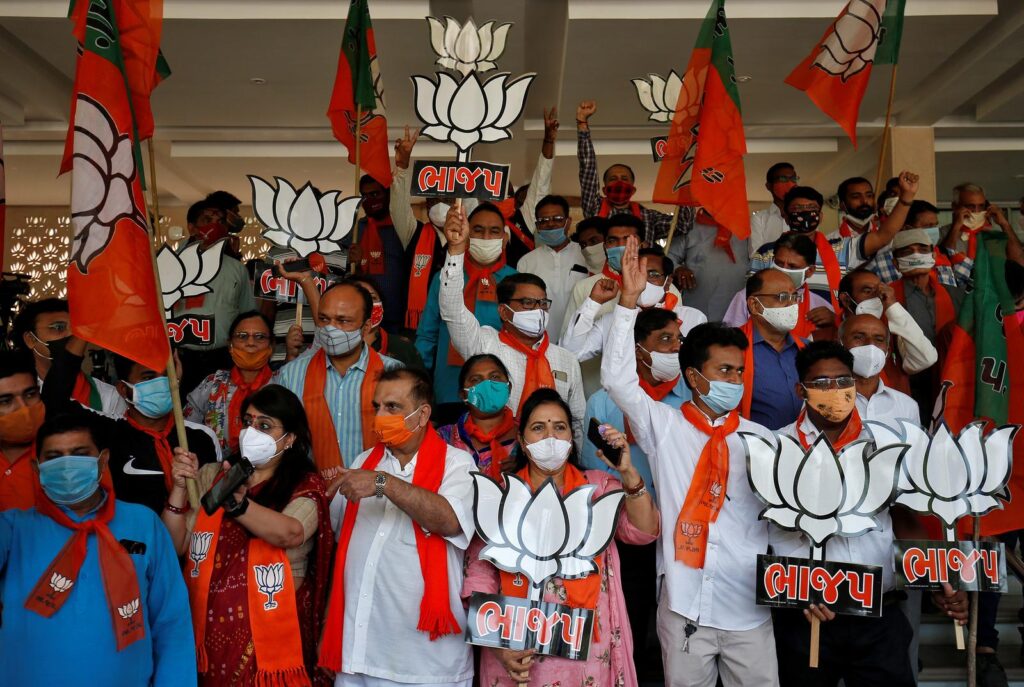
FILE PHOTO: Supporters of the Bharatiya Janata Party hold their party symbols and flags in Ahmedabad, Gujarat
The ruling Bharatiya Janata Party (BJP) has asserted that it will be in power for a long time.
Home Minister Amit Shah recently claimed that the party would be at the helm for the next 15 years. Earlier, in 2015, he had said the next 30-year period would be the era of the BJP.
The party has been in power in the state of Gujarat for more than two decades. It has ruled India for over ten years and won a third successive five-year term in June 2024.
What makes the BJP so sure it will continue to be in power?
The BJP has made institutional changes aimed at retaining power for a long time. Opposition leader Rahul Gandhi claims that it has institutionalised malpractices, and that is why the fight was not against a party but the ‘entire machinery’ of the Indian state. An election could not be fair without a free press, an independent judiciary, and a transparent election commission that is objective and neutral, he noted.
However, malpractices alone cannot explain the continuing electoral success of the BJP. There are complex strategies and political narratives that the party uses to attract voters.
The Opposition needs to decode the BJP’s political strategy.
It seems that the BJP, backed by its ideological parent organisation, the Rashtriya Swayamsevak Sangh (RSS), is working on a long-term plan.
An indicator of this is the process of delimitation of parliamentary constituencies, which is open to gerrymandering by the party in power, as was witnessed in Jammu and Kashmir. The other indicators of its strategy to capture power are breaking other parties to form a government in several Indian states and even changing the process of selection of election commissioners to skew it in favour of the ruling dispensation.
The Opposition has no long-term strategy and is purely reactive. It is also not as politically agile.
It often struggles to provide a counter-narrative to the BJP. The BJP takes into account the potential reaction and is prepared to weaponise even the counter-narrative to its advantage. The Opposition is unable to anticipate the BJP’s actions.
This, by far, remains the most significant challenge for the Opposition in taking on the BJP.
In the last ten years of the BJP’s rule at the Centre, the Opposition has not managed to provide an alternative perspective to the ruling party’s majoritarian agenda.
It has standalone critiques of each of the BJP’s slogans and campaigns. However, together these criticisms do not amount to an alternative social vision.
The campaigns around the Constitution and the need for a caste census are the closest the Congress has come to an alternative perspective. However, the party is not effective in countering the BJP’s social vision which is layered and rooted in micro-dynamics that account for variations in each state.
The opposition Congress party under Rahul Gandhi`s leadership did manage, for example, to launch a campaign around saving the Constitution and protecting job reservations during the 2024 general elections. It paid some dividends.
However, the ruling BJP, alert to such counter narratives, was quick to course correct. It moved quickly to appropriate the narrative of protecting the Constitution. Similarly, it was quick to appropriate the idea of providing internships as a provisional solution to the growing problem of youth unemployment.
Eventually, it is the BJP that sets the terms of reference for the political discourse while the Opposition only has an ad hoc counter to it.
Consider the fact that the BJP pushes the religious minorities to the wall to produce religious polarisation. But it does not stop with that. It also calibrates the political options and scenarios emerging from that situation.
It anticipates the responses of the religious minorities and factors them in their electoral calculations.
It also opens up the way for pro-minority and pro-Dalit parties to represent them and wean them away from the secular parties of the Opposition. These parties such as Asaduddin Owaisi’s All India Majlis-e-Ittehadul Muslimeen (AIMIM) and Prakash Ambedkar’s Vanchit Bahujan Aghadi inexplicably never join the Opposition bloc, thereby indirectly strengthening the BJP electorally. They, however, remain critical of both the BJP and the Opposition parties.
The same is the case with another Dalit party, the Bahujan Samaj Party. It also claims to maintain equidistance from the BJP and the Opposition bloc.
The BJP seems to anticipate these developments. However, the Opposition is not so clever in anticipating the consequences of its political discourse.
In fact, the political discourse of the Opposition is often taken advantage of by the BJP in ways that are not anticipated by it.
In the recent Haryana election, for example, the Congress attempted to ride to victory on the protests of farmers, youth desirous of joining the armed forces angry with the four-year contracts as Agniveers, and women wrestlers agitated over alleged molestation by a former wrestling federation chief.
The BJP cleverly used these protests to polarise the voters along caste lines — Jats vs. non-Jats. The main Opposition in the state, the Congress party, could not understand the nature of this division and its consequences till it was too late. It lost the assembly election.
Similarly, in Maharashtra, the BJP propped up the anti-Maratha sentiment. In elections in Gujarat, it used anti-Patel and later anti-Rajput sentiments to win elections.
The BJP also promotes its own opponents and then situates them in its political process to benefit electorally. This is what it did with the Aam Adami Party (AAP), almost helping create it through the “India Against Corruption” movement and then projecting it as its main rival to diminish the Congress. AAP essentially cuts into the Congress vote as has been evident in Delhi and Punjab.
Finally, the BJP disallows the development of a counter-narrative by constantly carpet -bombing the public with a range of slogans, policies and campaigns. As soon as one narrative begins to falter, it moves on to the next.
Along with this, its agility in creating distractions and disruptions in the parliament means that the Opposition is unable to offer a consistent critique.
In effect, the BJP pre-empts the Opposition’s response, while the Opposition only responds to what the BJP does. Therefore, it continues to struggle to occupy the electorate’s mind-space.
This ability to set the terms of the discourse is what BJP leaders have in mind when they say that they are here to stay for a long time.
(Originally published under Creative Commons by 360info™. Read the original article here)