Trouble Brews In The Taj Ganj Area As SC Order Creates Uncertainty
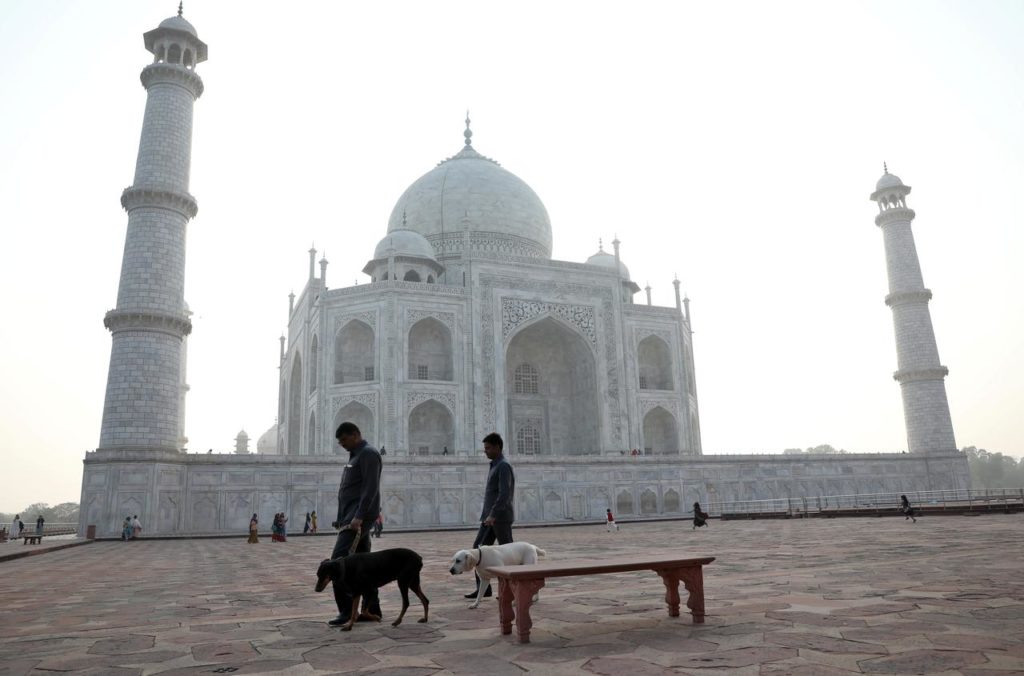
FILE PHOTO: Police officers use sniffer dogs to scan the premises of the historic Taj Mahal in Agra
Already in deep crisis, the latest order of the Supreme Court banning commercial activities within 500 metres of the Taj Mahal threatens to further dent the fragile tourism industry in Agra. More than 450 shops, hotels, restaurants, emporiums will be forced to down the shutters, as the Agra Development Authority (ADA) has begun a process of identifying business activities in the restricted zone.
Action could begin any day now. Trouble is brewing as the locals are angry and frustrated. Some may file a review petition, for which funds are being collected. “These days Corridors are in fashion from Kashi to Ujjain to Vrindavan. Some experts could suggest construction of a corridor around the world heritage monument to facilitate mobility,” says Ved Gautam, a tourist guide.
Tourism industry captains complain of a step motherly treatment from the state government. Due to the pandemic, the Agra hospitality industry has suffered losses and many hotels have been forced to close. “The taxes are high, electricity bills are huge, occupancy rate is poor, night stay of tourists has shown a decline,” says senior industry leader Sandip Arora.
Agra is not entirely dependent on tourism. “Though the general perception is that being home to the world heritage monuments draws millions of tourists round the year, Taj city’s economy would be totally dependent on tourism. The fact is that Agra earns its revenue from the shoe industry, iron foundries, glassware, handicraft and a fast developing service sector,” explains Rajiv Gupta, former president of the National Chamber of Industries and Commerce.
The chief reason why tourism has not become “everybody’s business” and failed to directly benefit a major chunk of the local population, is the lack of heritage consciousness among citizens. “The city is neither tourist-friendly nor do its residents feel a sense of pride in its history and culture.”
And the builders’ lobby does not favour heritage city status for Agra as they fear new constructions would not be permitted. Still, Agra is India’s number one tourist centre, but continues to lag dismally in modernising its urban base and developing a comfortable ambience for promoting culture and arts.
The city hasn’t changed much if one takes into account a ghazal written in 1723 by Lakshmi Chandra, who describes in great detail the roads and the localities of Agra — from Agra Fort to Charsu Darwaza and beyond to Lashkarpur — which was then the tenting ground for the Mughal Army.
Agra, some historians say, was founded in 1504. Even today, the city retains the original names and the functions of various places also remain largely the same.
“Yes, in the so-called modern Agra there is evidence of haphazard planning and irrational growth, but then those are not the heritage pieces one would like to be preserved,” says N.R. Smith, a chronicler of Agra’s modern history through his columns.
“We have to begin by demarcating the areas as Mughal Agra, the British Agra and the Agra Development Authority’s Agra. Only then can one go ahead with conserving the real heritage of the city of the Taj Mahal. And those who think people and their workplaces need to be demolished to make way for modern malls or parking slots are only hurting the spirit of conservation,” Smith added.
Were emperor Akbar to rise from his grave in Sikandra some day, he would have no difficulty reaching Agra Fort without asking for directions. “The road plans have not changed, the landmarks are all there,” social activist Devashish Bhattacharya said.
Conservationists feel the Archaeological Survey of India (ASI) is not doing enough to sincerely conserve monuments according to the manual laid down by John Marshall, who was the ASI chief during 1902-1928 period.
Once is enough, say most tourists, who rarely have good things to say or share any pleasant memories of their stay in Agra. No one wants to return. “The dirt and stink hurts. From shopkeepers to ‘lapka’ guides to the hotel staff to drivers, all are out to fleece or cheat. Hotels are expensive and so is food, compared to other cities. The weather is harsh and it is not safe on the roads. I don’t understand why the concerned government departments are not addressing these issues,” Subramaniam, a group leader from Tamil Nadu said.