How Faith Can Inspire Environmental Action
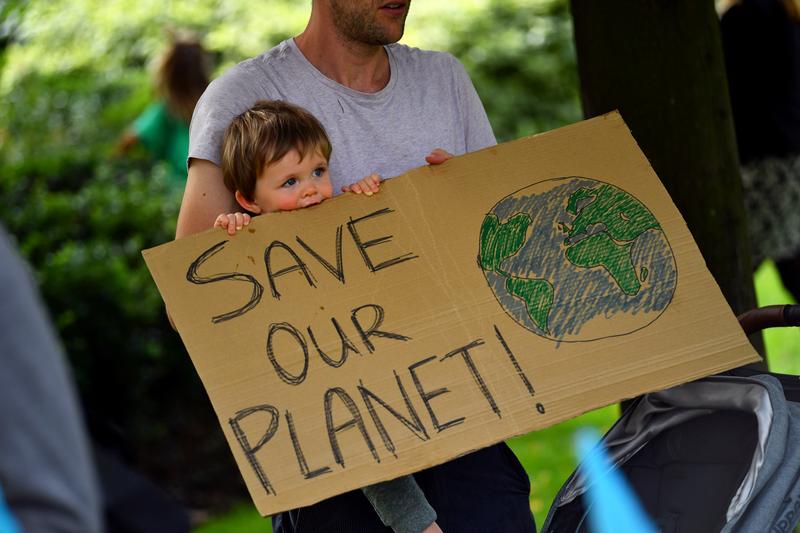
A father and his child hold a sign at a protest by climate activists in London, Britain (Representational Image)
It has become clear that meaningful progress on climate change is not going to be achieved by one person or indeed, one government. Coordinated action between governments, industry, local leaders and society is needed urgently. The recent COP27 decision itself mentions the importance of local communities, cities, indigenous peoples and children. But strikingly absent is the role of faith or religion.
Roughly 84% of the global population identifies with some sort of religion, a figure expected to rise to 87% by 2050. Our research shows there is potential for faith to mobilise social environmental change, yet it is usually left out of conversations about sustainability.
Religion can have a significant and positive influence on people’s behaviour when it comes to the environment. Spiritual practices and liturgies are being developed to help believers integrate environmental concerns with their spirituality.
Two key publications are Pope Francis’s encylical Care for our Common Home and Zen master Thich Nhat Hanh’s Zen and the Art of Saving the Planet. Both highlight the relevance of religious ideas to environmental crises and guide people to live sustainably.
Faith can be a driving force behind environmentally responsible investment. The organisation FaithInvest helps religious institutions use their financial resources ethically and sustainably. Religious groups can also coordinate collective action on the climate. Ahead of COP27, faith leaders from around the world published a letter calling for an end to new fossil fuel projects.
Of course, the same influences can and have been used to obstruct action on climate change, and formal institutional commitment does not necessarily translate to personal action. Our research helps explain how mechanisms of religious belief can be used to inspire environmental action.
Faith And The Planet
We were interested in understanding processes of personal and practical change towards sustainability among Christians in the UK. We studied responses to the Archbishop of Canterbury’s 2020 Lent book, Saying Yes to Life, authored by Ruth Valerio. The book presented theological perspectives on the importance of taking care of the natural world, focusing on environmental challenges such as water scarcity, air pollution, land degradation, biodiversity loss and energy use.
We surveyed 133 people from a range of age groups and church backgrounds before and after engaging with the text, and conducted focus groups. We found that this intervention significantly influenced participants’ beliefs and behaviour related to the environment.
After engaging with the text, people had more positive attitudes towards the environment. Most reported at least a short-term increase in pro-environmental behaviours, particularly around energy use, food choices and recycling.
Framing environmental issues in theological terms also influenced participants’ environmental attitudes. They reported perceiving nature as sacred, feeling more connected to the natural world, and adopting a belief that humans should care for creation.
We identified three steps that people go through when their faith is mobilised into action. The first step is revealing, where the nature of environmental problems and pre-existing theological beliefs (such as humans having a divine right to dominate the environment) are illuminated to the individual. For our participants, this came through thoughtful reading of the text and discussion with other believers.
The second step is reflecting. People then consider how their own beliefs and lifestyles might need to be reconsidered according to new theological ideas or scientific information.
The final step depends on the degree of environmental commitment already held. For those whose lifestyles are incompatible with the new information, the step of redirecting describes a process of internal (cognitive or spiritual) and external (behavioural) change. For those already pursuing pro-environmental lifestyles, the step of reinforcing involves further strengthening these commitments.
Tackling The Environmental Crisis
Currently, many conversations about the environment are framed by economics – the triple bottom line (a concept urging businesses to think about profit, people and the planet), natural capital and green investment. Appealing to moral and spiritual worldviews could inspire people to think about environmentalism in terms of justice, sacred duty, compassion, empathy and kindness.
Having a community of faith that can support, reinforce and sustain environmental action is another critical function of religion. Many participants mentioned the hope and resolve that came from knowing they were part of a larger body of Christian believers working for change.
Appealing to faith-based worldviews has potential to bypass political divides and cultural affiliations that have stifled action. Indeed, in this research, the greatest shifts towards environmental concern were among participants who self-identified as politically conservative.
Faith is fundamental to many people’s outlook on the world. Our research shows that religion offers a powerful opportunity to inspire environmental action. But there is work to be done on both sides. Religious leaders could further incorporate environmental matters into their spiritual teaching and practice, and scientists and policymakers could engage more with people of faith.
Humanity’s ability to avert environmental catastrophe will depend on sustainability becoming embedded into every institution and cultural setting. Religion is no exception.
(This article is republished from The Conversation under a Creative Commons license. Read the original article)