Fields Of Fire Drive Delhi’s Air Quality To Unhealthy Levels
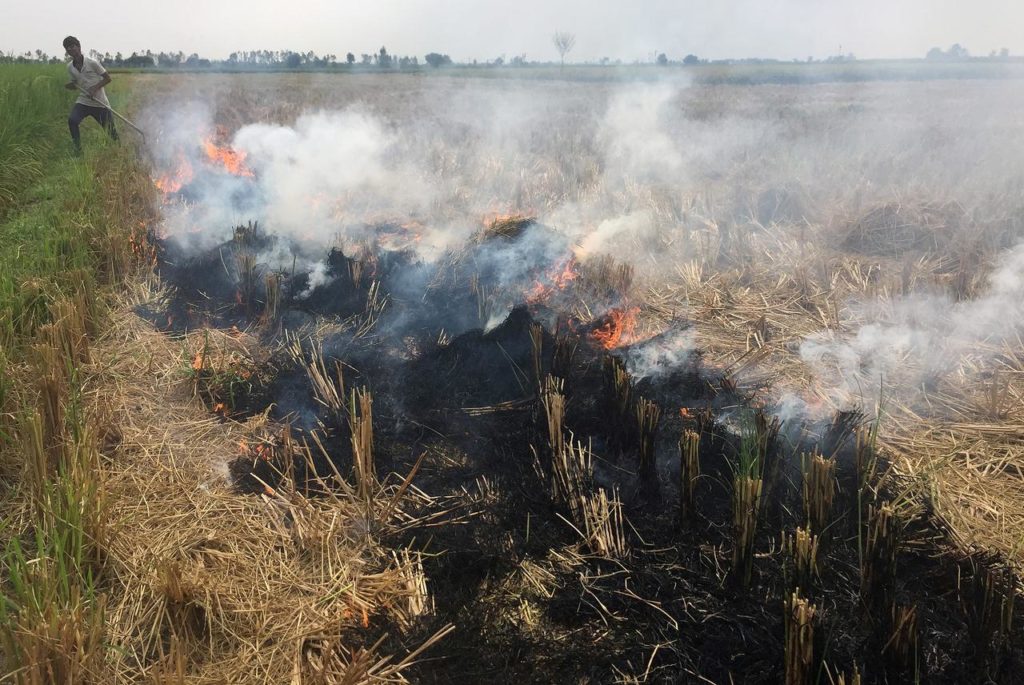
FILE PHOTO: A man burns paddy waste stubble in a field in the Karnal district of Haryana
When it comes to air quality, there are few worse places to live on the planet than New Delhi, and driving north out of the Indian capital it is easy to see why, as plumes of smoke rise from the burning farmland lining the expressway.
Every year, at this time, farmers in states surrounding the sprawling mega-city are burning off the crop straw and stubble in preparation for the sowing season.
The smoke from fields combines with urban pollution from vehicles and industry to make New Delhi the world’s most-polluted capital.
“The situation is set to get worse this year,” Vimlendu Jha, an environmental expert on a government panel to clean up the capital, told Reuters, lamenting the dismal impact of a subsidy scheme to persuade farmers to switch to cleaner methods.
This week in Delhi, levels of PM 2.5, tiny particulate matter that goes deep into the lungs, rose to an “unhealthy” 200 micro-organism per cubic metre. That is double the acceptable level, and it is likely to get worse going into the winter, as cold air and a seasonal reduction in wind leaves pollutants hanging in the atmosphere for longer.
The government has allocated $160 million for a subsidy scheme offering to cover up to 80% of a mulching and seed drilling machine, called “happy seeder machines”, that farmers can mount on tractors to dispose of the paddy stalks and straw without burning them.
But, as often happens in India, good intentions, according to farmers, have been hampered, by poor implementation.
Reuters spoke to 50 farmers in Punjab and Haryana states, two of the states bordering Delhi, and found that only 20% of them used the machines.
Bureaucrats believe the fault lies with the farmers, and subsidies alone are not the answer.
“It’s mindset, and behaviour that needs to be changed,” said Ashwani Kumar, an official at the federal agriculture ministry.
The National Green Tribunal (NGT), the main environmental court of India, has banned crop residue burning, but the ban is rarely enforced.
Delhi did have its best air quality in nine years in September, with PM 2.5 averaging 40, but the improvement was largely down to heavy rains and strong winds clearing the atmosphere, rather than people changing their ways.
GOING UP IN SMOKE
Field burning is up by 45% in Punjab over the last 20 days compared with the same period last year. Haryana has registered a slight drop but officials expect the numbers to go up in the next 15-20 days.
In the Karnal district of Haryana, 117 km (73 miles) north of Delhi, a Reuters reporter saw farmers burning tracts of their land.
Farmer Ramesh Singh said he had thought about not torching his land this year because he didn’t want to break the law.
But in the end the effort to purchase machines that cost upwards of 350,000 Indian rupees ($4,915) and the paperwork required to claim the subsidy proved too much.
“Last year, I promised myself I wouldn’t set the rice paddy residue on fire to clear my field for planting winter crops,” said Singh. “But as the new sowing season drew closer, I started running out of time and I reluctantly set the farm waste on fire to prepare the field for wheat planting.”
After harvesting rice in late September, farmers have to plant wheat and rapeseed by mid- or late-October, as any delay will result in lower crop yields.
And they say the time between clearing the land and the sowing season is too short for them to be worrying about Delhi’s pollution.
The smoke from their fields accounts for nearly one-quarter of Delhi’s winter air pollution, and as it is a quicker fix than cleaning up industry or improving public transport to reduce the traffic in a city of 20 million people, authorities have prioritised stamping out the practice of burning crop stubble.
TORTUOUS PROCESS
Under the subsidy scheme, individual farmers can claim back 50% of the cost of “happy seeders” while a group of growers, or farmers’ cooperatives, are entitled to reclaim 80% of the cost.
The downside for farmers is that the need to pay upfront, and to claim the subsidies, they say they have to submit three sets of applications, six separate forms, receipts for buying the machines and clearances from half a dozen local government offices. And once all the papers are submitted, everything depends on how fast the bureaucrats process the claim.
“Other than the formalities that we have to complete, various government offices take their own sweet time to process our applications, resulting in considerable delays in receiving our reimbursements,” said farmer Sukrampal Dhayana.
And as the “happy seeder” machines are expensive, and are needed for only 15-20 days in a year, farmers admit they are reluctant to buy them, especially when they are earning meagre incomes from low crop prices.
“The economics didn’t work out,” said Sanjeev Kumar, a grower, sitting at the edge of a lush, green rice field.