Will White Americans At George Floyd Protests Work For Change?
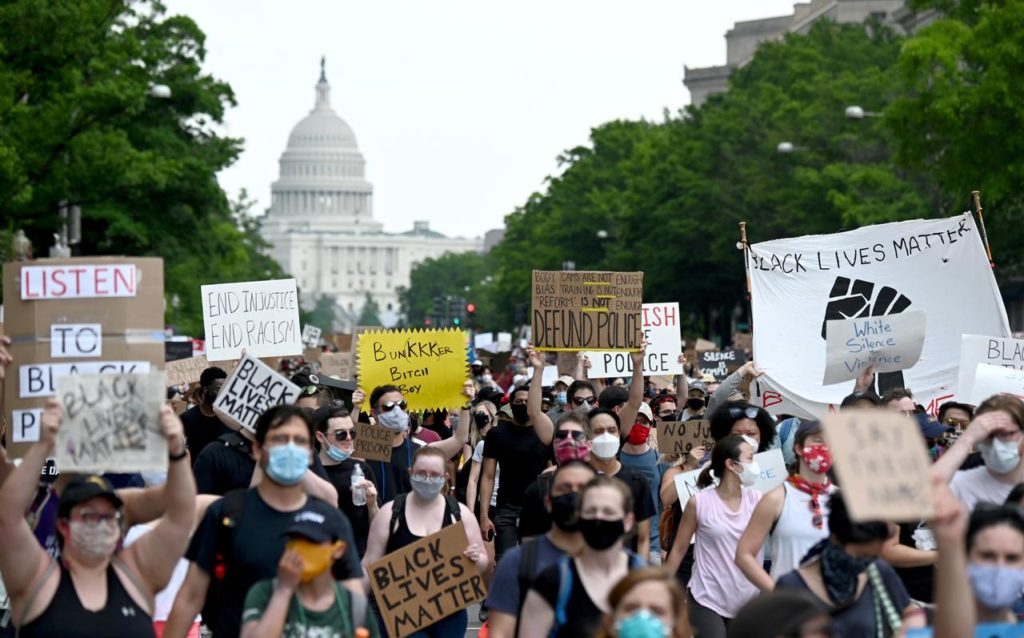
Demonstrators march from the U.S. Capitol Building during a protest against racial inequality in the aftermath of the death in Minneapolis police custody of George Floyd, in Washington, U.S. on June 6, 2020
Leslie Batson, a white office administrator from Maryland, joined the thousands of marchers protesting the killing of George Floyd in Washington, D.C., last weekend after her children asked why the family had done nothing about racism.
“This is my attempt to help elevate the voices of people of color, people who don’t look like me and who don’t benefit from the status quo,” Batson, 42, said on Saturday, as her 9- and 11-year-old children hid shyly behind her.
In recent days, white Americans have donned “Black Lives Matter” shirts, carried homemade signs, and shouted “Hands up, Don’t shoot” in cities and small towns across the United States. Sometimes they lay down in the streets, just as Floyd, an unarmed black man in handcuffs, lay face down and struggling to breathe as a white police officer knelt on his neck.
Books like “White Fragility” and “The New Jim Crow” are topping U.S. best-seller lists, and social media is flooded with #BlackLivesMatter posts. Fortune 500 companies and sports franchises, predominantly run and owned by white Americans, voiced support for anti-racist activism, and the New York Stock Exchange held its longest moment of silence ever for Floyd.
The United States has a long history of white participation in civil rights protests, but the current outpouring of support is unprecedented, historians and social scientists agree.
That said, many question white Americans’ long-term commitment to do the work to fight racism.
“Historically, when we see higher levels of participation from white folks in movements and moments like this, that participation falls off precipitously after we move away from the protest,” said Charles McKinney, associate history professor and chair of Africana Studies at Rhodes College in Tennessee.
After civil rights activists leading protest marches in Selma, Alabama, in 1965 were beaten bloody by police, twice as many Americans polled expressed sympathy with protesters than with the state of Alabama, Pew Research noted.
In a separate opinion poll at the same time, however, 45% believed the U.S. administration of President Lyndon Johnson was moving too fast on the voting rights and integration that protesters advocated.
McKinney is analyzing whether the high white protester turnout will translate into laws that aid the Black Lives Matter movement.
“In order for this to be the last racial inflection point… white America must end its sideline sympathy and assume full ownership of this problem,” said Allyn Brooks LaSure, a former U.S. diplomat, and executive vice-president for communications at the Leadership Conference on Civil and Human Rights, a national coalition of civil and human rights groups.
That would include awkward conversations on family Zoom calls, in work conference rooms, and at Thanksgiving dinners, he recommends.
REAL CHANGE OR TALK?
Big companies around the world which have typically stayed away from this debate have pledged over $1.7 billion to advance racial justice and equity. City councils are voting to cut police funding and limit police tactics, and statues to the slave-holding supporters in the U.S. Civil war are coming down.
Reuters research shows some of the same U.S. companies have elevated few African Americans to top jobs; two centuries after it started, the NYSE’s traders and management remain overwhelmingly white; an anti-lynching bill named after a black teen killed in 1955 failed to pass the U.S. Senate on June 5.
On June 8, senior Democrats, including House speaker Nancy Pelosi, donned kente cloth, a Ghanaian fabric that is a prominent symbol of African arts and culture, knelt in the U.S. Capitol building for nearly nine minutes of silence for Floyd.
Charles Preston, a Chicago-based black activist and organizer, called the gesture “ridiculous.”
“I think it’s a charade, it’s hollow, it’s empty and I don’t understand what is the purpose of kneeling,” he said. Politicians, he said, should push for policy changes that help African-Americans instead.
The very gesture, known as “taking a knee,” echoes the “Black Power” raised-fist salute that U.S. Olympic medalists Tommie Smith and John Carlos made on the medal podium at the 1968 Mexico City Olympics.
Half a century later, it was still controversial when San Francisco 49ers quarterback Colin Kaepernick took a knee to protest police brutality and racial injustice in 2016. Years after leaving the team, he has yet to be picked up by another.
A NEW GENERATION
Melanie Campbell, president of the National Coalition on Black Civic Participation, said veteran activists have doubts this phase will endure for long. But she said the level of anger and frustration after Floyd’s death is new.
“This is a generation seeing mass shootings in schools, a divisive president, black people being killed and they are pushing back,” she said.
And the demographics of the country itself are changing.
One in 10 eligible voters in the 2020 electorate, about 22 million Americans, will be part of a new generation that is the most ethnically diverse in U.S. history, Pew reports, with just 52% of the generation white.
“This is not an insurmountable task,” said Kyle Holman, a 21-year-old white student in Washington, D.C., who protested on Saturday. “If we can just start by acknowledging that things can be really bad for people of color, have scales fall from our eyes, we will move this debate forward,” he said.