Pandemic Lessons For India’s Electric Mobility
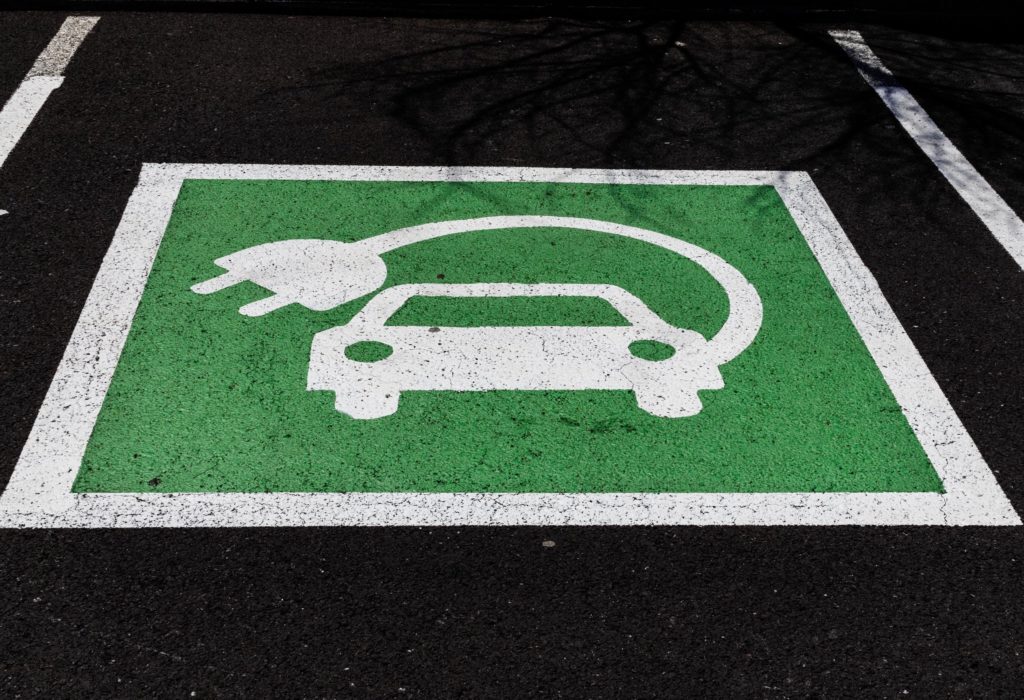
A green electric car parking sign can be seen painted on asphalt (Image: Martin Leber/Alamy)
India’s electric mobility ambitions have suffered a major setback due to the Covid-19 pandemic. Vehicle manufacturers concede that with core business being heavily impacted, electrification will take a backseat for now. But they remain firm on the long-term goal of promoting cleaner alternatives to fossil fuel-powered vehicles.
Sales of all forms of passenger carriers, including light and heavy duty buses, three-wheelers, e-rickshaws and taxis, have decreased since the pandemic struck in 2020, as most have opted for private transportation.
This has affected India’s efforts to electrify public mobility, a segment that the government has been targeting as an efficient way of reducing the carbon footprint of a greater number of passengers.
“The Covid-19 induced lockdown and restrictions have severely impacted the overall commercial passenger segment,” said Rohit Srivastava, vice president for the buses segment with the manufacturer Tata Motors. “The pace of electrification, specifically in the case of e-buses, has also been dampened.”
Srivastava, however, is hopeful that continuation of robust subsidy schemes such as the Faster Adoption and Manufacturing of Hybrid and Electric Vehicles (FAME) will help revive consumers’ interest in electric mobility in the long run.
THE NEED FOR A LONG-TERM VISION
Anumita Roychowdhury, executive director of research and advocacy at the think-tank Centre for Science and Environment (CSE), says that to get electrification back on the mobility agenda, India will need a long-term and consistent policy road map.
“But the reality is, we don’t even know what will happen after [the second iteration of the] FAME [scheme],” she said. “While we do understand that Covid-19 has derailed the economy, we could have been a lot more strategic in terms of linking economic and green recovery,” Roychowdhury added.
She welcomed the central government’s newly announced incentive scheme rewarding the production of batteries, known as Production Linked Incentives (PLI). But the centre and states need to come together with a cohesive policy for all the initiatives to be effective, she added.
Despite all the disruptions, Mahindra & Mahindra, one of the earliest entrants into the shared electric transport segment, remains optimistic that rapid electrification is possible, particularly for vehicles covering short distances such as rickshaws. “We expect about 40% of overall three-wheelers sold in the country to be electric by 2025,” said Mahesh Babu, chief executive of Mahindra Electric.
Unlike developed countries, India requires complex transportation solutions involving a range of different vehicles for each stage of a journey. Last-mile mobility in India offers a huge opportunity for electric vehicle (EV) penetration and is set for a massive transformation, Babu said. “We aim to roll out new, innovative and customised EV solutions in both personal and commercial segments that will invigorate India’s last-mile mobility and delivery needs.”
Mahindra has over 3,000 electric four-wheeled vehicles and more than 20,000 electric three-wheeled vehicles, such as rickshaws, running in the shared and corporate markets. As these vehicles cost as much as their carbon-intensive counterparts but are cheaper to maintain, Babu believes EV is well suited to take over last-mile transportation and delivery
However, the pandemic has not spared even the low-speed e-rickshaws that have been at the front line of India’s electric vehicle revolution. Close to 8,000-11,000 e-rickshaws were sold per month prior to the pandemic, according to a 2018 study carried out by the consulting firms Kearney and Bloomberg. This number had been expected to grow steadily, said Rahul Mishra, a partner with management consultancy Kearney.
“Covid has not only severely impacted the e-rickshaw market and shared mobility but also pushed the electric mobility agenda out of the country,” said Mishra. As the e-rickshaw market was organising and manufacturers were entering the space with better products, the pandemic forced them to fundamentally review their strategy, he said.
CHARGING AHEAD
However, Eric Vas, president of the Urbanite brand business unit at the motorcycle and auto rickshaw manufacturer Bajaj Auto, believes that three-wheelers will remain a cost-effective solution for average city commuters.
“We may not have launched anything commercially, but we have put enough vehicles in the market that are going through trials. At this point, there are multiple challenges ranging from initial cost of acquisition to charging infrastructure,” he said.
The lack of charging infrastructure is a big reason why electric mobility is yet to take off in India. According to Vas, even battery-swapping solutions, in which the user only rents the charged battery pack and replaces it at dedicated swapping points, are not efficient given the high costs of batteries.
If a battery is the most expensive part of a vehicle, investors would rather reduce the number of batteries and not vice versa, Vas said, pointing out that in battery-swapping systems the number of batteries available at any point will have to exceed the number of vehicles that end up using them.
Battery manufacturing is expected to grow in India as local production is necessary to keep electric vehicles cost-competitive, according to a recent report by Emkay Global called Decoding Electric Vehicle Disruption. Due to economies of scale and technological advancements, battery costs are expected to decrease, which would make battery swapping sustainable for smaller vehicles, the report said.
Despite the setbacks due to the pandemic, public transport cannot be wished away, says CSE’s Roychowdhury. A clear, long-term road map for electrification covering the next decade will determine whether India’s roads will become less carbon-intensive.
But India can move in the direction of clean mobility only by learning from its policy failures and successes, incentivising manufacturing and investing in the lighter modes of transportation that are most popular among consumers.