Over 2,000 Deaths: Explaining The Turkey-Syria Earthquakes
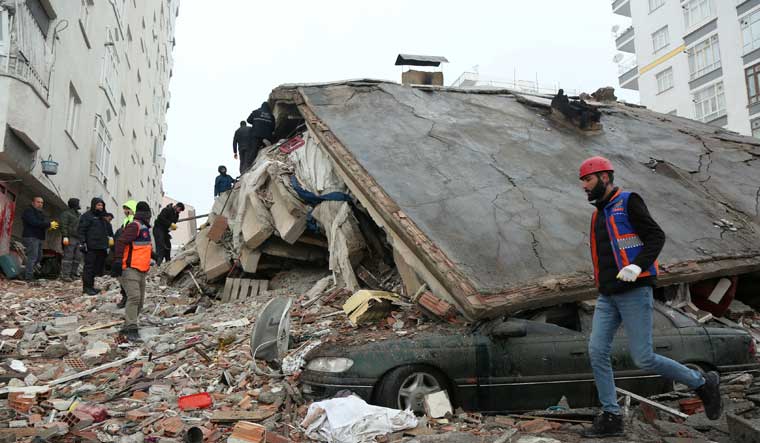
The epicentre of the first quake in February 2023 was at Gaziantep in southern Turkey (Image: Reuters)
An extremely large earthquake has occurred in the southeast of Turkey, near the border with Syria. Data from seismometers which measure shaking of the ground caused by earthquake waves suggest this event, in the early morning of February 6, was a magnitude 7.8 out of 10 on the moment magnitude scale. Seismic waves were picked up by sensors around the world (you can watch them ripple through Europe) including places as far away as the UK.
This was a really big one.
The shaking caused by energy travelling outwards from the source or epicentre has already had terrible consequences for people living nearby. Many buildings have collapsed, at least 2,000 people are thought to have died across the two countries, and there are reports of damage to gas pipelines leading to fires.
A second very large earthquake of 7.5 magnitude also occurred in central Turkey around lunchtime.
Why This Happened Here
This area of Turkey is prone to earthquakes as it lies at the intersection of three of the tectonic plates that make up the Earth’s crust: the Anatolian, Arabian and African plates. Arabia is moving northwards into Europe, causing the Anatolian plate (which Turkey sits on) to be pushed out westwards.
The movement of the tectonic plates builds up pressure on fault zones at their boundaries. It is the sudden release of this pressure that causes earthquakes and ground shaking.
This latest earthquake is likely to have happened on one of the major faults that marks the boundaries between the Anatolian and Arabian plates: either the East Anatolian fault or the Dead Sea Transform fault. These are both “strike-slip faults”, which means they accommodate some motion of plates moving past each other.
‘Significantly Bigger’ Than Previous Earthquakes
While this area has many earthquakes every year caused by the ongoing motion of the tectonic plates, today’s earthquake is particularly large and devastating as so much energy was released. The United States Geological Survey (USGS) states that only three earthquakes bigger than magnitude 6 have happened within 250km of this location since 1970. At magnitude 7.8, the February 6 event is significantly bigger than ones the area has experienced before, releasing more than twice as much energy as the largest previously recorded earthquake in the region (magnitude 7.4).
Modern seismologists use the moment magnitude scale, which represents the amount of energy released by an earthquake (the Richter scale is outdated, though is sometimes wrongly quoted in the news). This scale is non-linear: each step up represents 32 times more energy released. That means a magnitude 7.8 actually releases around 6,000 times more energy than the more moderate magnitude 5 earthquakes that might usually happen in the region.
We tend to think of earthquake energy as coming from a single location, or epicentre, but they are actually caused by movement along an area of a fault. The bigger the earthquake, the larger the fault area that will have moved. For something as large as this magnitude 7.8, there is likely to have been movement over an area roughly 190km long and 25km wide. This means the shaking will be felt over a very large area.
Severe to violent shaking (enough to cause significant property damage) is estimated to have been felt by 610,000 people in the surrounding area up to around 80km away north-eastwards along the tectonic plate boundary. Light shaking was felt as far away as the Turkish capital of Istanbul (around 815km away), as well as Baghdad in Iraq (800km) and Cairo in Egypt (950km).
What About Aftershocks?
After major earthquakes there will be many smaller earthquakes known as aftershocks as the crust readjusts to the changes in stress. These can continue for days to years after the initial event. In the first 12 hours after the initial tremor in southeast Turkey, there were already three other earthquakes above magnitude 6.0. The first was a 6.7 which happened only 11 minutes after the first shock, and there have been hundreds of smaller magnitude aftershocks.
The second, magnitude 7.5 earthquake occurred further to the north on a different but adjacent fault system: the Sürgü Fault. Technically this one was powerful enough to count as a separate earthquake in its own right, though it is likely to have been triggered by the first earthquake, and it will generate its own series of aftershocks.
While aftershocks are usually significantly smaller than the main shock, they can have equally devastating consequences, further damaging infrastructure that was damaged by the first earthquake and hampering rescue efforts.
As the aftermath of these major earthquakes continues to be felt by the people living in this region, we can only hope that international aid gets to Turkey and Syria as soon as possible to help in ongoing rescue efforts, amid the ongoing aftershocks.
(This article is republished from The Conversation under a Creative Commons license. Read the original article)