Making Global Health Greener, Fairer, Younger
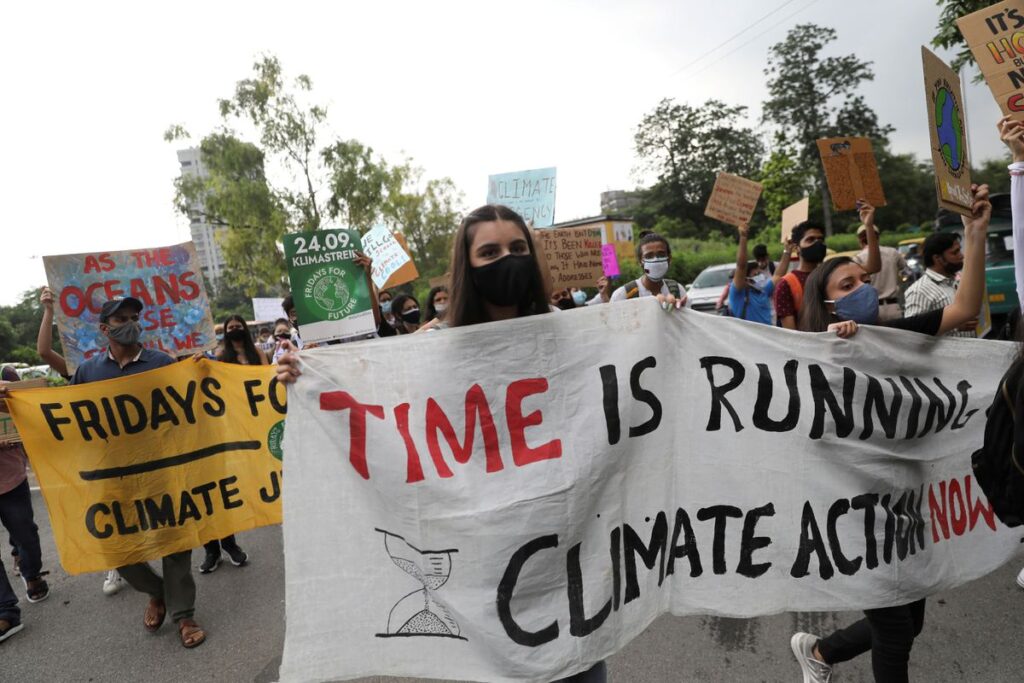
FILE PHOTO: People hold banners and signs as they take part in a march calling for urgent measures to combat climate change, in New Delhi (Reuters)
The COVID-19 pandemic has been a chaotic dress rehearsal for more serious health crises in the future. And the blunders of the past few years revealed what is missing from the politics of intertwining domestic and foreign policy with global health.
The failure to ensure universal access to vaccines — especially in low- and middle-income countries — highlights some nations’ selfishness. The existential threat of climate change presents new health problems that will require more international collaboration and consensus. There is a way to do this. And it involves bringing in the views of those not currently dominating global health discussions.
The climate emergency is a global health issue that has dramatic consequences for the health of the world’s population from rising dengue fever and heat-related illness, to worsening undernutrition and ‘climate anxiety’, especially among young people. It affects every health arena and every agenda item of the annual World Health Assembly. But because climate is seen as a ‘tomorrow’ problem and is also not seen as being linked to healthcare, it barely features in World Health Organization negotiations, government relations or boardroom discussions.
But the health sector needs to be ready to respond to the health impacts of climate change and be able to develop a strategy on how to influence other sectors (for example energy and agriculture) that primarily drive climate change through their emissions. Therefore the climate crisis must be a top issue for health diplomacy, integrated into all aspects of global health deliberations.
Protecting the planet improves human health in return. Future health diplomacy should begin caring not only about the health of people but also the planet. Keeping the focus on people and forgetting about the planet will lead to the continuation of rapid and damaging global environmental change that will in turn affect the health of people.
This concept of planetary health has only recently become popular among the scientific community but its message — that the health of people and the planet are inextricably intertwined — is something many indigenous communities across the world have been embracing for centuries.
Ignoring health in climate discussions means health impacts are not considered in decisions on mitigation, adaptation or financing. Climate change, after all, is an issue of human survival. Framing climate change as a public health emergency will help create a greater sense of urgency on climate action.
The Paris Agreement, which the WHO once described as a ‘public health treaty’, only mentioned health once — in the preamble. Last year’s COP26 in Glasgow, which was postponed 12 months because of COVID-19, featured a health pavilion while more than 50 countries made a commitment to build climate-resilient and low-carbon national health systems. It is perhaps a sign that health will be more than a footnote or a side event at future COP meetings.
Health diplomacy could also be fairer. At the moment, the voices, needs and interests of the powerless and poor (people and countries alike) aren’t given as much consideration in global health decisions (for example in relation to vaccines); global health policy continues to favour the rich and powerful.
Discussions are growing around the idea of ‘decolonising global health’. This recognises that the global health sector evolved from colonial roots and continues to reflect that power imbalance in education and research, governance and financing, diplomacy and policy making.
Health leadership is entrenched in the Global North — it’s very white and very male. The annual Global Health 50/50 reports have documented the uneven distribution of power and opportunities for global health leadership. Academia is the same — there are still global health journals whose Global North-dominated editorial boards remain far from truly global while journal articles about health issues in Africa — some still conducted through ‘parachute, safari, or parasitic research’ — continue to be published despite the absence of African scientists as lead authors.
Aside from ‘vaccine apartheid’, global health professionals from the Global South have also been enduring ‘visa apartheid‘ marred by long waits, humiliating interviews, and visa denials, which further limit their participation in global health conferences. Even in the era of Zoom, when discussing health issues affecting poor black women in Africa, ‘manels’ (all-male panels), ‘whanels’ (all-white panels) and “HICanels” (high-income country panels) continue to dominate. The voices, perspectives, needs and lived experiences of non-male, non-white and non-HIC need to be taken into account in discussions and decisions.
Health diplomacy could involve young people and even incorporate the perspectives of generations not yet born. A youthful contribution to discussions is being missed, while neglecting the perspectives of future generations leads to policies that are short-term, destroy the planet and steal their ability to live and thrive in the future.
Decision-makers are becoming increasingly receptive to youth participation in health diplomacy. This year, the WHO launched its first youth council, consisting of representatives from major international youth and student networks. Youth organisations such as the annual Youth Pre-World Health Assembly of the International Federation of Medical Students’ Associations, which commemorates its 10th year in 2023, have been proactive in advocating to WHO and other global health agencies.
The highly influential Lancet Commissions are also beginning to include young people. A decade ago, the first Lancet Youth Commission focused on global governance for health. One of the proposals then was for the UN members to appoint an ombudsperson for future generations.
Next year, the first Global Model WHO will be held and it is possible health diplomacy may eventually move beyond youth simulations and instead engage true young diplomats in actual negotiations.
Caring for the Earth, dismantling inequitable power structures and meaningfully engaging young people should be the new tenets of post-pandemic health diplomacy. A greener, fairer and younger future requires demolishing colonial mindsets towards the planet, marginalised groups and youth and replacing them with humility, commitment to inclusivity and reverence for all.