Is Pursuing The ‘Liberal Arts’ A Luxury Today?
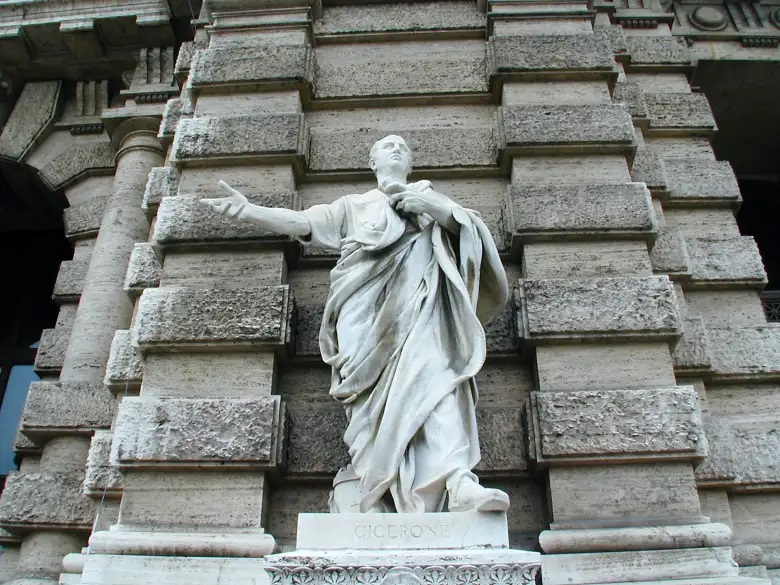
Cicero defined ‘liberal arts’ in a book he wrote about rhetoric in a republic (ra-photos/E+ via Getty Images)
The term “liberal arts” is one of the most misunderstood terms in the public discourse on higher education today. A higher education expert once said that putting the words “liberal” and “arts” together was a “branding disaster” – one so toxic that it was undermining public support for higher education. To break down the meaning and origin of the term, The Conversation reached out to Blaine Greteman, a professor of English, who looks at how the term emerged in ancient times.
What Does The Term Mean?
Contrary to how it might sound, “liberal” in the phrase “liberal arts” has nothing to do with political liberalism. And the “arts” part is not really about the arts as most people understand them, such as painting, dancing and the like.
The “liberal” in “liberal arts” derives from the Latin “liberalis,” meaning “free.” “Arts” comes from Latin “ars”, for “knowledge” or “skill.” The word “artifact” has the same root: something made by human skill or knowledge. “Liberal arts,” in this sense, is education that equips a person for life as a free citizen.
That was how the Roman statesman and philosopher Cicero meant it 2,000 years ago when he became the first on record to refer to a “liberal arts” education. Cicero did this in “De Inventione,” an influential handbook on rhetoric written around 90 B.C. Cicero composed the book as a young man considering the role that public speaking served in the life of a republic.
In his later and more comprehensive work, “De Oratore,” Cicero explained that the full liberal arts education will equip students with a deep understanding of human emotion, skills in literary expression and a “comprehensive knowledge of things,” or “scientia comprehendenda rerum plurimarum.” This is the “education befitting a free person,” or “eruditio libero digna.”
It’s easy to get bogged down in what exactly that comprehensive or universal education entailed for Cicero or his followers in the Renaissance. But “liberal arts” for Cicero didn’t mean some subject, like “art” or “English,” so much as it meant a broad, general education.
Classically, meaning from the ancient Roman educational system up through the 1800s, when the Victorians began to reform education as practical training for the masses, students would pursue the “trivium” – grammar, logic and rhetoric – before continuing to the “quadrivium” – arithmetic, geometry, astronomy and music. But to get hung up on where painting, ballet or history fits into this scheme kind of misses the point.
“Liberal arts” really means education that is broad, and not strictly vocational, in that it gives you the ability to exercise free choice as a citizen and thinker. A course in philosophy or history will improve a student’s communication skills in ways that will ultimately help them find a job, but the core purpose of the class is to study deeper lessons of the self or the past. That’s very different from the way a course in electrical engineering might cultivate skills students will use in a career designing circuits.
Why Does Studying The Liberal Arts Matter?
True freedom, as I see it, is the ability to choose wisely between arguments and theories about how the world works and understand how language can manipulate or elevate us. This is why 17th-century English poet and revolutionary John Milton focused his foundational anti-censorship text, “Areopagitica,” on the civic value of the liberal arts. “Give me the liberty to know, to utter, and to argue freely according to conscience, above all liberties,” Milton wrote.
One of the greatest defenses of the liberal arts in America was written just 37 years after the Civil War by W.E.B. Du Bois. “The Souls of Black Folk” is probably best known today as a groundbreaking work of sociology.
Du Bois also insisted that without access to a complete and comprehensive liberal arts education, Black Americans can never truly be free. To the question, “Shall we teach them trades or train them in liberal arts?” Du Bois answered, “Both.” But he maintained that liberal arts must always be the foundation, because “to make men, we must have ideals, broad, pure, and inspiring ends of living, not sordid money-getting, not apples of gold.”
He was concerned that Booker T. Washington’s “unnecessarily narrow” emphasis on vocational education might come at the expense of this broader education in the arts of freedom. For his part, Washington felt that inspiration, ideals and “dead languages” were less important than learning “how to apply the knowledge of chemistry to the enrichment of the soil, or to cooking, or to dairying.”
Are The Liberal Arts A Luxury?
A similar debate is playing out today in places like West Virginia University. The state’s government and university leadership announced in August 2023 plans to cut 32 programs, including its entire Department of World Languages, Literatures and Linguistics.
Many faculty and students protest that this move sacrifices a broad civic education and equates a college education with job training.
The governor, university president and legislature have argued that the university’s offerings “must align majors with future careers.”
Republican Eric Tarr, state Senate finance chair in West Virginia, explained in an opinion piece written for the West Virginia Record that the goal of the budget decisions is to “provide degrees that lead to jobs.” In other words, to train workers to work, rather than educating citizens in what Du Bois and Cicero would have called “the knowledge of being free.”
(This article is republished from The Conversation under a Creative Commons license. Read the original article here)