How Free And Fair Will This Year’s Election Be?
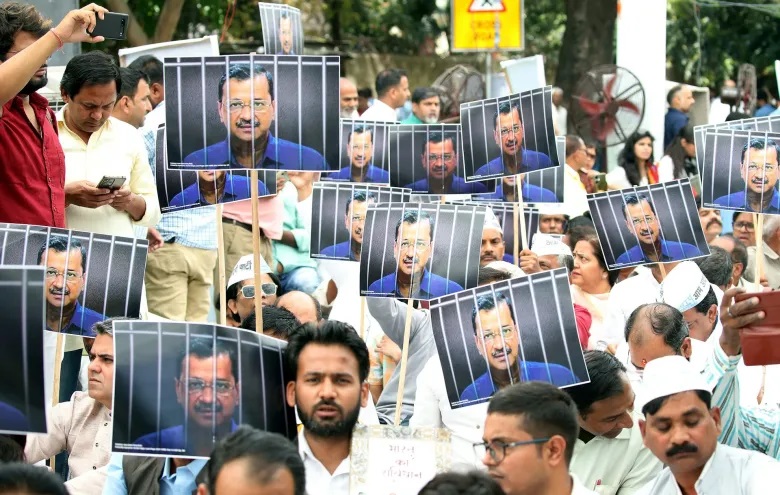
A mass fasting protest against the arrest of Arvind Kejriwal in New Delhi on April 7 (Harish Tyagi/EPA)
India’s prime minister, Narendra Modi, is favoured to win reelection when India’s 970 million voters start heading to the polls on April 19 in the country’s massive, six-week general election.
Modi, who has been prime minister since 2014, has benefited from a divided opposition, glowing mainstream media coverage and high economic growth rates.
However, recent polling indicates significant voter discontent over inflation and unemployment. While 44% of respondents want the Modi government to return to power, a sizeable 39% do not want his Bharatiya Janata Party (BJP) to be reelected.
Moreover, Modi’s election campaign has been tainted by several events in recent weeks:
- the arrest of a major opposition leader in what his party says was a “conspiracy” by Modi’s government
- the freezing of the accounts of the major opposition Congress party over a tax dispute
- revelations of heavily skewed political financing favouring Modi’s party.
These incidents have raised concerns about how free and fair India’s election will actually be.
India’s Democratic Decline
For much of its history as an independent state, India has been an electoral democracy, defying political sociologist Seymour Lipset’s theory that democratic institutions and cultures usually only thrive in affluent societies.
Barring a period of emergency rule in the 1970s when elections were suspended, India has met the threshold for free and fair elections throughout its history.
Voter turnout in elections has typically been high, at around 70%. A complex electoral structure has also been put in place to ensure electoral integrity, involving:
- phased voting over a number of weeks
- a model code of conduct governing how parties and candidates must behave in elections
- travelling electoral and security officials to oversee the voting process and reach all voters
- the implementation of an electronic voting system to prevent electoral fraud.
Since 2018, however, there has been a steep decline in the quality of India’s electoral democracy. The V-Dem Institute, which tracks democratic freedom around the globe, now considers India to be an electoral autocracy, which means it still holds regular elections but its government is increasingly autocratic.
V-Dem also says India does not have sufficient safeguards in place to ensure free and fair elections.
What Makes Elections Free And Fair?
To safeguard electoral integrity, governments must ensure the free participation of all parties and voters in elections and maintain an independent election commission. All candidates must have equal access to the media, which should act as a watchdog. Incumbents should not have a large financial advantage over opponents.
These norms of electoral integrity have been endorsed in numerous international and domestic codes of conduct, treaties and protocols around the world.
However, the world is experiencing a new wave of autocratisation, and electoral manipulation is on the rise.
Of particular concern is long-term electoral manipulation that results in the lack of a level playing field. This involves political financing that favours one party over others, the political persecution of opposition politicians and journalists, media dominance by incumbents and the erosion of independent electoral institutions.
An Uneven Political Financing System
On February 15, an opaque system of political financing introduced under the Modi government in 2017 was declared unconstitutional by the Supreme Court. In this “electoral bonds” system, individuals and companies were permitted to make unlimited and anonymous donations to political parties through the purchase of bonds from the State Bank of India.
The Supreme Court ordered the release of the names of donors and recipients despite resistance from the bank.
These data revealed Modi’s BJP as the prime beneficiary of hundreds of millions of dollars of donations by corporations and individuals since 2019.
Thirty-three corporations donated electoral bonds worth more than their profits, raising questions about the true source of these funds. And three-quarters of these donations went to the BJP.
Thirty corporate donors were also found to have purchased electoral bonds after India’s Enforcement Directorate, which investigates economic crimes, and the Tax Department launched investigations against them for money laundering and tax violations.
In addition, Indian media reported that companies donating large amounts to the BJP were later awarded major government contracts.
Targeting The Opposition
Opposition leaders allege the Modi government is also misusing state agencies to target them.
For instance, a media report revealed that 95% of investigations by the Enforcement Directorate since the BJP came into power in 2014 have focused on the opposition. There has also been a five-fold increase in the number of money laundering investigations by the body since 2014.
The Enforcement Directorate has been unable to prove most of these cases. In fact, it has a less than a 0.5% conviction rate dating back to 2005.
Modi has denied accusations he has used the body to target the opposition. However, Indian media have found corruption investigations involving 23 of 25 opposition politicians were shelved after they defected to the BJP.
In recent days, a popular opposition leader and anti-corruption campaigner, Delhi Chief Minister Arvind Kejriwal, was also jailed on allegations he received kickbacks from the Delhi government’s attempt to privatise the liquor industry. The Enforcement Directorate has yet to provide evidence of his guilt.
Monitoring The Election
Once considered a robustly independent institution, the Indian Election Commission’s reputation has been tarnished by questions about its impartiality.
It has failed to adequately address criticisms of its weakening of verification processes in the electronic voting system, as well as allegations of voter suppression of Muslims, Dalits and women.
Indian democracy is not, however, dying in darkness. While the Supreme Court’s independence has been questioned, its persistence in challenging the government on the issue of electoral bonds provides some reassurance that it has not yet become an “executive court”.
Despite being subjected to tax investigations, censorship and arrests, independent journalists and media organisations continue to hold the government to account. They have pooled their resources to investigate the electoral bonds scandal and provide critical election coverage in the recent Karnataka election, which the BJP lost.
The electoral bonds scandal also came to light thanks to the dogged efforts of “right to information” (RTI) activists in the face of efforts by the government to weaken the RTI Act.
And though YouTube has emerged as source of disinformation and hate speech, it has also been a venue for journalists and influencers to provide fact checking and critical commentary on the government. A video by a popular young influencer, Dhruv Rathee, accusing Modi of cultivating a dictatorship recently went viral with 25 million views.
Meanwhile, a new citizens’ initiative, the Independent Panel for Monitoring Elections is issuing weekly bulletins documenting violations of the Model Code of Conduct, media bias and voter exclusion.
If India is the “mother of democracy”, as Modi likes to claim, it is this unbowed civil society that will ensure its survival.
(This article is republished from The Conversation under a Creative Commons license. Read the original article here)