‘Ganga, Brahmaputra Flows To Reduce Due To Global Warming’
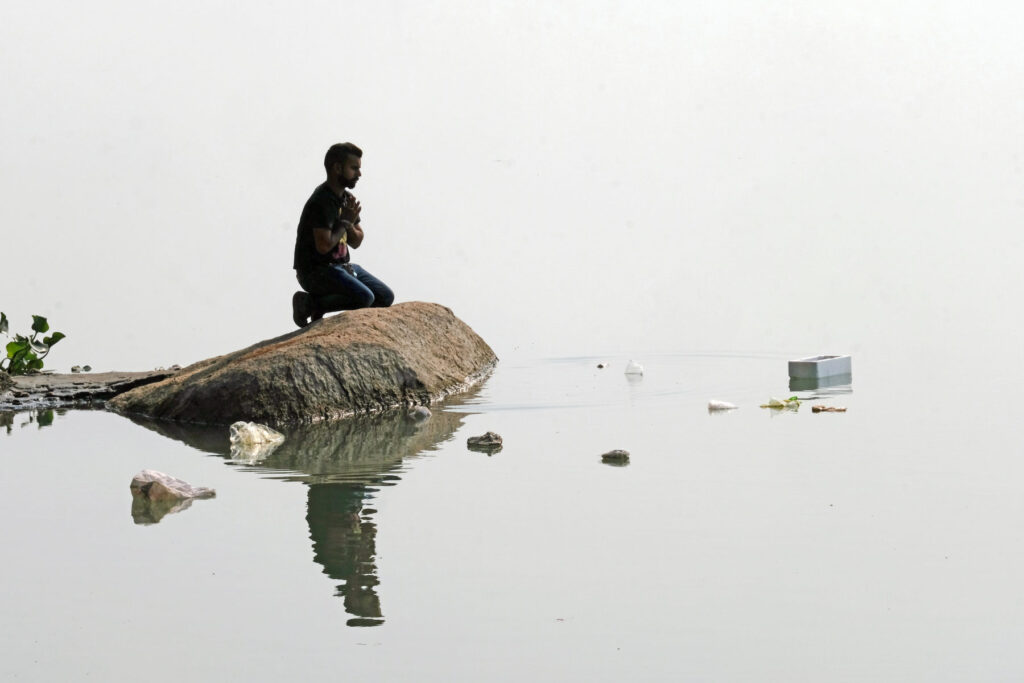
The grass and trees in the area around the Periyar river appear wilted, as if scorched by noxious fumes. The birds seem to have been driven away by the air. Without official action, the pall over the region and its residents is unlikely to lift soon (Representational Image: Friedrich Stark/Alamy)
Source: PTI
UN Secretary-General Antonio Guterres warned that major Himalayan rivers like the Indus, the Ganges and the Brahmaputra, all hugely important for India, could see reductions in their flows as glaciers and ice sheets recede over the coming decades due to global warming.
“Glaciers are critical to all life on earth. Over centuries, they carved out the landmasses we call home. Today, they cover 10 per cent of our world. Glaciers are also the world’s water towers,” Guterres said in his remarks at an event on the International Year of Glaciers’ Preservation on Wednesday.
Guterres voiced concern that human activity is driving the planet’s temperature to dangerous new levels and “melting glaciers are the canary in the coalmine”. Antarctica is losing an average of 150 billion tons of ice mass every year while the Greenland ice cap is melting even faster — losing 270 billion tonnes per year.
In Asia, 10 major rivers originate in the Himalayan region, supplying freshwater to 1.3 billion people living in its watershed.
“As glaciers and ice sheets continue to recede over the coming decades, major Himalayan rivers like the Indus, the Ganges and Brahmaputra will feel the impact – seeing their flows reduced,” Guterres said, adding the world has already witnessed how Himalayan melts have worsened flooding in Pakistan.
He added that rising sea levels combined with saltwater intrusion will decimate large parts of these huge deltas.
The event was held on the margins of the UN 2023 Water Conference – formally known as the 2023 Conference for the Midterm Comprehensive Review of Implementation of the UN Decade for Action on Water and Sanitation (2018-2028) – currently underway at UN Headquarters.
Co-hosted by Tajikistan and the Netherlands, the March 22-24 conference will result in a summary of proceedings from the UNGA President that will feed into the 2023 session of the UN High-level Political Forum on Sustainable Development.
“The first UN water conference in a generation, the UN 2023 Water Conference, co-hosted by the Governments of Tajikistan and the Netherlands will be a watershed moment to mobilize Member States, the UN system and stakeholders alike to take action and bring successful solutions to a global scale,” the UN has said.
Guterres cited data from the World Meteorological Organization that warned that global average sea levels have already risen faster since 1900 than over any preceding century in the last 3,000 years.
“Unless we reverse this trend, the consequences will be catastrophic. Low-lying communities and entire countries could be erased forever. We would witness mass movements of entire populations – and fierce competition for water and land,” he said, adding that disasters would accelerate worldwide — including floods, droughts and landslides.
Guterres called on all countries to act as one to protect people and communities alike, emphasizing the urgent need to limit global warming to 1.5-degree rise to avert the worst impacts of climate change.
“We urgently need to reduce emissions, enhance adaptation measures, and ensure climate justice. And developing countries must have the resources to adapt and build resilience against climate disaster,” he said.
He urged the international community to invest in climate-resilient buildings, infrastructure, water pipelines, as well as policies that conserve precious water resources and their ecosystems for the future.
He stressed the need to build institutional capacities and integrate risk reduction measures to ensure that every person in the world is protected by life-saving early warning systems against hazardous climate or weather events by 2027.
In his remarks to the opening of the conference on Wednesday, Guterres lamented that “we’ve broken the water cycle, destroyed ecosystems and contaminated groundwater”.
Nearly three out of four natural disasters are linked to water, one in four people lives without safely managed water services or clean drinking water and over 1.7 billion people lack basic sanitation. He pointed out that half a billion practice open defecation and millions of women and girls spend hours every day fetching water.
He said he has proposed to the G20 a Climate Solidarity Pact, in which all big emitters make extra efforts to cut emissions, and wealthier countries mobilize financial and technical resources to support emerging economies.
India is currently the President of the G20.
In 2015, the world committed to Sustainable Development Goal (SDG) 6 as part of the 2030 Agenda – the promise that everyone would have safely managed water and sanitation by 2030.
“Right now, we are seriously off-track. Billions of people and countless schools, businesses, healthcare centres, farms, and factories are being held back because their human rights to water and sanitation still need to be fulfilled,” the UN said.
A day before the UN Water Conference, the ‘United Nations World Water Development Report 2023: partnerships and cooperation for water’ published by the UN Education, Scientific and Cultural Organization (UNESCO) said that around 80% of people living under water stress lived in Asia; in particular, northeast China, as well as India and Pakistan.
“The global urban population facing water scarcity is projected to increase from 933 million (one-third of the global urban population) in 2016 to 1.7–2.4 billion people (one-third to nearly half of the global urban population) in 2050, with India projected to be the most severely affected,” the report said, citing data.