Climate Change Causing More Lightning Strikes In India
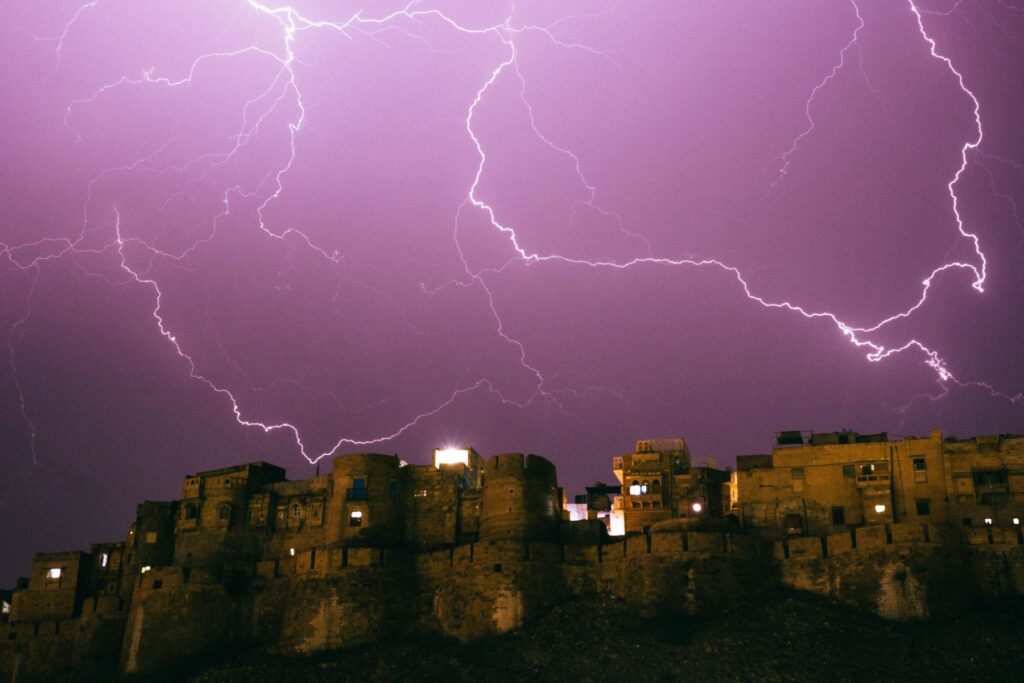
Lightning strikes above the city of Jaisalmer, Rajasthan (Image: Alamy)
The frequency and intensity of lightning strikes have risen sharply in South Asia since the 1970s. So have fatalities, especially of farmers, during the monsoon cropping season.
Lightning is now the most fatal natural hazard in India: data from the National Crime Records Bureau (NCRB) reveals that over 100,000 people died due to lightning strikes between 1967 and 2019. This is 33% of all deaths caused by natural hazards over the 52-year period – more than twice the casualties due to floods.
Despite this, lightning has not yet been officially notified as a disaster by the federal Ministry of Home Affairs. The State Disaster Response Fund currently covers cyclones, droughts, earthquakes, fires, floods, tsunamis, hailstorms, landslides, avalanches, cloudbursts, pest attacks, frosts, cold waves and now Covid-19.
Until lightning is added to the official list, it is not mandatory to incorporate risks posed by the phenomenon into all development and disaster-management plans.
Rising Number Of Lightning Strikes In India
In recent years, there has been a significant rise in the frequency, intensity and geographical spread of lightning strikes in India. The 2020-21 Annual Lightning Report published by the non-profit Climate Resilient Observing Systems Promotion Council (CROPC) recorded a 34% jump in lightning strikes within a year.
A 2014 study by scientists at the University of California, Berkeley, found that lightning strikes in the US may increase by 12% for every degree of rise in the global average air temperature. The authors forecast a 50% rise in lightning strikes in the US by 2100. CROPC data shows India is already experiencing a sudden rise in lightning strikes, suggesting the situation is far more alarming in India.
Volatile Monsoon Means Higher Lightning Risk
Hot weather and humidity create ideal conditions for thunderstorms – so as climate change causes more heatwaves, more storms and lightning strikes will follow.
In South Asia, lightning frequency increases rapidly during pre-monsoon storms, stays high during the monsoon, and rises again when the monsoon is retreating in September.
The monsoon has become more erratic due to climate change. There are often periods of intensely hot sunny days between rainy days. This has also led to an increase in lightning strikes during the monsoon.
A count of lightning strikes in the past two years shows that while strikes remain highest in and around the monsoon, the sharpest rise between the two years was in the months of April and May – the hottest pre-monsoon months in South Asia. This seasonality – which is different in different parts of India – is important for disaster preparedness. CROPC has also identified lightning hotspots in each state. Together, this information can help local policymakers prepare for lightning strikes and prevent fatalities.
Unlike floods and cyclones, where early warning systems help to minimise the number of casualties, less work has been done in India to reduce the risks lightning poses.
Most victims of lightning are struck outdoors. This places farmers, herders, fishers, construction and agricultural labourers, and those working in outdoor factories such as brick kilns and construction sites at high risk. Anyone taking shelter under a tall isolated object like a tree, pole or building is at risk.
There is no time to react when lightning strikes; the only way is to avoid exposure.
Some states – Andhra Pradesh, Odisha, Jharkhand, Kerala, Nagaland, Bihar – have taken comprehensive lightning risk management measures. As a result, there was a decrease of up to 70% in lightning deaths in Andhra Pradesh and Odisha between April 2019 and March 2021.
Raising Awareness Of The Risk
In 2019, CROPC launched its Lightning Resilient India Campaign 2019-2022. It uses a citizen science approach, and is in partnership with India Meteorological Department (IMD) and World Vision India and supported by a host of agencies inside and outside government. It is being run through an early warning system created by the IMD. In 2019, the IMD started a lightning and thunderstorms forecast, issuing them at ranges of three-five days, 24 hours and three-four hours.
The campaign, through its collective efforts, has already reduced lightning deaths considerably since its launch in April 2019. It now aims to reduce deaths and losses by 80% over three years.
Other steps taken include the Indian Institute of Tropical Meteorology’s launch of Damini, a mobile phone app. This provides a lightning forecast within a radius of at least 40 kilometres around a phone and also advises on preventive measures. The Indian Space Research Organisation has also set up a lightning detection network and an online lightning early warning system. This early warning is communicated by disaster-management authorities at state and district levels.
In addition, electronic and social media and volunteers spread information of potential lightning risks to raise awareness. More weather-monitoring stations are being set up across the country; more and more institutional buildings – schools, hospitals, community centres and so on – have lightning safety devices installed.
The National Disaster Management Authority has issued guidelines to state governments to prepare lightning action plans and provide early warning. It also has a list of dos and don’ts for the public. Seventeen state governments have notified lightning strikes as disasters.
CROPC has led the way in research and development, in collaboration with academia and scientific institutions. As a result, more studies are now being undertaken. CROPC’s report is even hosted on the World Meteorological Organisation’s website.
The need now is for state and local governments to play a more active role in raising vulnerable communities’ awareness of this deadly climate change impact.