“This Strike Is A Warning To The Government”
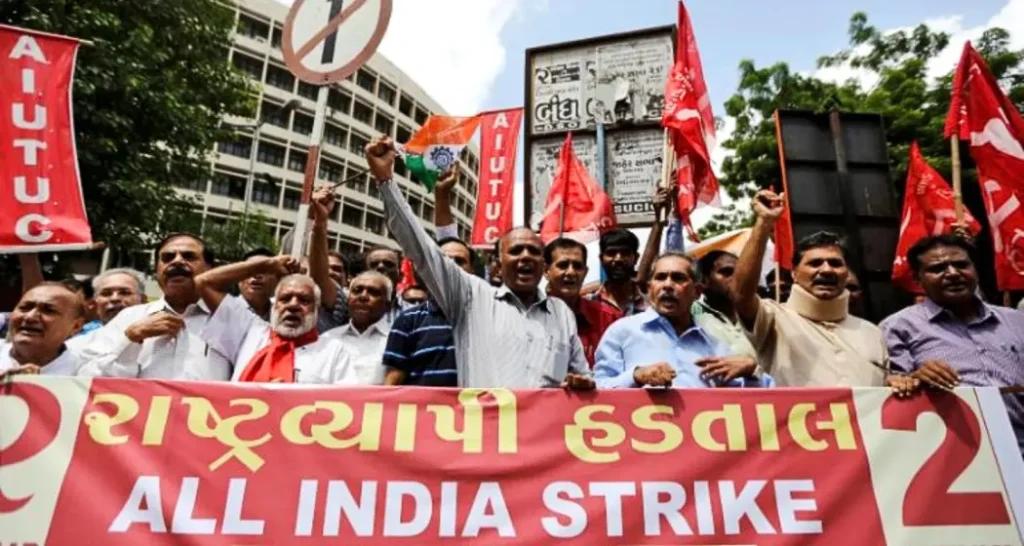
The nationwide strike aimed to protest labour reforms, privatization policies, and escalating living costs. Trade union leaders emphasized that the agitation was a response to worsening conditions for workers (Representational Image)
A nationwide strike — Bharat Bandh — organized by a joint platform of central trade unions on Thursday caused significant disruptions in banking operations, public transport, industrial production, and government services across parts of Kerala, West Bengal, Tamil Nadu, Punjab, and Bihar. Essential services remained largely unaffected in other regions, as worker groups affiliated with organizations like AITUC, CITU, HMS, and sector-specific federations held rallies, road blockades, and demonstrations in industrial hubs and district headquarters.
The strike aimed to protest against labour reforms, privatisation policies, and escalating living costs. Trade union leaders emphasized that the agitation was a response to worsening conditions for workers. “Rising inflation and job insecurity have worsened conditions for workers in both organised and unorganised sectors,” said a representative from CITU. “This strike is a warning to the government to address our grievances before things escalate further.”
The unions presented a charter of demands to the Union government, including the withdrawal or review of the four labor codes, a halt to privatization and disinvestment of public sector undertakings, an increase in minimum wages, strengthening of social security schemes, protection for contractual, gig, and platform workers, and measures to curb price rises and ensure pension security. “We demand protection for all workers, including those in the gig economy who are often left vulnerable,” noted an HMS spokesperson.
Banking and financial services faced partial disruptions in Kerala, West Bengal, and Tamil Nadu, where sections of bank employees participated. Customers in cities like Kochi, Kolkata, and Chennai reported delays in cheque processing and reduced counter services. “Public sector banking operations were hit hard, but private banks stayed operational,” observed a bank employee in Chennai. Insurance sector employees and postal unions also joined in some areas, slowing services.
Transport services experienced varying disruptions. In Kerala, private buses and autorickshaws stayed off the roads in Thiruvananthapuram, Kollam, and Ernakulam, leading to reduced commuter movement. “We had to walk miles to reach work today,” complained a commuter in Kochi. West Bengal saw sporadic road blockades in industrial belts, while state-run buses operated under police protection. In Tamil Nadu, protests near Tiruppur and Coimbatore affected freight and factory commutes, though long-distance services continued. Punjab and Haryana witnessed rallies, but state-run buses functioned with security deployment.
Industrial output and markets were partially impacted. Manufacturing units in Tamil Nadu’s textile and engineering clusters ran reduced shifts due to lower attendance. “Factories are operating at half capacity; workers are standing firm,” said a union leader in Coimbatore. Wholesale markets in Bihar and Jharkhand districts remained shut for hours, while most northern markets stayed open.
Educational institutions operated normally across most states, with slight attendance dips in protest areas. Central government offices in Delhi functioned as usual, but state government employees in Kerala and West Bengal boycotted work. Healthcare and emergency utilities continued without major issues, with authorities deploying extra personnel.
Politically, opposition parties supported the strike, accusing the government of ignoring workers. “The government is sidelining workers’ concerns, favoring corporations over the common man,” stated a Congress leader in Kerala. Ruling party officials criticized the shutdowns for harming productivity. “These strikes affect daily wage earners and disrupt economic growth,” remarked a BJP spokesperson in Delhi.
Security was heightened in major cities to prevent clashes and ensure traffic flow. Officials noted that despite localized disruptions, economic activity persisted in many regions. “We maintained order and ensured essential services ran smoothly,” said a police official in Kolkata.
Trade union leaders described the strike as a “warning protest,” hinting at further mobilizations if demands are unmet. “If the government doesn’t listen, we’ll escalate our actions,” warned an AITUC representative. Observers attributed the uneven participation to regional political dynamics and varying union influence, highlighting ongoing tensions over labor and economic policies.
Charter of protestors’ demands
Leaders of trade unions said the agitation was focused on a common set of demands submitted earlier to the Union government. Among these were:
- Withdrawal or review of the four labour codes
- Halt to privatisation and disinvestment of public sector undertakings
- Increase in minimum wages and strengthening of social security schemes
- Protection of contractual, gig and platform workers
- Measures to curb price rise and ensure pension security