Arab Spring Claim ‘False’, Sonam Wangchuk Tells SC
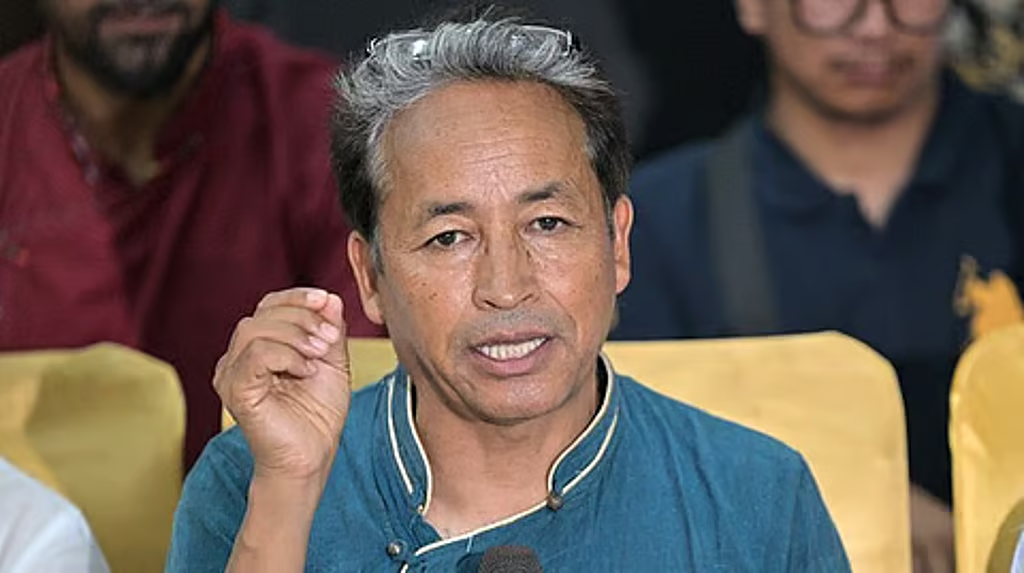
Sonam Wangchuk has been held in Jodhpur Central Jail since September 26, 2025, just two days after violent protests erupted in Ladakh demanding statehood and Sixth Schedule status; they resulted in four deaths and 90 injuries. The government alleges that Wangchuk incited the unrest
The Supreme Court on Thursday issued directives for the immediate medical examination of climate activist Sonam Wangchuk, who is currently detained in Jodhpur Central Jail, following complaints of stomach issues allegedly stemming from contaminated drinking water in the facility.
Senior advocate Kapil Sibal, representing Wangchuk’s wife Gitanjali J. Angmo, informed the bench that an application had been submitted requesting urgent medical attention for the detainee. “He has problems in his stomach because of the water. He has been wanting a doctor to check. But nobody comes. Let him have a weekly check. And let him have the water we provide,” Sibal urged the court.
This request was made during the ongoing proceedings on Angmo’s petition challenging Wangchuk’s detention under the National Security Act (NSA). Wangchuk, aged 59, has been held in Jodhpur Central Jail since September 26 last year, just two days after violent protests in Ladakh demanding statehood and Sixth Schedule status resulted in four deaths and 90 injuries. The government alleges that Wangchuk incited the unrest.
Sibal vigorously disputed the charges against Wangchuk, including claims that he had threatened to overthrow the government akin to the Arab Spring. Appearing before the bench, Sibal contended that police had used selectively edited video clips to mislead the detaining authority. “Look at the video. What he says (according to the police) is if the government of India will not give statehood, he will overthrow the government like the Arab Spring. He does not say so. I will give the transcription (of the video),” Sibal stated.
The Arab Spring refers to a series of anti-government protests and uprisings that swept across parts of the Middle East and North Africa starting around 2010.
Sibal also rejected allegations that Wangchuk had suggested Ladakhi people would refuse to support the Indian Army in wartime if the government neglected the region. “False, that is the problem with this case. They have misled the detaining authority. I have a link to the video itself where he is praising the government and the prime minister; the video makes specific reference to peaceful protest… ‘Somebody told him (Wangchuk) Kargil wants to merge with Kashmir. He said, ‘Fine, if they want to join, they can join.’ There’s nothing relating to a plebiscite,” Sibal explained.
On another charge, Sibal denied that Wangchuk had made derogatory remarks about Hindu deities, asserting that such statements were misrepresented by certain IT cell accounts. “The unedited version brings out the complete picture. It was meant to say that after liberating Ladakh from Kashmir, the central government failed to extend its promise of constitutional safeguards under the Sixth Schedule (of the Constitution). He says like Ram got Sita out of the clutches of Ravan and left her in the market, a similar thing the central government did with Ladakh. He just made this allegorical statement on Ram. If these are statements on the basis of which one is detained, then we might as well stop speaking. His wife is a practising Hindu,” Sibal argued.
The senior advocate further highlighted that Ladakh is an ecologically sensitive and untouched region, and Wangchuk’s activism has long centered on environmental preservation. “A lot of investments of different kinds are coming in now. The same thing happened in Uttarakhand. There is the Aravalli matter now. We must protest. There’s nothing wrong with that. If Ladakh is to remain pristine, we don’t want any kind of activity that destroys the environment,” Sibal submitted.
Meanwhile, in her petition, Angmo argues that her husband’s speech in Leh was intended to calm tensions rather than incite violence, and that facts were distorted to depict him as a criminal. She claims Wangchuk was not given the full grounds for his detention and lacked a fair chance to respond to the order.
The plea asserts that the detention is unlawful and an abuse of power, infringing on Wangchuk’s fundamental rights. According to the amended petition, the order relies on “stale FIRs, vague imputations and speculative assertions,” lacking any “live or proximate connection” to the alleged grounds, thus rendering it without legal or factual basis. “Such arbitrary exercise of preventive power amounts to gross abuse of authority, striking at the core of constitutional liberties and due process, rendering the detention order liable to be vitiated by this court,” the petition states.
Angmo also described it as “wholly preposterous” that Wangchuk—acknowledged for over three decades for his work in grassroots education, innovation, and environmental conservation—would be targeted this way. She insists the September 24, 2025, violence in Leh cannot be linked to Wangchuk, noting that he condemned it on social media, calling it the saddest day of his life and a setback to Ladakh’s “tapasya” and peaceful efforts over five years.
The Supreme Court had previously adjourned the case on November 24 last year after solicitor-general Tushar Mehta, representing the Centre and Ladakh administration, requested time to reply to Angmo’s rejoinder. On October 29, the court had called for responses from the Centre and Ladakh on the amended plea.
The NSA allows the Centre and states to detain individuals to prevent actions “prejudicial to the defence of India,” with a maximum detention period of 12 months, subject to earlier revocation. The hearing on Wangchuk’s detention legality remains unresolved and is set to resume on February 2, with the court prioritizing his medical needs during custody.
Sonam Wangchuk, a renowned engineer and environmentalist, is best known for founding the Students’ Educational and Cultural Movement of Ladakh (SECMOL) and inventing the Ice Stupa technology to combat water scarcity in high-altitude regions. His activism has earned him international recognition, including the Rolex Award for Enterprise in 2016. However, his outspoken advocacy for Ladakh’s autonomy has put him at odds with authorities.
The protests in Leh on September 24, 2025, erupted after years of demands for statehood and constitutional protections for Ladakh, which was reorganized as a Union Territory in 2019 following the abrogation of Article 370. Demonstrators clashed with security forces, leading to fatalities and widespread condemnation. Wangchuk’s role, as per the government’s narrative, was to have fueled the unrest through his speeches, though his supporters argue he promoted non-violence.