The Bull Lady Of Kathasamipalayam Dies At 59
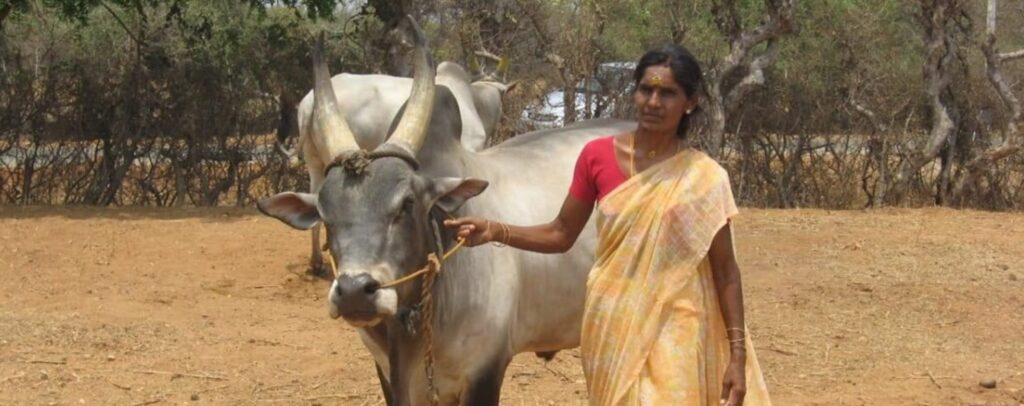
Soundaram Ramaswamy resided in Kathasamipalayam village, in western Tamil Nadu’s Tiruppur district. People called her “Kalakara Amma,” the Bull Lady
The bulls were the first thing visitors noticed. Seven of them, huge and muscled, grazing under acacia trees in the heat of Tamil Nadu’s drylands, when a reporter from The Hindu visited in 2012.
They were Kangayam cattle, a native breed once counted in the hundreds of thousands. Now their numbers are falling fast. A short woman in a mustard sari would walk up to the biggest of them, put her hand on his face, and lead him calmly away, as though the animal had decided long ago that he could trust her.
She spent nearly every waking hour with those bulls. She took them out to graze. She brought them water mixed with feed so they stayed strong. She trained them to be gentle, even when age and instinct might have made them dangerous. She rarely travelled. Her mother ran the kitchen. Her life was here.
Her name was Soundaram Ramaswamy of Kathasamipalayam village, in western Tamil Nadu’s Tiruppur district. People called her “Kalakara Amma,” the Bull Lady. That is how Karthikeya Sivasenapathy, a cattle-breed conservation advocate who had known her since the late 2000s, introduced her to others.
She was perhaps the only woman bull-keeper in the region, and one of the very few anywhere who kept so many stud bulls used for natural breeding. Nearly every day, farmers travelled long distances so their cows could be serviced. She stayed beside the animals the entire time. “My bulls need me beside them all the time,” she once said.
What she was doing mattered far beyond her village’s boundaries. Kangayam cattle can survive droughts. They thrive on tough grasses that would not sustain other animals. For generations they helped plough farms, haul loads and support rural livelihoods. But tractors replaced bullocks. Imported dairy breeds replaced native ones.
She protected more than cattle. Ten acres of her land were dedicated to korangadu, a traditional dryland pasture system with 29 species of trees and shrubs. The United Nations once called it a “globally important agricultural heritage system.” Others nearby were selling these lands for development. She did not.
She was honoured with the National Biodiversity Authority’s Breed Saviour Award. Her work was later presented at the UN Convention on Biological Diversity in Nagoya. She became a quiet symbol of rural conservation, admired by farmers, students and scientists.
When she whistled, the bulls came running to her. They would stand beside her like children, waiting. She devoted herself to a living heritage that could have been lost without people like her.
She died, aged around 59, on December 2, 2025. She leaves behind her family, her community and a breed that is a little safer because she refused to let it disappear. Her legacy will continue to graze those fields, heads lifted, listening for a familiar whistle.
(Published under Creative Commons from Mongabay India)