‘Hollow Symbolism And Ideological Betrayal’
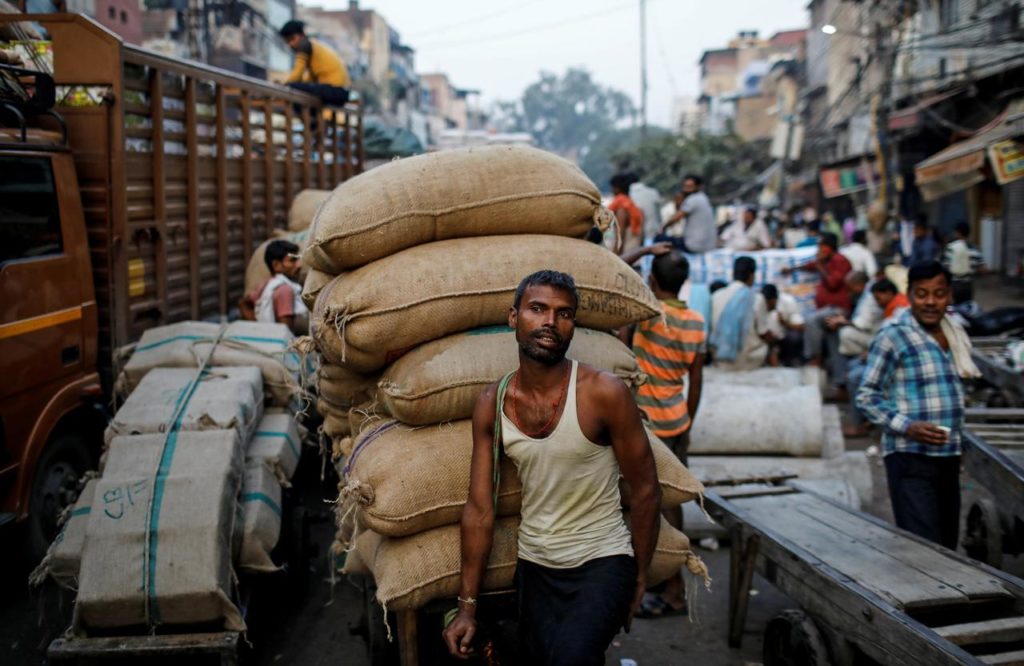
FILE PHOTO: A migrant labourer waits to pull his handcart at a wholesale market in the old quarters of Delhi. Congress leader Randeep Surjewala has alleged that the Centre’s MGNREGA revamp hits rural livelihoods, impacting nearly 50 crore people; he also accused the BJP of propaganda
Congress leader Randeep Singh Surjewala on Saturday launched a sharp and wide-ranging attack on the Narendra Modi-led government over its decision to replace the Mahatma Gandhi National Rural Employment Guarantee Act (MGNREGA), accusing the BJP of undermining the livelihoods of India’s rural poor through what he described as “hollow symbolism and ideological betrayal.”
Addressing a press conference in Bhubaneswar, Surjewala alleged that the Centre’s move to introduce the Viksit Bharat–Guarantee for Rozgar and Ajeevika Mission (Gramin) Act had weakened the very foundation of rural employment security and would adversely affect nearly 50 crore people across the country. “MGNREGA was not just a scheme; it was a legal guarantee of work and dignity,” he said. “By dismantling it, the BJP has struck at the backbone of rural India.”
Drawing a contrast between symbolism and substance, the Congress MP said, “For the last 11 years, Mahatma Gandhi’s spectacles have been used for propaganda, but his ideals have been ignored. Similarly, the BJP rode to power in the name of Lord Ram, only to abandon his values. This is the BJP’s model of governance — symbolism without substance.”
Calling MGNREGA a “lifeline for the marginalised,” Surjewala claimed that its replacement would directly impact around 12.5 crore poor, tribal, Dalit and backward class workers. “When you include their families, the consequences touch nearly 50 crore lives,” he said. “This is not a policy tweak; it is a direct assault on survival.”
Surjewala also criticised the structural shift from a demand-driven law to what he termed a centrally controlled programme. “Under MGNREGA, any rural worker could go to the panchayat and demand work,” he said. “If employment was not provided within the stipulated time, wages had to be paid. That was the guarantee. Under the new law, decisions will be taken in Delhi — which state, which district, which village will get work, and how much.”
He further targeted the funding model of the new scheme, pointing out that while MGNREGA was entirely funded by the Centre, the new framework requires states to contribute 40 per cent of the cost. “States simply do not have the financial capacity to bear this burden,” Surjewala argued. “The inevitable outcome will be the gradual suffocation of employment opportunities for the rural poor.”
Reinforcing the party’s opposition, Odisha Congress in-charge Ajay Kumar Lallu announced a statewide agitation titled ‘MGNREGA Bachao Sangram’. “From January 10 to February 25, we will take this fight to the people,” Lallu said. “Public meetings will be held from the district level to the state level to expose how this law has delivered a severe blow to rural livelihoods.”
As the Congress intensifies its campaign, the future of rural employment — and the competing visions surrounding it — is set to become a major political flashpoint in the months ahead.