Wuhan Lab Leak Theory Back After WHO Chief’s Reference
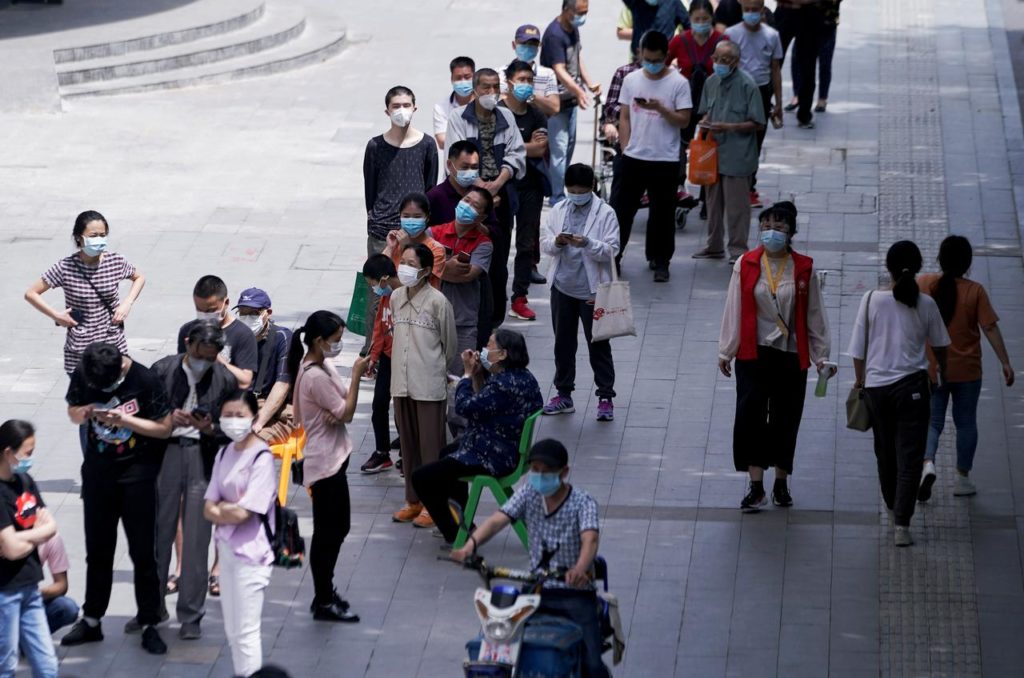
FILE PHOTO: Residents wearing face masks queue for nucleic acid testings in Wuhan, the Chinese city hit hardest by the coronavirus disease outbreak in Hubei province, China on May 16, 2020
The Wuhan lab leak theory has been thrust back into the spotlight after the WHO chief reopened the hypotheses that the coronavirus seeped from its facilities.
World Health Organisation director Tedros Adhanom Ghebreyesus on Tuesday said the laboratory leak was the “least likely” hypotheses, but still needed “further investigation.”
China says full access was given to the lab and has hit out at the “politicisation” of the investigation into the cause of the global pandemic.
But Tedros has kept alive a notion that WHO experts had earlier doused as “highly unlikely”.
Here are some key facts about the Wuhan Institute of Virology’s lab:
High security
The institute houses a lab with a biosafety rating of “P4” — the highest possible — which is determined by the level of danger and resulting security measures posed by the pathogens studied there. P4-level pathogens include those that cause diseases such as Ebola.
The P4 lab is Asia’s first and was built at a cost of 300 million yuan ($42 million), opening in 2018. It houses the largest virus bank in Asia, with more than 1,500 strains.
A P3 lab — the biosafety level that includes coronaviruses — has been in operation at the site since 2012.
Critical research
The institute studies some of the world’s most dangerous diseases and previously conducted extensive investigations into the links between bats and disease outbreaks in China.
Its scientists helped shed light on the Covid-19 pathogen in the early days of the outbreak in Wuhan.
In February 2020, researchers there published work concluding that the genetic makeup of the new virus was about 80 percent similar to the SARS coronavirus, and 96 percent identical to a coronavirus found in bats.
Many scientists think the virus that causes Covid-19 originated in bats and may have jumped to people via another still-undetermined mammal, and gained traction among humans in late 2019 at a wet market in Wuhan where wildlife species were sold as food.
Liang Wannian, head of the Chinese contingent of the WHO mission, said at the mission’s conclusion that animal transmission remained the likely route, but “the reservoir hosts remain to be identified”.
The ‘lab leak’
Previous US diplomatic cables reported by the Washington Post had revealed concern in Washington about safety standards in the Wuhan facility.
Shi Zhengli, one of China’s leading experts on bat coronaviruses and deputy director of the P4 lab, further raised eyebrows in a June 2020 interview with Scientific American magazine in which she said she was initially anxious over whether the virus had leaked from her lab.
Subsequent checks revealed that its gene sequence differed from viruses held at the lab, and Shi said she would “bet her life” that there was no leak, according to Chinese state media.
But the theory was kept alive by the likes of Trump and his former Secretary of State Mike Pompeo. Pompeo insisted last year that there was “significant evidence” that the virus came from the lab, while offering no such proof.
Prominent global publications including Le Monde and the Wall Street Journal, as well as scientists at Harvard and Stanford, also kept the theory alive by publishing articles or reports saying it was a possibility.
WHO conclusions
The WHO team’s mission to Wuhan included a stop at the virology institute, where they met with Chinese scientists including Shi.
The team’s leader Peter Ben Embarek said at the end of the mission that the lab-leak theory was “extremely unlikely” and “not in the hypotheses that we will suggest for future studies.”
The mission found nothing to overturn the general consensus within the scientific community that the pathogen appeared to be of natural origin.
Doubts persist
But questions about the lab persist, with critics noting that the WHO team’s investigative hands may have been tied by strict parameters set by its Chinese hosts.
Team members spent only four hours at the virology institute, just an hour at the wet market, and several days inside their hotel without venturing out into the city.
In a subsequent interview with AFP, Embarek voiced “frustration” at lack of access to raw data while in China.
On the laboratory accident hypothesis, he told reporters on Tuesday that Chinese lab staff had acknowledged they initially feared a leak.
“Even the staff in these labs told us that was their first reaction,” Embarek said.
“They all went back to their records… but nobody could find any trace of something similar to this virus in their records or their samples.”