Why Tackling Air And Water Pollution In India Is Not Complex But Straightforward
Bringing down levels of air and water pollution in India is not as Herculean a task as it is made out to be. The solution is rooted in acknowledgement of the causes of pollution, execution of extant policies and measures to stop this pollution and ensuring it does not recur. It is really as straightforward as that
Like clockwork, India’s northern areas, especially the National Capital Region (NCR), experience suffocating air pollution every winter, particularly between late November and late January.
This is apart from the presence of polluted rivers like the Ganga and Yamuna and other water bodies across the Indo-Gangetic plains.
The same story is repeated every year, and the same noises are made across media platforms, like a broken record, by ‘experts’, activists and roving commentators. Meanwhile, the situation on ground remains unchanged, even worsening in some aspects.
Some reasons why air and water pollution remains rampant in India is the apathy endemic to government institutions which are responsible for keeping pollution under check and the shocking lack of civic sense that is the bane of life in this country.
Government bodies like the Central Pollution Control Board, supported by State Pollution Control Boards and Pollution Control Committees, come under the aegis of the Ministry of Environment, Forest and Climate Change (MoEF&CC). There are mechanisms in place to aid each of these entities to achieve their executive aims; unfortunately, they are overwhelmingly tied up in red tape and bureaucratese and that ends up hampering their working.
The result: the same scenario is repeated every year. Air pollution in north India is variously attributed to setting off of Diwali firecrackers, farm fires and vehicular emissions. All these factors can be easily brought under control. Creating awareness about the damage caused to air quality by firecrackers is not rocket science. Similarly, farm fires can be stopped by making farmers cognizant of the irreversible effects of the practice. Keeping vehicular emissions within legally-permissible limits is more a measure of policing than anything else. There are processes in place to take off road old, polluting vehicles; it’s only a matter of strict implementation of rules and regulations.
Diverting heavy vehicles from city limits and thus preventing them becoming a factor in air pollution is also a common sense solution.
Kindred policy and execution structures can be followed where water pollution is concerned. The poor condition of India’s two largest and most revered rivers – Ganga and Yamuna – is a matter of shame for its citizens.
Pollution in these two ancient rivers is caused largely by industrial waste, untreated sewage, agricultural runoff, religious offerings, presence of plastic and human/animal remains. These factors lead to overload at treatment facilities, causing high bacterial loads and toxic contamination. This is especially true in urban areas like Delhi and along the Indo-Gangetic plains.
A look at polluting factors in detail:
- Untreated Sewage: Most domestic wastewater from cities is discharged directly into the rivers, containing high organic matter and disease-causing bacteria.
- Industrial Effluents: Factories release untreated chemical waste, heavy metals (such as chromium), and toxic substances.
- Agricultural Runoff: Fertilizers and pesticides from farms flow into the rivers, contributing to pollution.
- Religious Practices: Immersion of idols (often coated with lead or chrome paints) and puja items, along with dumping of flowers and food, introduce toxins and solid waste.
- Solid Waste & Plastics: Plastic debris clogs the rivers, especially the Yamuna, in cities like Agra.
- Human & Animal Remains: Bodies and animal carcasses are disposed of directly into the water.
The Ganga river passes through numerous large cities, with much of the sewage untreated; this results in elevated microbial levels.
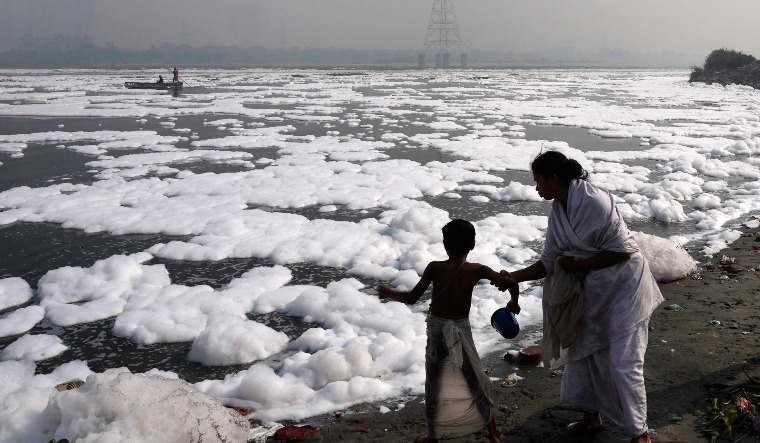
The Yamuna, on the other hand, is heavily polluted in Delhi. While only a small fraction of the river’s water reaches the city, Delhi contributes 76% of the pollution, including toxic foam from chemicals (visible in the photograph above). The cumulative result is degraded water quality, with bacteria exceeding safe limits and toxins harming ecosystems and human health.
The need of the hour is to deal with each of the factors listed above and do it within a stipulated duration. It’s a no-brainer that before drainage into the Yamuna river, sewage can be treated properly at the 37 to 42 operational Sewage Treatment Plants (STPs) in Delhi. These have a combined capacity of roughly 600-700 MGD (Million Gallons per Day).
Dealing with stopping the discharge of industrial effluents into rivers needs political will more than anything else. The harmful effects of effluents being callously channelled into rivers to maximise profit are hidden from no one. If only our political leaders could show some spine and end this practice once and for all. Preventing agricultural runoff, solid waste and plastics, and human and animal remains from being drained into rivers, again, requires strict prevention and penalties. Where religious practices are concerned, raising awareness about the damage done to water bodies because of idol immersion and then stopping the rituals from being carried out (as is) is the need of the hour.
As evident from the elements discussed above, bringing down levels of air and water pollution in India is not as Herculean a task as it is made out to be. The solution is rooted in acknowledgement of the causes of pollution, execution of extant policies and measures to stop this pollution and ensuring it does not recur. It is really as straightforward as that.
Anyone telling you otherwise or obfuscating the way leading to finding a solution to pollution is, unfortunately, bound to have ulterior motives and a hidden agenda.