This Is Why Parliament Must Debate The Iran War
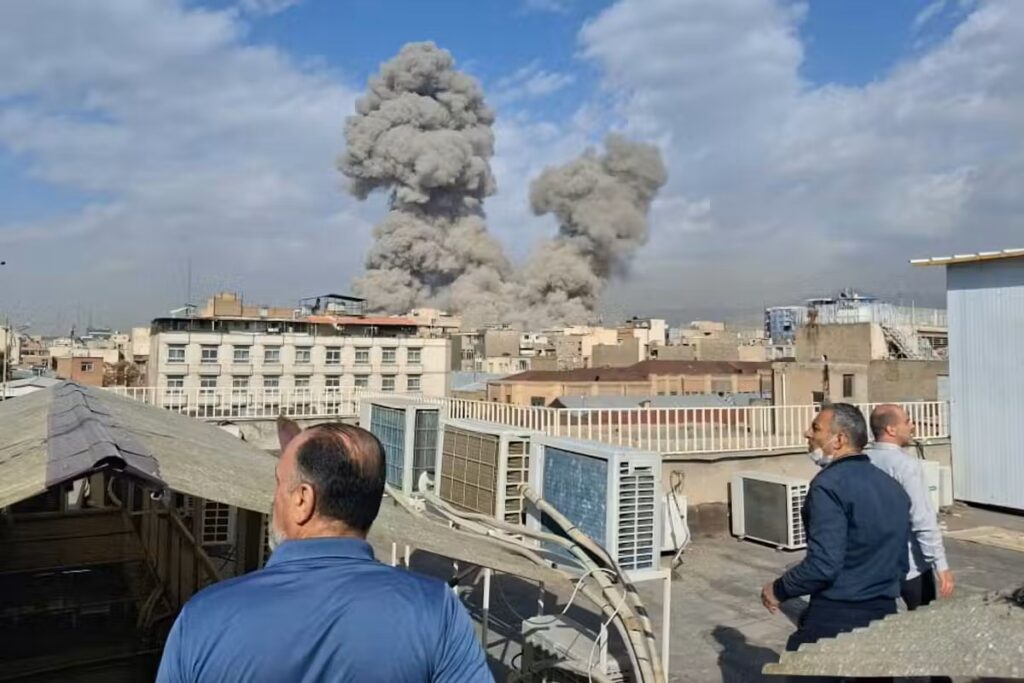
Iranians watch as explosions erupt across Tehran in early March 2026 (AP Photo)
The ongoing conflict involving Iran, Israel, and the United States has rapidly evolved into a major geopolitical crisis with far-reaching consequences. For a country like India—deeply connected to West Asia through energy dependence, trade, and a vast expatriate population—the implications are immediate and profound. Yet, despite repeated demands, a full-fledged discussion in the Parliament of India has not taken place.
The government has argued that a statement by External Affairs Minister S. Jaishankar suffices. However, a brief statement cannot substitute for a comprehensive parliamentary debate. At stake are questions of foreign policy, national security, energy stability, and the safety of millions of Indian citizens abroad. A democratic system requires that such issues be debated openly and thoroughly.
The Limits of Official Statements
While S. Jaishankar has asserted that the government is acting in the national interest, the precise contours of that “national interest” remain unclear. Parliamentary debate is essential not merely for information-sharing but for scrutiny. It allows elected representatives to question assumptions, test policy decisions, and demand clarity on critical issues.
Without such a discussion, Parliament is left with broad assurances rather than detailed explanations. What assessments guided India’s diplomatic positioning? What contingency plans exist for escalation? These are not peripheral questions—they are central to governance in a time of crisis.
Foreign Policy and Strategic Signalling
One of the key concerns that merits parliamentary scrutiny is India’s diplomatic posture during the early stages of the conflict. Prime Minister Narendra Modi’s engagement with Israeli leadership, including Benjamin Netanyahu, took place against the backdrop of rising tensions.
Such engagements inevitably carry symbolic weight. In geopolitics, timing and messaging are as important as policy substance. A high-level visit during a period of imminent conflict can be interpreted as tacit endorsement, even if that is not the intention.
Equally significant is the absence of strong public messaging in support of diplomatic negotiations at a critical moment. While India has historically advocated dialogue and peaceful resolution, the lack of visible, timely articulation of this stance raises questions about consistency in foreign policy. Parliament provides the appropriate forum to examine whether India’s actions aligned with its long-standing principles.
Energy Security at Risk
India’s dependence on West Asia for oil and gas makes the conflict an immediate economic concern. A significant portion of global energy supplies passes through strategic chokepoints such as the Strait of Hormuz. Any disruption in this corridor can have cascading effects on fuel prices, inflation, and overall economic stability.
Given these risks, Parliament must be informed about the country’s preparedness. What are India’s current energy reserves? Are there alternative supply arrangements in place? How does the government plan to mitigate price shocks?
Energy security is not an abstract policy issue—it directly affects households, industries, and the broader economy. Transparent discussion in Parliament would not only reassure citizens but also enable informed policy inputs from across the political spectrum.
Safety of Indian Citizens Abroad
Perhaps the most urgent concern is the safety of Indian citizens in the conflict zone. Millions of Indians live and work across West Asia, forming one of the largest expatriate communities in the world. In addition, Indian students in Iran and other countries face immediate risks as the conflict intensifies.
Reports of distress signals from students and workers underscore the urgency of the situation. Parliament must be apprised of evacuation plans, emergency protocols, and coordination mechanisms with host governments.
The safety of citizens abroad is a fundamental responsibility of the state. A parliamentary debate would ensure that this issue receives the attention and urgency it deserves, while also allowing representatives to convey the concerns of affected families.
Regional Cooperation in South Asia
The crisis is not limited to India alone. Other South Asian countries—such as Bangladesh, Nepal, and Pakistan—also have large numbers of citizens working in West Asia. This shared vulnerability presents an opportunity for regional cooperation.
India, as a major regional power, could take the lead in coordinating efforts to ensure the safety of South Asian migrant workers. Joint evacuation plans, shared resources, and diplomatic coordination could significantly enhance the effectiveness of response measures.
Parliamentary discussion can help shape such initiatives by fostering consensus and encouraging proactive regional engagement.
Maritime and Security Concerns
The conflict has also raised concerns about maritime security in the Indian Ocean region. Incidents involving naval activity and attacks on vessels highlight the potential risks to shipping lanes and coastal security.
India has long aspired to play the role of a “net security provider” in the Indian Ocean. However, recent developments raise questions about the extent to which India is prepared to fulfill this role under challenging circumstances.
Parliament must examine whether India was adequately informed about regional security developments and how it is responding to emerging threats. Such discussions are vital for evaluating defence preparedness and strategic capabilities.
The Multilateral Dimension
The Iran conflict has broader implications for the global order. Many countries have expressed concern about unilateral actions and the erosion of international norms. Organizations such as BRICS and regional groupings like ASEAN have called for dialogue and adherence to international law.
As a prominent voice in the Global South, India has an opportunity to play a constructive role in promoting diplomacy and multilateral engagement. However, this requires clarity of vision and consistency in approach.
Parliamentary debate can help articulate India’s position on these issues and explore whether existing platforms can be leveraged for mediation or conflict resolution.
Democratic Accountability and Representation
At its core, the demand for a parliamentary debate is about democratic accountability. Opposition parties represent a substantial portion of the electorate, including families of those directly affected by the conflict.
In a democratic system, Parliament is not merely a legislative body but a forum for national dialogue. Major international crises with direct domestic implications must be discussed openly, allowing diverse perspectives to be heard.
Denying such a discussion risks undermining public trust and weakening democratic institutions. Transparency and accountability are essential, particularly in times of uncertainty.
The conflict involving Iran, Israel, and the United States is not a distant geopolitical event—it is a crisis with immediate consequences for India’s security, economy, and citizens. From energy supplies and maritime safety to the welfare of millions of Indians abroad, the stakes are too high to be addressed through limited statements alone.
A comprehensive debate in Parliament is not just desirable; it is necessary. It would provide clarity, ensure accountability, and enable a more robust national response. In moments of global instability, democratic institutions must rise to the occasion, offering both scrutiny and solutions.
The questions surrounding India’s foreign policy, preparedness, and strategic direction will not disappear. Addressing them in Parliament is the first step toward ensuring that the country navigates this crisis with foresight, responsibility and unity.