Strict Action Needed To End Overspeeding Deaths By Reckless Rich Brats
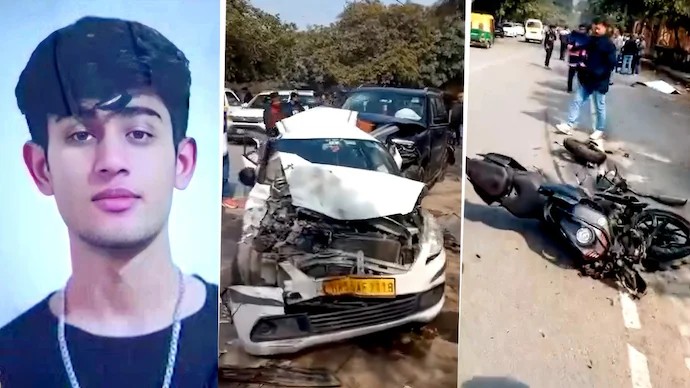
Sahil Dhaneshra (aged 23) was killed when an overspeeding SUV driven by a juvenile crashed into his bike head-on, in Dwarka on February 3, 2026
In yet another incident of overspeeding with fatal consequences, a Delhi teenager caused his SUV to hit a biker head-on, leading to his death. This incident took place in NCR’s Dwarka on February 3 but only became known in the past few days due to a sustained media campaign.
The biker, 23-year-old Sahil Dhaneshra, was flung around 50 ft into the air and died of wounds suffered due to the speed of the SUV and the reckless manner of its driving.
Being a juvenile (17 years old), the driver of the SUV cannot be named. But his actions will ring ominously in the life of Sahil’s mother Inna Maakan and friends. This was not the first time he was overspeeding – 13 challans were issued to the same vehicle previously, for the same offence of overspeeding.
This indicates that there were multiple warning signs that no one paid heed to; those responsible for the juvenile’s actions – his parents – have as much blood on their hands as the juvenile himself. Shockingly, he has been allowed to write his board exams and is currently out on bail.
This is not a rare incident. In the past too, whether in Pune or NCR (including Delhi, notoriously), rich brats driving their expensive SUVs or sedans, have caused many lives to be lost untimely.
In the Sahil Dhaneshra case, the juvenile was accompanied by his sister, who was making reels for social media, as her brother drove the SUV recklessly, ultimately leading to Sahil’s tragic death.
Now, Sahil’s mother Inna, who brought him up on her own (as a single mother), is left to deal with the unfathomable void left by his passing. A young life, full of dreams and plans for the future, was cut short so lamentably. If only the juvenile driver had been disciplined at home and not allowed to indulge in underage driving – Sahil might have been alive today.
What is needed is strict enforcement of penalties for overspeeding and instilling the fear of the law among reckless drivers. Unless that happens, Indians will keep waking up to devastating news of an innocent life cut short by impetuous drivers high on privilege and lack of accountability.
Overspeeding leading cause of road accidents in India
According to figures available for the year 2023, over 1.73 lakh people were killed in road accidents; the major cause of these accidents was overspeeding.
India witnessed a grim surge in road accidents in 2023, with over 1.73 lakh fatalities and nearly 4.48 lakh injuries, as per the National Crime Records Bureau (NCRB) report. This marks a 1.6% rise in deaths from 1.71 lakh in 2022, alongside a total of 4,64,029 accident cases—an increase of 17,261 from the previous year. Two-wheelers bore the brunt, accounting for 45.8% of all deaths (79,533), followed by pedestrians at 15.9% (27,586) and SUV/car/jeep occupants at 14.3% (24,776).
The primary culprits behind these tragedies were reckless drivers. Over-speeding contributed to 58.6% of fatalities (1,01,841 deaths), while dangerous or careless driving, including overtaking, caused 23.6% (41,035). Other factors like poor weather, driving under the influence of drugs or alcohol, and animal crossings accounted for 2.8% (4,952 deaths). These statistics underscore the urgent need for stricter enforcement of traffic laws and awareness campaigns to curb preventable losses.
Accidents peaked during evening hours, with 20.7% occurring between 6 pm and 9 pm (95,984 cases), 17.3% from 3 pm to 6 pm (80,482), and 15% from noon to 3 pm (69,397). This pattern suggests heightened risks during rush hours, possibly due to fatigue, haste, or increased vehicle density.
State-wise data reveals stark disparities. Uttar Pradesh reported the highest number of SUV/car/jeep fatalities (4,768 out of 24,776, or 19.2%), and truck/lorry/mini-truck deaths (4,138 out of 13,823, or 29.9%). Tamil Nadu and Uttar Pradesh dominated two-wheeler deaths, with 11,490 (14.4%) and 8,370 (10.5%) respectively. In places like Andaman and Nicobar Islands, Jharkhand, Punjab, Bihar, and Uttar Pradesh, fatalities exceeded injuries, indicating severe accident impacts. For instance, Andaman and Nicobar saw 27 deaths from 25 accidents, while Uttar Pradesh recorded 23,947 deaths from 37,764 incidents.
Expressways, despite their design for safety, were not spared, with 3,630 accidents resulting in 2,372 deaths and 2,762 injuries. National Highways accounted for 34.6% of total deaths (60,127), followed by State Highways at 23.4% (40,611). Uttar Pradesh led on National Highways with 11.7% of fatalities (7,041), trailed by Tamil Nadu (10.4%, 6,258), Maharashtra (8.5%, 5,104), Karnataka (7%, 4,230), and Madhya Pradesh (7%, 4,184).
These figures highlight systemic issues in India’s road safety framework. While infrastructure improvements and technology like speed cameras are steps forward, behavioral changes and better enforcement are crucial. The NCRB data serves as a wake-up call for policymakers to prioritize road safety measures, potentially through stricter penalties for violations and public education to reduce the toll on lives and families.