Startups Seek High-Tech Solutions To Colossal Food Waste
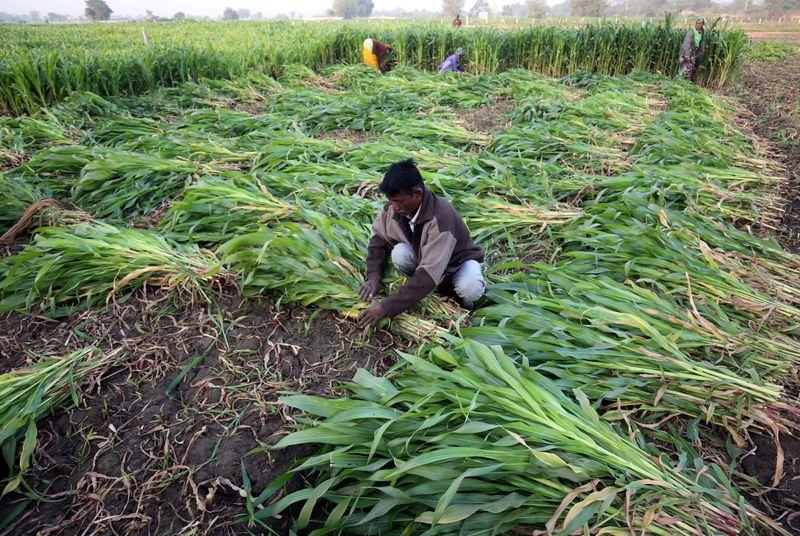
FILE PHOTO: A farm worker harvests maize crop in a field on the outskirts of Ahmedabad, Gujarat
Startups and venture capital are pouring into what might seem an unlikely place: India’s vast, outdated agriculture industry.
Seizing on controversial new deregulation, entrepreneurs are selling farmers apps to connect them to big buyers nationwide and using artificial intelligence (AI) to improve the rickety supply chains that lose one-fourth of India’s produce to wastage.
Enormous amounts of India’s grain, fruit and vegetables rot between farm and table because of manual handling, repeated loading and unloading, poor inventory management, lack of adequate storage and slow movement of goods. This rate of wastage from faulty supply chains is four to five times that of most large economies, experts say.
Prime Minister Narendra Modi’s government introduced changes it calls a watershed that will “remove middlemen and let farmers sell their produce directly to buyers,” improving their prospects, especially in far-flung areas.
Modi’s September overhauls, potentially the biggest reform ever to India’s massive farm economy, let farmers sell to institutions and big retailers such as Walmart, not just to regulated wholesale markets.
But farmers fought back with disruptive national protests and Modi lost a cabinet minister from breadbasket state Punjab over concerns that the deregulation might endanger government-guaranteed minimum prices for produce.
The farm sector contributes nearly 15% of the output of India’s $2.9 trillion economy and employs around half its 1.3 billion people.
HIGH-TECH SPUDS
Producers and buyers are looking for business, helped by high-tech gear backed by big investors.
Some 85% of India’s farmers own less than 2 hectares (5 acres) of land and lack the means to sell beyond local markets, even if that means forgoing better prices.
Potato farmer Rakesh Singh in Uttar Pradesh said he is keen to get computer-enhanced tools to help his business in India’s most populous state.
“Real-time prices available on live electronic trading platforms and easy-to-use trading apps for mobile phones make the process of price discovery and selling goods a transparent and hassle-free experience for us,” he told Reuters.
Singh is looking forward to a trading app from Farmpal Technologies Pvt Ltd, a small firm based in Maharashtra, targeting heartland states with technology that connects producers directly with retailers, its software predicting market conditions and managing inventories accordingly.
“As a two-year-old startup, we’ve seen the transformative nature of AI, which drastically reduces food waste and helps farmers get better prices, and buyers get better quality with a predictable supply chain,” said Farmpal founder Puneet Sethi.
Affordable mobile phones and ultra-cheap data make it easier for farmers to go electronic.
Mark Kahn, managing partner of Omnivore Capital, a venture capital firm that funds farm-tech companies, estimates $1 billion will flow into India’s agritech sector each year with startups growing 20% to 30% annually.
“The new law will have an immediate impact, and there is going to be a spurt in agritech startups,” Kahn said.
Sequoia Capital and Tiger Global have also funded agritech startups that aim to run the entire food supply chain.
Some firms will develop AI tools for assaying and warehousing, others will offer electronic platforms to connect farmers with mom-and-pop stores and large retailers.
Digitising the supply chain will generate data that firms will use to gauge demand, crop size and new season arrivals, said Farmpal’s Sethi.
Nukul Upadhye, co-founder of Bijak, another startup, said: “We provide farmers with a data set of good, reliable buyers from far-off places willing to pay a premium for the produce of their choice and quality. That way, we help both farmers and their buyers.”
But some growers, like Singh, will also continue to rely on existing markets that offer a level of protection.
“I don’t have 100% control over the quality of my crop, which will always be vulnerable to bad weather,” he said. “I know that agritech companies will reject my crop if it doesn’t meet their rigid quality standards.”