Smart Cities Mission Under Fire: ‘Nation Was Sold A Half-Baked Scheme’
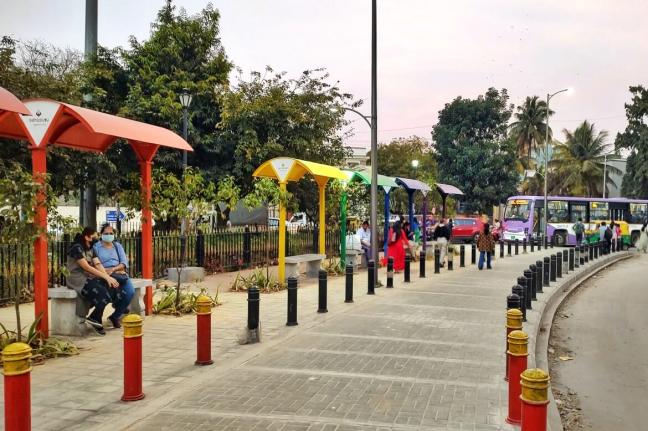
The pedestrian plaza at Balekundri Circle, Bengaluru. On March 31, Rahul Gandhi sharply criticised the Smart Cities Mission, calling it a “half-baked” scheme that failed to deliver meaningful and comprehensive urban transformation (Photo by Chetan Sodaye/WRI India)
The Smart Cities Mission, once projected as a flagship initiative to redefine urban India, is increasingly facing scrutiny over its real-world impact. On March 31, Rahul Gandhi sharply criticised the programme, calling it a “half-baked” scheme that failed to deliver meaningful and comprehensive urban transformation. His remarks reflect a growing concern that the initiative, despite massive financial outlays and political branding, may have fallen short of its ambitious claims.
Launched with the promise of creating technologically advanced, efficient, and citizen-friendly urban spaces, the mission aimed to position selected cities as models of development. However, critics argue that the gap between rhetoric and reality has become increasingly evident. Gandhi’s critique underscores a fundamental issue: the programme was marketed as a transformative vision for entire cities, yet its actual design focused only on limited, area-based interventions.
A Vision Narrowed By Design
At the heart of the criticism lies the mission’s structural approach. Rather than addressing systemic urban challenges across entire cities, the programme adopted what officials describe as an “area-based development” model. This includes retrofitting existing areas, redeveloping select zones, and building new greenfield projects, alongside broader “pan-city” initiatives. While this model was intended to create replicable examples of urban innovation, it has also meant that large portions of cities remain untouched by the initiative.
Gandhi argued that this limited scope undermines the very idea of a “smart city.” According to him, no urban centre can claim such a label without ensuring basic services like clean water, safe infrastructure, and breathable air for all residents—not just those living in designated pockets of development. His criticism highlights a deeper concern: that the mission prioritised visible, showcase projects over addressing foundational urban deficiencies.
This concern resonates with many urban observers who point out that persistent issues—such as water contamination, poor sewage systems, and uneven infrastructure—continue to plague Indian cities. In many cases, these problems coexist alongside isolated smart projects like upgraded roads, digital dashboards, or beautified public spaces. The contrast raises questions about whether the mission has truly improved quality of life or merely created islands of progress within otherwise struggling urban environments.
Moreover, Gandhi’s remarks in Parliament draw attention to the lack of clarity surrounding how success is defined. He questioned the criteria used to determine what qualifies as a “smart city” and what metrics are employed to evaluate outcomes. The absence of clear, transparent benchmarks makes it difficult to assess whether the mission has achieved its stated goals or simply met administrative targets.
Numbers Without Accountability?
In response to parliamentary queries, Tokhan Sahu presented an optimistic picture of the mission’s progress. According to government data, approximately ₹48,000 crore was allocated as the central share, with nearly 99% claimed and 98% reportedly utilised by early 2026. Additionally, thousands of projects have been completed, with only a small fraction still under implementation.
On paper, these figures suggest a high level of efficiency and execution. However, critics argue that financial utilisation and project completion rates do not necessarily translate into meaningful outcomes for citizens. Gandhi’s pointed question—“If everything is complete, then what exactly has changed?”—captures this skepticism. The emphasis on expenditure and project counts, he suggests, risks obscuring the more important question of impact.
This critique also raises broader concerns about accountability. Large-scale government programmes often rely on quantitative indicators—funds spent, projects completed, deadlines met—to demonstrate success. Yet such metrics can fail to capture qualitative improvements in people’s daily lives. For instance, a completed infrastructure project may look impressive in official reports but still fall short in addressing local needs or long-term sustainability.
The government has defended the mission by citing an evaluation conducted by NITI Aayog, which found the programme aligned with national development priorities and the Sustainable Development Goals. Officials argue that the initiative was never intended to overhaul entire cities at once but to create scalable models that could be replicated elsewhere.
However, this defense does little to address the core criticism: that the mission’s scope was misrepresented to the public. By framing a limited intervention as a comprehensive urban transformation strategy, the programme may have set expectations it was never designed to meet. This disconnect between promise and delivery has become a focal point in the ongoing political debate.
Furthermore, the reliance on pilot-style development raises questions about equity. If only select areas receive upgrades, what happens to the rest of the city? Critics argue that such an approach risks deepening existing inequalities, as better-resourced neighbourhoods are more likely to benefit from targeted investments, while marginalised communities continue to face neglect.
As the mission nears completion, the debate surrounding its legacy is intensifying. Supporters highlight the infrastructure improvements and technological advancements introduced in participating cities. Detractors, however, point to persistent urban challenges and argue that the programme has not fundamentally transformed the urban experience for most residents.
Ultimately, the controversy surrounding the Smart Cities Mission reflects a larger issue in public policy: the tension between ambitious narratives and grounded realities. While bold initiatives can inspire hope and mobilise resources, their success ultimately depends on how well they address the everyday needs of citizens.
Gandhi’s call for people to evaluate the mission’s impact in their own cities underscores the importance of lived experience as a measure of success. Beyond official statistics and political claims, it is the condition of roads, the reliability of water supply, the safety of public spaces, and the quality of air that will determine whether the mission has truly delivered on its promise.
As discussions continue, one thing is clear: the Smart Cities Mission has sparked an important conversation about what urban development should look like in India—and whether the country’s policy frameworks are equipped to meet the complex challenges of rapid urbanisation.