Shrinking Commons, Broken Routes Strain Nomadic Pastoralists
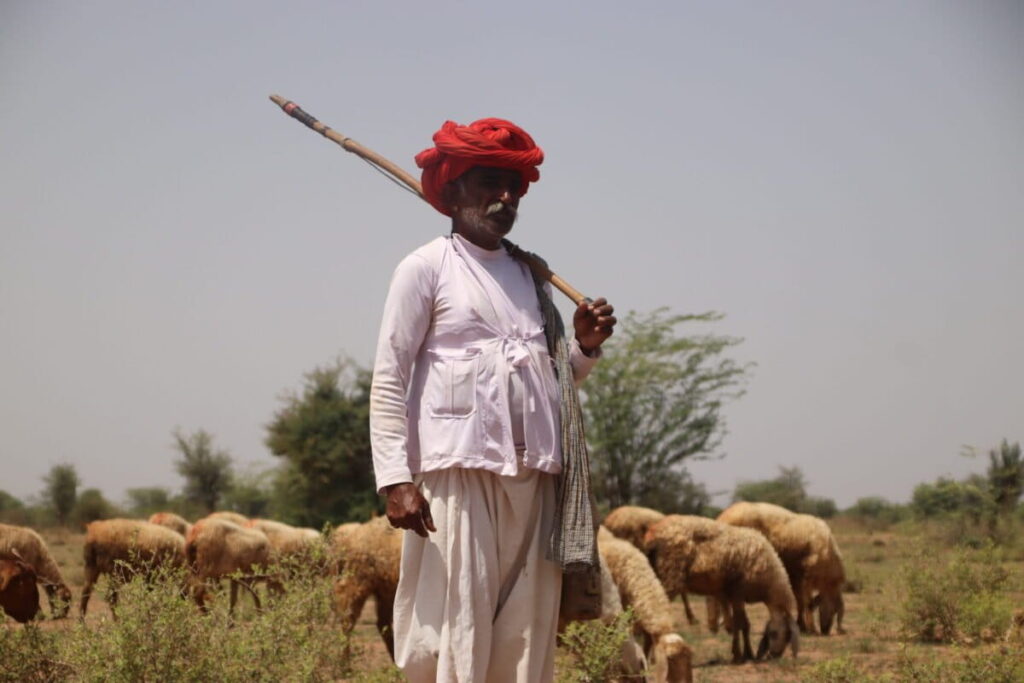
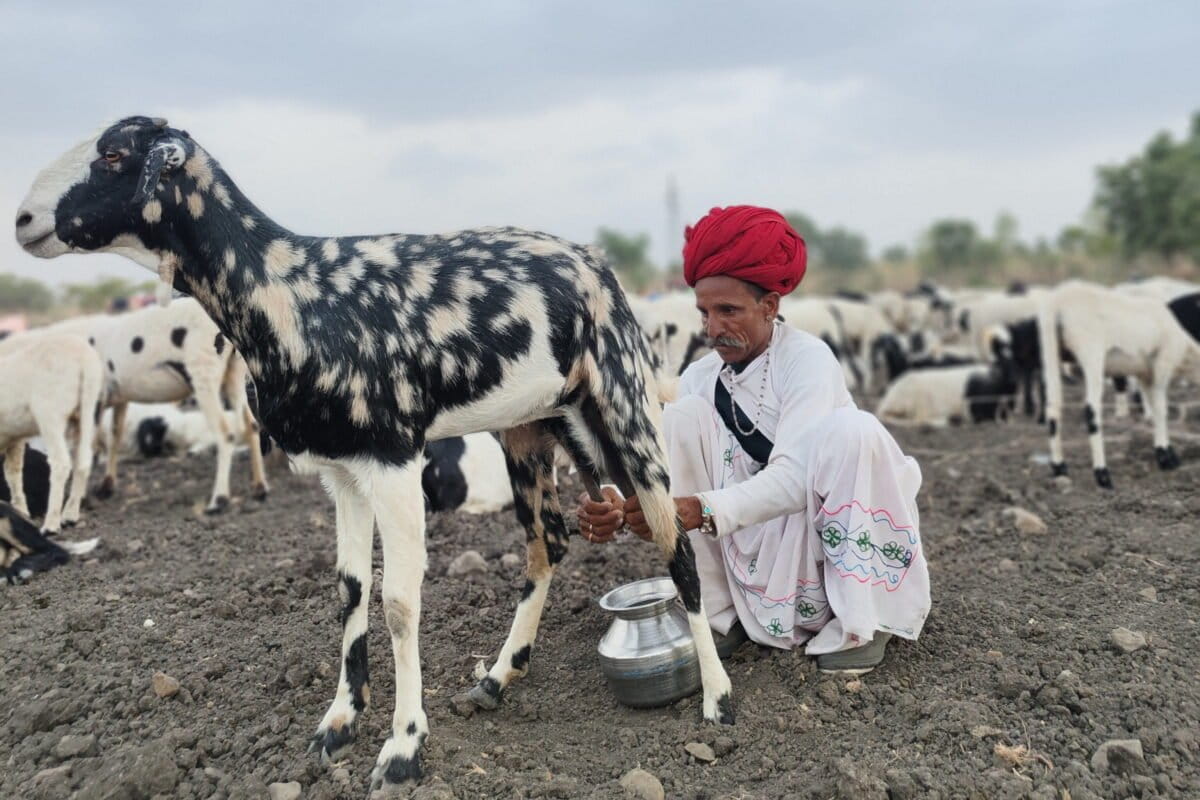
Nathuram Rabari, a Raika pastoralist, with his herd of sheep grazing in the backdrop. Over the years, the number of sheep he owns have drastically come down (Image by Aishwarya Mohanty)
- Highway expansion, fenced farms, village expansion and shifting land-use patterns have erased many of the Raikas’ century-old routes, forcing herders to walk longer distances or rely on trucks to move their livestock.
- The decline of on-farm hosting arrangements and tightened forest rules has intensified pressures for the community.
- As many young Raikas seek wage work in towns, migratory herding is declining, threatening the ecological functions of seed dispersal, soil fertility and grassland health that benefit semi-arid landscapes.
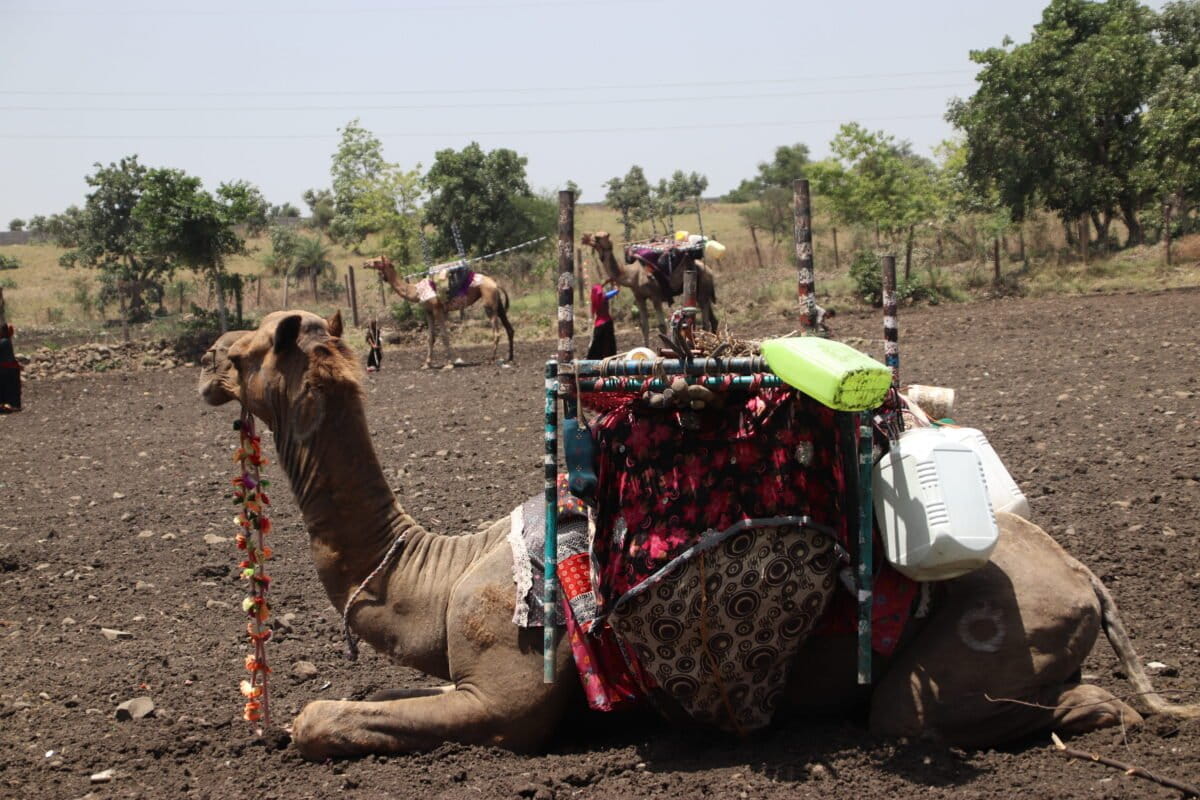
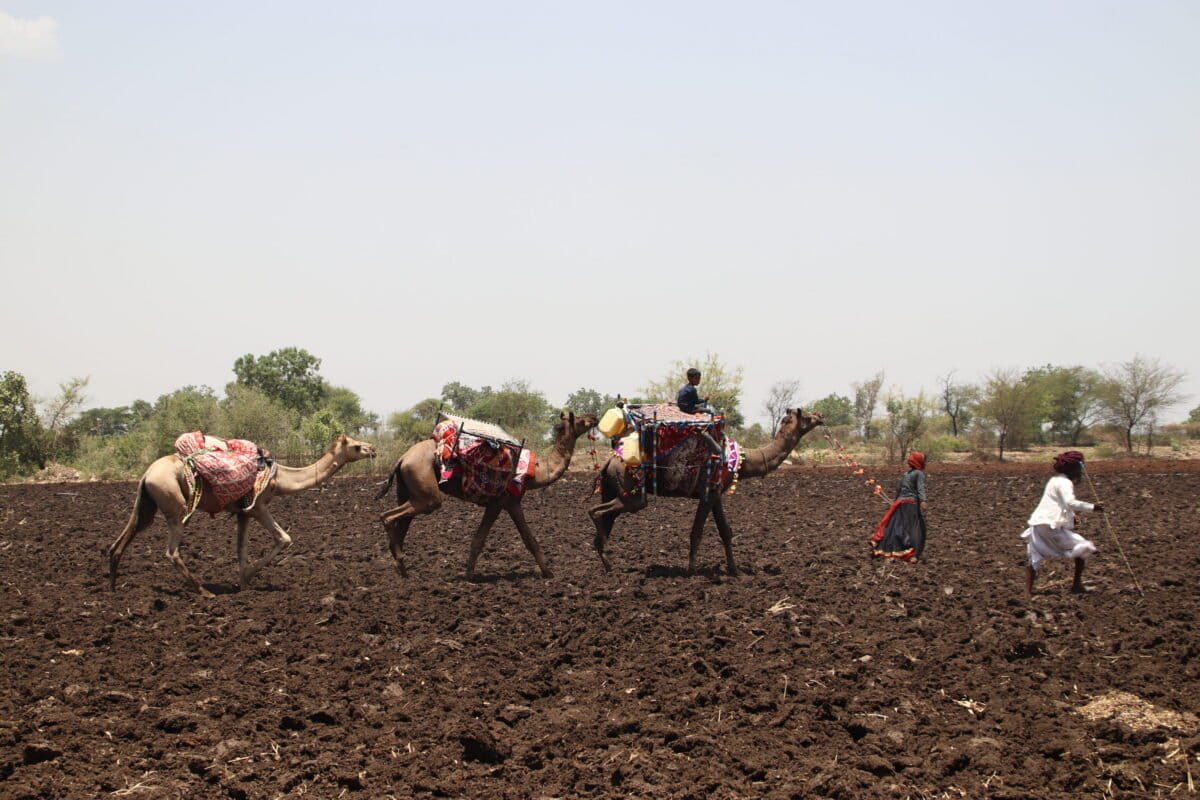
In Madhya Pradesh’s Neemuch district, Narayan Rabari, 42, walks with his sheep and camels, looking for fields with fodder. He has travelled on foot for over two days, covering 17 kilometres, but his journey is far from over. Since leaving his village in Rajasthan’s Pali district, Narayan has already covered nearly 300 kilometres, moving across highways, fenced farms and settlements where open grazing once existed. He belongs to the Raika community, a nomadic agropastoralist community from Rajasthan, which followed seasonal routes across western India.
Today, shrinking grazing lands, disappearing migration routes and declining access to commons are pushing the Raika pastoralists to the brink.
As younger generations leave herding for waged labour, older Raikas continue to migrate on foot, trying to sustain their traditional agropastoral system, now struggling to survive amid rapid land-use change.
Walking father, resting less
“When I was young, I remember there was grazing land around, not enough for all the cattle in the village, but still there. But over the years, the grazing open lands were converted into private farmlands; some were diverted for road construction,” Narayan said. “What remained hardly had any grass. It was all deserted,” he added. “There is no grazing land near our home.”
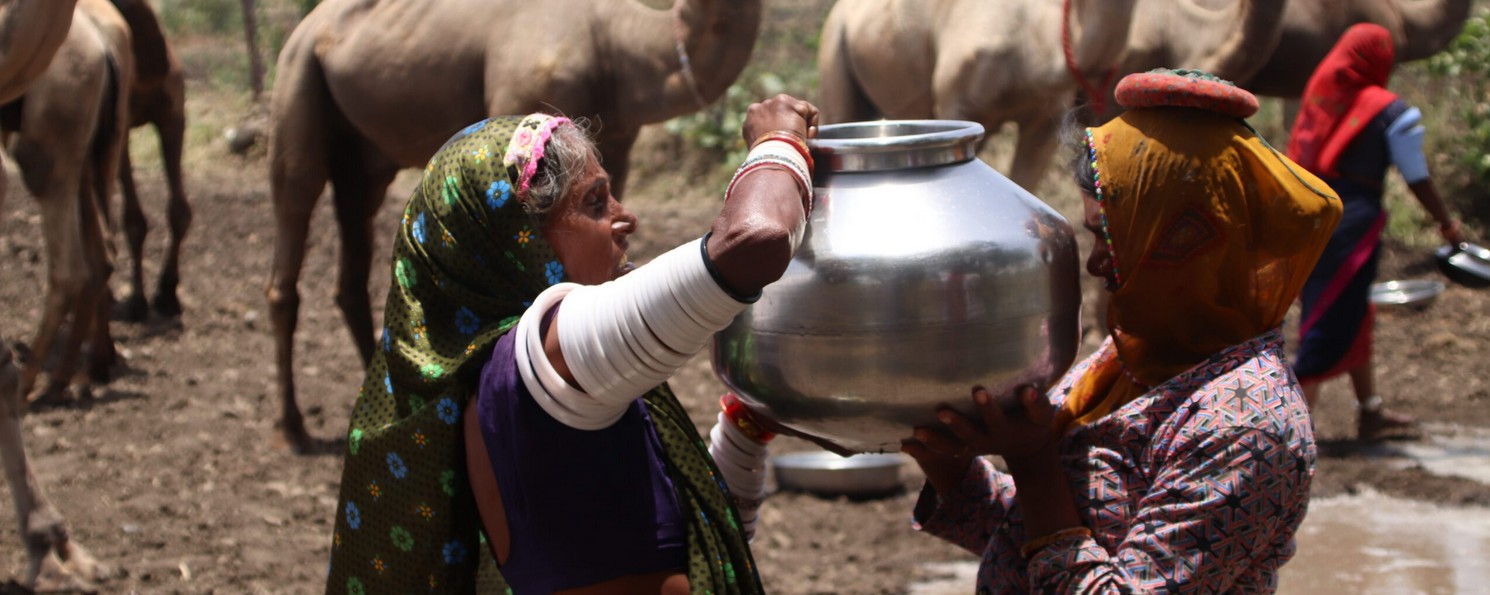
He began herding livestock at 10-years-old, joining his father on seasonal migrations. “Earlier, we had more camels, sheep and goats. But over the years, as their food became limited in areas around us and we walked longer distances looking for pasture land, it increasingly became difficult to manage a big herd. Diseases also became common in them. To sustain the cattle better, we had to sell off a few,” he said.
The traditional barter system that has long sustained pastoral communities still exists, but it is increasingly under strain. Along their migration routes, herders stay on farmers’ fields for a few days, exchanging manure from their livestock for grains, but access to such farms is now limited.
For generations, their herds of sheep, goats, and camels formed the basis of an agropastoral system that once depended on a wide mosaic of grazing commons, forest edges, fallows, and open migration routes, that are accessible to anyone. Today, these landscapes and pathways are rapidly shrinking, threatening their way of life. While there is no official data on the pastoral population in India, a report by non-governmental organisations League for Pastoral Peoples and LIFE Network, suggests that India is home to 46 pastoral communities. In Rajasthan, these include the Raikas, Raths, Gujjars, and Sindhi Muslims.
Traditional migration routes are disappearing
“Our long-distance migration began around 100 years ago,” says Hanwant Singh Rathore, founder of Lokhit Pashu-Palak Sansthan (LPPS), an organisation working with pastoral communities in western Rajasthan. “The traditional routes of the Raikas have completely disappeared,” he says, reflecting a common experience the Raikas narrate about how infrastructure development such as highways, roads, schools and more coming up on their traditional walking routes and conversion of common pasture lands into private farm lands with restricted access have changed their nomadic journeys.
Rathore adds that the earlier routes from Udaipur to Sadri are now highways where accidents are rampant. “At times, 50-60 sheep die in truck accidents,” Rathore says. “On those routes, there are now schools and government buildings. In other parts of the world, there are systems with dedicated corridors for pastoral communities. But here, there aren’t any. Because these routes have disappeared, many people have stopped migrating.”
The Raikas traditionally migrate in dholris, groups of 40 to 50 families travelling together. A dholri, meaning ‘bed’, represents a family unit, each led by a Patel (leader) who negotiates routes, camp sites and grazing arrangements.
“In the past, 50 dholris would move together,” says Rathore. “The Patel inspected and finalised the route, which changed every year.” Global studies also suggest that these leadership systems allow pastoralists to adapt routes annually, responding to rainfall patterns, fodder availability and informal agreements with farmers.
“At times, they walked extremely long distances. Now, because routes cutting through farms are blocked, they have started travelling by trucks,” he says about the patterns of their journey changing.
Bholaram Rabari, Narayan’s troupe leader, says, “Every time there is development, a few farms are given up and we have to travel to extreme interiors in search of farms.”
“When the farms were close by and we could walk from one farm to another, the time we spent on foot was lesser. A decade and a half ago we would walk 5 to 6 kms a day and camp at the next destination. Today we walk not less than 15 kms a day to get to the next farm, because all the farms are not accessible for us,” he said.
These longer distances have become especially difficult during peak summers and with the changing climate. “There are unseasonal rains now and summers are warmer than before,” Narayan says. “Walking on the roads is very difficult during peak summers. The heat makes us feel nauseous and weak, but we have to keep walking.”
Fragmented landscapes and declining grazing access
The landscape changes impacting the Raikas extend beyond routes. Rajasthan’s grazing ecosystems, gochar lands, orans (sacred groves), revenue wastelands and forest-edge pastures, are themselves under unprecedented pressure.
Commons in western Rajasthan account for around 34.75% of the geographical area. About half of this comprises cultivable waste lands, 21% fallow lands (other than current fallow), 14% uncultivable waste lands, 11% permanent pastures and 7% is village forests.
While there is no official data documenting the declining pasture lands, the 2019 livestock census recorded a 1.61% decrease in Rajasthan’s total livestock population.
“Availability of grazing land is directly linked to livestock,” says Rathore. “If there is not enough pasture land or there is not sufficient fodder to feed the livestock, how can the community sustain them?”
Mularam Rabari, 48, from Rajasthan’s Rani village says that the land they used to graze on close to their villages did not belong to any individual. “They belonged to all of us,” he says. “But now, the villages have expanded too and these lands have reduced. Some of these lands also fall under the purview of the forest department. So there is not enough access.”
The decline of on-farm hosting arrangements has further intensified pressures. Vikram Rabari, 34 from Dadai village says they stay on farms during their journey, grazing on crop residue and offering manure in return, a mutually dependent system. “But today, farmers increasingly rely on chemical fertilisers instead of livestock manure, and mechanised harvesting leaves less stubble for grazing,” he adds. “Many farmers have also started fencing their farms.”
Forest access has also tightened over time. After the Forest Rights Act (FRA) was implemented in 2006, many pastoral routes skirting forest patches became difficult to use as forest boundaries and rules were more strictly enforced. FRA recognizes vital traditional rights for pastoralists, including seasonal grazing, access to water bodies, and biodiversity in forest areas, but access to pastoral communities remains a challenge.
“The FRA recognises rights for forest-dwelling communities, but pastoralists who do not permanently reside inside forests often find themselves excluded,” says Vagtaram Dewasi, Founder, Adivasi Vikas Sangatha.
Researchers studying mobile pastoralism under the FRA framework, note that nomadic and semi-nomadic groups face greater restrictions because their traditional use patterns do not align neatly with the Act’s documentation requirements.
“There are several hurdles. One of the main challenges in their absence from gram sabha meetings as they are a nomadic community. Secondly, as they keep moving across multiple jurisdictions as these routes are also dynamic now, mapping these traditional routes becomes difficult to apply for claims. In such access their grazing rights are restricted,” Dewasi added. A Raika himself, Dewasi has been working for the grazing rights of the community.
For the Raikas, this has meant losing access to forest-edge shading points, water sources and resting sites that once formed essential components of their migration cycles.
Younger generations step away
As landscapes close in, the younger generation of Raikas is increasingly choosing to step away from herding. Many now take up wage labour in Gujarat’s industrial belts or seasonal construction work near cities.
“Almost 10 years ago, I decided to not migrate with my family, as there was hardly any return or income to sustain ourselves,” says Vikram. “I went to Gujarat, worked at construction sites and later returned to join my cousin in setting up a medicine shop.”
He adds that their families have a deep emotional connection with their herd. “It’s not easy to give up on pastoralism altogether,” he says. “This year, I have joined my uncles again on their migration.”
Parents are also prioritising education for their children. “We were very young when we started herding, but now we want our children to go to school,” he says. “They join us during holidays so they do not lose connection with the animals. But we are unsure of what the future holds for us and for our traditional livelihood system.”
Ecological value under threat
Pastoralism remains ecologically significant, especially in semi-arid regions. Several studies, both global and local, show that migratory herds play a key role in maintaining biodiversity by dispersing seeds across long distances, and enhancing soil fertility through manure. Pastoral mobility also allows landscapes to recover after grazing.
For the Raikas, the stakes are both environmental and cultural. Their seasonal migration routes have been shaped over generations, tied to rainfall cycles, fodder availability and relationships with farmers across states.
“The decline of pastoral mobility in Rajasthan has implications far beyond the community itself,” he says. “As India pushes for climate mitigation, biodiversity restoration and sustainable land management on global platforms, the erasure of pastoral systems contradicts several of these goals. Without sustained attention to land rights, access to commons and the protection of migration corridors, the Raikas’ centuries-old agropastoral system may become increasingly unviable, taking with it a landscape-level ecological function that cannot be easily replaced.”
The United Nations has declared 2026 as the year of Rangelands and Pastoralists, “reflecting the important role healthy rangelands play in creating a sustainable environment, economic growth and resilient livelihoods for communities across the world.”