Oppn Targets PM Over LPG Shortage, Calls It Failure Of Energy Governance
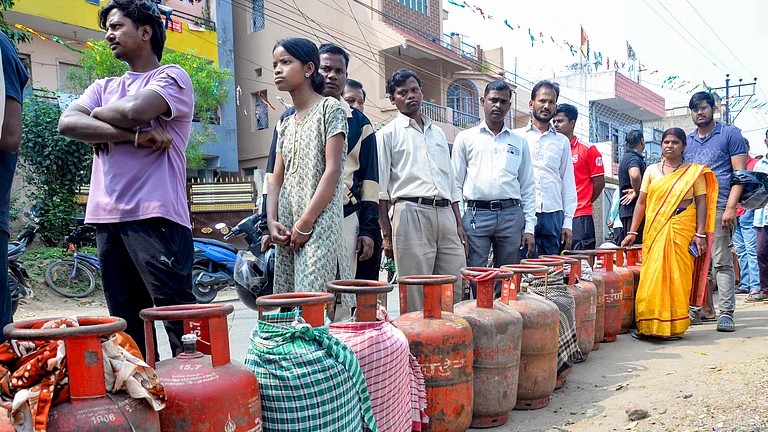
Opposition figures argue that despite being aware that India imports nearly 80-85% of its LPG needs, the government did little to build adequate storage capacity, diversify supply chains, or expand domestic production at the scale required
India’s ongoing shortage of Liquefied Petroleum Gas (LPG) has sparked sharp political reactions, with opposition leaders accusing Prime Minister Narendra Modi’s government of mismanaging the country’s cooking gas supply. As delays in cylinder deliveries and supply disruptions affect households, restaurants and small businesses across several states, opposition parties argue that the crisis reflects deeper failures in energy planning, import dependence and policy priorities.
From Parliament debates to public rallies, critics have increasingly questioned the government’s preparedness and accountability, accusing it of prioritising publicity-driven schemes over long-term energy security.
A crisis hitting kitchens across the country
The LPG shortage has created significant distress for millions of households and businesses. In several cities, the waiting period for domestic LPG cylinder refills has stretched from around two weeks to nearly a month. Commercial users such as restaurants, tea stalls, street vendors and catering services are reporting even greater difficulties in securing cylinders.
Opposition leaders argue that the crisis is particularly damaging for low- and middle-income families who depend heavily on LPG as their primary cooking fuel. For many households, the disruption has forced rationing of cooking gas usage or a return to alternative fuels such as kerosene, firewood or electric appliances.
Small eateries and food vendors, who rely on commercial LPG cylinders to run their daily operations, are also facing mounting uncertainty. Industry groups have warned that prolonged supply disruptions could lead to higher food prices and temporary closures of small businesses.
Opposition parties say that the government’s response so far has been reactive rather than proactive.
Opposition blames government’s energy dependence
A central criticism from opposition leaders is that the government has failed to reduce India’s heavy reliance on imported LPG. Currently, the country imports nearly 80–85% of its LPG requirement, making domestic supply highly vulnerable to global disruptions.
Opposition figures argue that despite being aware of this vulnerability for years, the government did little to build adequate storage capacity, diversify supply chains, or expand domestic production at the scale required.
They contend that the current shortage exposes the risks of depending heavily on imports from geopolitically volatile regions, particularly West Asia. With tensions affecting shipping routes and energy markets, the flow of LPG shipments to India has slowed, triggering supply constraints.
Critics say the government should have anticipated such risks and strengthened energy resilience long before the crisis reached Indian households.
Ujjwala scheme under scrutiny
The LPG shortage has also renewed criticism of the government’s flagship cooking gas programme, the Pradhan Mantri Ujjwala Yojana. While the scheme expanded access to LPG connections among low-income households, opposition leaders argue that the government focused more on distributing connections than ensuring sustained affordability and supply.
They point out that rising cylinder prices and inconsistent availability have made it difficult for many beneficiaries to continue using LPG regularly. According to opposition leaders, the current shortage further undermines the scheme’s promise of reliable access to clean cooking fuel.
Some critics have gone further, accusing the government of using welfare schemes as political tools while neglecting the structural reforms needed to maintain stable supply chains.
Government response seen as inadequate
Government officials have stated that the shortage is temporary and linked to international supply disruptions. Energy companies have been asked to maximise domestic LPG production, while authorities are reportedly exploring alternative import sources.
However, opposition leaders argue that these measures come too late and fail to address deeper structural issues. They say that prioritising domestic consumers while restricting supply to commercial users may offer short-term relief but risks shifting the burden onto small businesses.
Opposition parties have also criticised the lack of transparency in the government’s communication about the scale of the shortage and the steps being taken to address it.
Political pressure mounting
With state elections approaching in several parts of the country, the LPG shortage has quickly become a political flashpoint. Opposition parties are using the issue to question the government’s broader economic and governance record.
They argue that the crisis reflects a pattern of reactive policymaking in which the government responds only after problems escalate. According to critics, effective energy governance requires long-term planning, diversified supply sources and stronger domestic production capacity.
As the shortage continues to affect kitchens and businesses across India, political pressure on the central government is likely to intensify. For the opposition, the LPG crisis has become a potent symbol of what they describe as the government’s failure to safeguard the everyday needs of citizens.