‘Inequality On The Rise, Welfare In Retreat’
The Congress report titled “The Real State of the Economy 2026” contends that economic disparity in India is escalating rapidly, while social welfare expenditures are being progressively reduced during the Modi administration
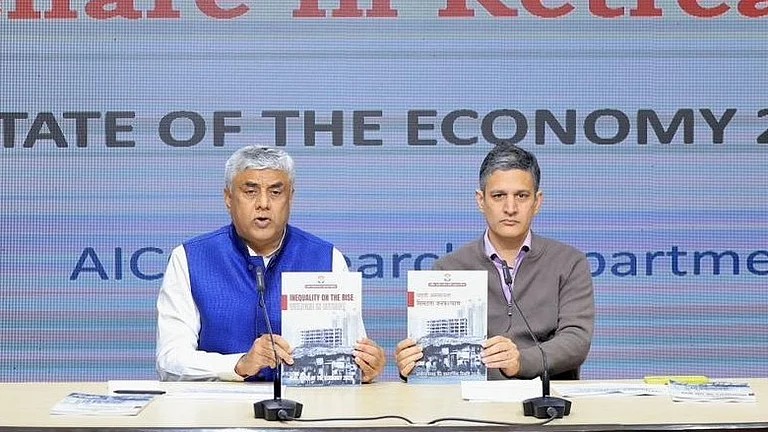
Ahead of the Union Budget, the Congress party unveiled a report on January 27, titled “The Real State of the Economy 2026.” The document contends that economic disparity in India is escalating rapidly, while social welfare expenditures are being progressively reduced during the Modi administration.
The party also provided a detailed counterargument to what it described as the government’s fabricated story of economic expansion.
During a press briefing, Prof. Rajeev Gowda, a former MP and head of the All India Congress Committee (AICC) Research Department, criticized the central government for its obsession with cutting welfare programs.
“The Modi government is tearing down the social protections for the impoverished, young people, farmers, and women—the four groups the Prime Minister professes to prioritize,” Gowda stated. He further remarked that the administration’s boastful rhetoric mirrored the arrogance of the India Shining initiative from a previous NDA government.
Amitabh Dubey, a member of the AICC’s research team, argued that economic progress favoring only a privileged few cannot be considered a triumph. “Increasing disparities and declining welfare indicate severe economic mismanagement. Effective policies require accurate information. We urge the government to present genuine data to the nation, rather than distorted statistics that deceive the public,” he emphasized.
The report offers a fact-driven analysis of India’s economy, disputing official assertions regarding growth, jobs, and investments.
Emphasizing doubts about data reliability, the Congress pointed out that the IMF has rated India’s statistics as “C” grade and referenced former Chief Economic Adviser Arvind Subramanian, who suggested that India’s GDP growth might be inflated by approximately 2.5 percentage points.
Questioning personal financial situations, the report inquired why household savings have plummeted while household borrowing has surged, highlighting a growing disconnect between official figures and everyday experiences.
Additionally, it observed that in four out of ten months in 2025, net foreign direct investment (FDI) was negative, indicating that more capital exited India than entered.
On education, the report pointed out
- School enrolment fell from 25.18 crore to 24.69 crore in two years
- 68 lakh students dropped out in 2024–25, including 32 lakh girls
- Over 3.5 lakh teacher posts remain vacant
- Funding for higher education has declined by 55 per cent over the past decade
- Student suicides have increased by 65 per cent in the last ten years
Welfare Rollback and Human Development in Retreat
On MGNREGA, the report said the rights-based employment scheme had been systematically weakened even before being replaced by the restrictive VB-G RAM G:
- Fewer than 2% of households received the guaranteed 100 days of work
- Average employment fell to just 37 days in FY 2025–26
- Large numbers of poor households were excluded due to technological barriers
The report also highlighted setbacks in human development.
On nutrition and health
- 12 per cent of Indians remain undernourished
- 31 per cent of children under five are stunted
- 59.1 per cent of adolescent girls and 52.2 per cent of pregnant women are anaemic
- Pollution, described as “silently killing large numbers of Indians”, has been largely ignored
Reversal of Structural Transformation
According to the report, India witnessed a reversal in structural transformation between 2017–18 and 2023–24:
- Manufacturing employment fell from 12.1 per cent to 11.4 percent
- Services employment declined from 31.1 per cent to 29.7 per cent
- Agricultural employment rose from 44.1 per cent to 46.1 per cent, indicating a return to low-productivity work due to inadequate job creation in manufacturing
The report said job growth has been concentrated in informal and gig work, with 40 per cent of salaried workers lacking contracts, paid leave or social security. While corporate profits grew by 22.3 per cent in 2023–24, employment increased by only 1.5 per cent.
Youth unemployment, the report says, touched 15 per cent in September 2025, rising to 18.4 per cent in urban areas. “One in four urban young women who want to work is unable to find a job,” the report said.
Inequality and Tax Burden
The report documents a sharp rise in inequality:
- The top 10 per cent earn 58 per cent of national income, while the bottom 50 per cent receive only 15 per cent
- The top 1 per cent own 40 per cent of total wealth, compared to just 6.4 per cent held by the bottom 50 per cent
- The tax burden has shifted from corporates to ordinary citizens, with individuals’ share in total direct taxes rising from 38.1 per cent in FY14 to 53.4 per cent in FY24
The Congress also flagged cuts to the National Social Assistance Programme (NSAP), which provides non-contributory support to the elderly, women and persons with disabilities.
Calling the “Make in India initiative” a failure, the report highlighted stagnation in manufacturing sector and decline in MSMEs.