India’s Literacy Programs Have Fallen Short
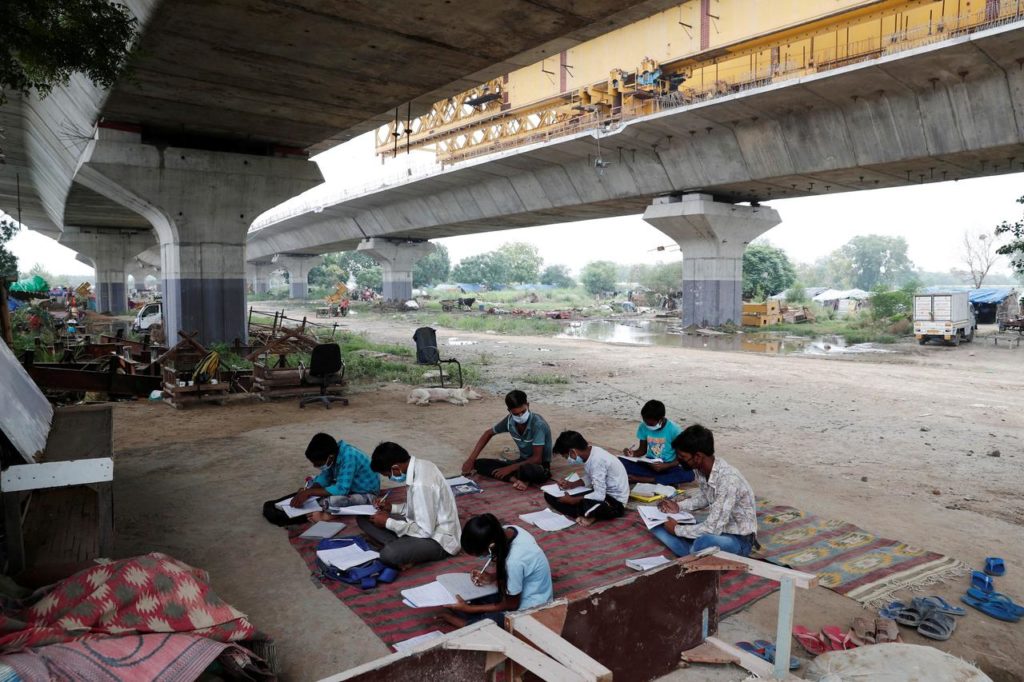
FILE PHOTO: Students from a slum area attend an open-air class after authorities closed all schools following the outbreak of the coronavirus disease in New Delhi
Lack of literacy can have serious implications for employability. Conversely, it can also be a major hurdle for applying for public welfare. The lack of basic literacy can influence someone’s resilience to setbacks, stress, feeling of well-being and the extent to which they feel in control of their lives.
‘Literacy’ is a complex and dynamic concept. No one definition of literacy accommodates all its facets. It refers to a context-bound continuum of reading, writing, and numeracy skills, acquired and developed through a process of learning and application.
In India, literacy is understood as the definition from the Census of India (held every decade) — the ability to read and write in at least one language. India’s literacy rate has almost doubled over a period of 40 years, from 37.3 percent in 1971 to 74.0 percent in 2011. Although commendable, India still remains far from the goal of achieving universal literacy.
The literacy rate is the highest for age-group 10–14 years and lowest for the 80 years+ age-group. In almost every country of the world, older cohorts are less educated than younger cohorts because education is concentrated in the younger age groups and most education systems have expanded over time.
There are broadly two different providers of the basic reading, writing and numeracy skills required for literacy — universal elementary education and adult education programmes. In India, priority was given to elementary education on the assumption that the expansion of elementary education would automatically take care of mass illiteracy over time. The Constitution of India, effective from 1950, made a provision for free and compulsory education for all children up to fourteen years of age.
Despite rapid expansion of the formal schooling system, India was unable to universalise free and compulsory elementary education within the 10-year-period period originally envisaged. A consequence was adults in the population with no literacy and no means of learning.
Against this backdrop, Indian policy makers realised the need for an adult education programme. The National Adult Education Programme, the first country-wide programme in 1978, aimed to cover illiterate people aged 15–35 in adult education centres across the country. In the latter years, it was restructured to be the National Literacy Mission, which is now engaged in imparting functional literacy to these adults.
There are more than 281 million illiterate people in India. This large number underlines the failures of both the universal elementary education policy and the National Literacy Mission. Some 25 million are 7–14 years old and 89 million 15–35 years old — together they make up more than 40 percent of total illiterate population. Nearly 88 percent of the children in the 7–14 years age-group are literate, leaving a 12 percent gap from achieving 100 percent literacy. Even highly developed states such as Kerala, Tamil Nadu, and Himachal Pradesh were unable to achieve 100 percent literacy in this age-group. The challenge is greater for the poorer states such as Bihar, Jammu & Kashmir, Uttar Pradesh, Assam, Jharkhand, Rajasthan, Odisha, Madhya Pradesh and Chhattisgarh, which have more than 10 percent illiteracy in the 7–14 age-group.
In 2011, nearly 20 percent of the Indian population between 15–35 years was found to be illiterate, with wide variations across the states. Four states had less than 10 percent illiteracy — Kerala, Himachal Pradesh, Tamil Nadu and Maharashtra, but some states, such as Bihar, Jharkhand, Rajasthan and Uttar Pradesh, had more than 25 percent illiteracy.
Effective implementation of adult-literacy programmes could improve literacy rates for the 15–35 age group. If India is to improve its literacy rates, the policies of the National Literacy Mission will need to be revisited and analysed to understand the reason for its limited achievement. A detailed mapping of illiteracy rates at district level would help target resources effectively.
Even if India achieved universal literacy for age groups 7–14 and 15–35, the goal of full literacy will not be realised in the near future due to the large number of illiterate Indians in the 35+ age group. Broadening the scope of adult-literacy programmes beyond the 15–35 age group will speed up the achievement of universal literacy.
Vachaspati Shukla, an economist, is assistant professor at the Sardar Patel Institute of Economics and Social Research, Ahmedabad. He declares no conflict of interest.
Originally published under Creative Commons by 360info™