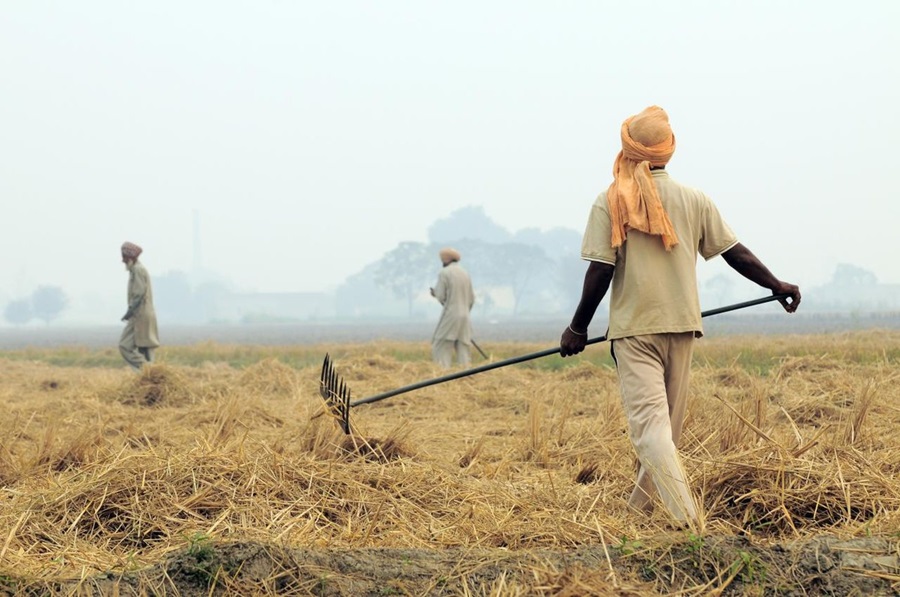
Addressing a farmers’ convention in Kerala, Congress leader Rahul Gandhi claimed that the proposed India–US trade deal would expose Indian agriculture to competition from heavily mechanised American farms. He warned that small and marginal farmers would bear the brunt of such a move (Photo by Neil Palmer (CIAT)/Wikimedia Commons)
Leader of the Opposition in the Lok Sabha Rahul Gandhi on Thursday alleged that US President Donald Trump had pressured Prime Minister Narendra Modi into signing a trade agreement that would “sacrifice” Indian farmers.
Addressing a farmers’ convention in Peravoor in Kerala’s Kannur district, Gandhi claimed that the proposed India–US trade deal would expose Indian agriculture to competition from heavily mechanised American farms. He warned that small and marginal farmers would bear the brunt of such a move. “Farmers are the foundation of India. If you weaken the foundation, nothing can stand,” he said, stressing that agriculture remains central to the country’s economic and social stability.
Criticising what he described as the government’s skewed priorities, Gandhi said, “The government talks about IT and other sectors, but no growth is sustainable without strengthening agriculture.” He added, “We eat food every day but do not remember who puts it on our table,” urging greater recognition of farmers’ contributions.
Gandhi alleged that negotiations over agricultural access had been stalled for months because the Indian government was initially reluctant to allow wider entry to US farm products such as soybean, fruits and vegetables. According to him, “the talks were stuck because the government knew the damage this would cause.” However, he claimed that renewed pressure from Washington led to a shift in India’s position, suggesting that external influence played a decisive role.
The Congress leader also alleged that he was prevented from speaking in Parliament after the President’s address because he intended to raise two contentious issues. “I wanted to speak about the unreleased files linked to Jeffrey Epstein and a case in the United States involving the Adani Group,” he said. Gandhi claimed that both matters had implications for the Prime Minister.
The Union government has dismissed attempts to link Modi to the Epstein case, describing such references as “baseless” and “not credible.”
Accusing the Prime Minister of prioritising political interests over farmers’ welfare, Gandhi said, “Indian farmers are being sacrificed.” He added that “no previous prime minister would have allowed unrestricted entry to American agricultural products.”
Referring to Kerala, where he earlier served as MP (from Wayanad), Gandhi said the Congress was preparing a manifesto centred on farmers and labourers. He called for legally guaranteed minimum support prices, better cold chain infrastructure and improved storage facilities. He also highlighted the issue of man-animal conflict in Wayanad, calling it “a complex challenge that requires sustained policy attention.”
Changes in NCERT textbooks ‘RSS-driven exercise full of mischief’, says Congress
Continuing its broadside against the ruling dispensation at the Centre — after Rahul Gandhi called out the government over its proposed policies being inimical to the interests of Indian farmers (as mentioned above) — the opposition Congress party on Thursday said the Supreme Court’s sharp observations on an NCERT social science textbook vindicated its long-standing charge that recent curriculum revisions were shaped by an “RSS-driven” agenda.
The reaction came after the Supreme Court imposed what it described as a “complete blanket ban” on the Class 8 social science textbook published by the National Council of Educational Research and Training (NCERT) and ordered authorities to seize all physical and digital copies. The court termed certain portions of the book “objectionable,” particularly references that flagged alleged corruption and structural challenges within the judiciary.
In a post on X, Congress general secretary Jairam Ramesh said, “The Supreme Court is rightly agitated over critical references to the judiciary in NCERT textbooks.” He added, “Actually, the way NCERT textbooks have been rewritten over the past decade is disgraceful, apart from being dangerous as well. It has been a RSS-driven exercise full of mischief and malice. It is this racket that needs to be investigated.”
A three-judge bench comprising Chief Justice Surya Kant and Justices Joymalya Bagchi and Vipul M. Pancholi issued show cause notices to the NCERT director and the secretary of the Department of School Education. The bench asked them to explain “why contempt proceedings should not be initiated” against those responsible for the content.
The court took suo motu cognisance of the matter after senior advocates Kapil Sibal and Abhishek Singhvi mentioned it for urgent hearing. They objected to passages in the textbook discussing the functioning of the judiciary, including references to corruption, a massive backlog of cases and an inadequate number of judges.
During the hearing, the bench made strong remarks, stating it would not allow “anyone on earth” to tarnish the integrity of the judiciary. The justices emphasised that while academic discussion was important, content that undermined public confidence in constitutional institutions would not be tolerated.
Following the court’s intervention, NCERT removed the textbook from its website. Sources indicated that the government was also displeased with the controversial references included in the curriculum.
In a statement issued on Wednesday, NCERT apologised for what it described as “inappropriate content” and said the book would be rewritten “in consultation with appropriate authorities.”
The episode has sparked a broader political debate. While the Congress insists that the controversy highlights ideological interference in curriculum design, the Supreme Court’s intervention has drawn attention to questions of academic oversight, institutional accountability and the limits of critique in school textbooks.