The Aghanashini river in Karnataka. The mangroves that flank the Aghanashini river serve as crucial nurseries for fishes and prawns and play a vital role in their breeding and spawning processes (Photo by Hegdesudarshan/Wikimedia Commons)
India has added five more Ramsar sites to its portfolio ahead of this year’s World Wetlands Day, taking its total tally to 80 from the existing 75. A Ramsar site is a wetland site designated to be of international importance under a convention on wetlands signed in 1971.
The Ministry of Environment, Forests, and Climate Change unveiled the new Ramsar sites on January 31, in the presence of the Ramsar Convention’s secretary general, Musonda Mumba, who was in the country to commemorate World Wetlands Day. “With the addition of these five wetlands to List of Wetlands of International Importance, the total area covered under Ramsar sites is now 1.33 million hectares,” said the Ministry in a statement.
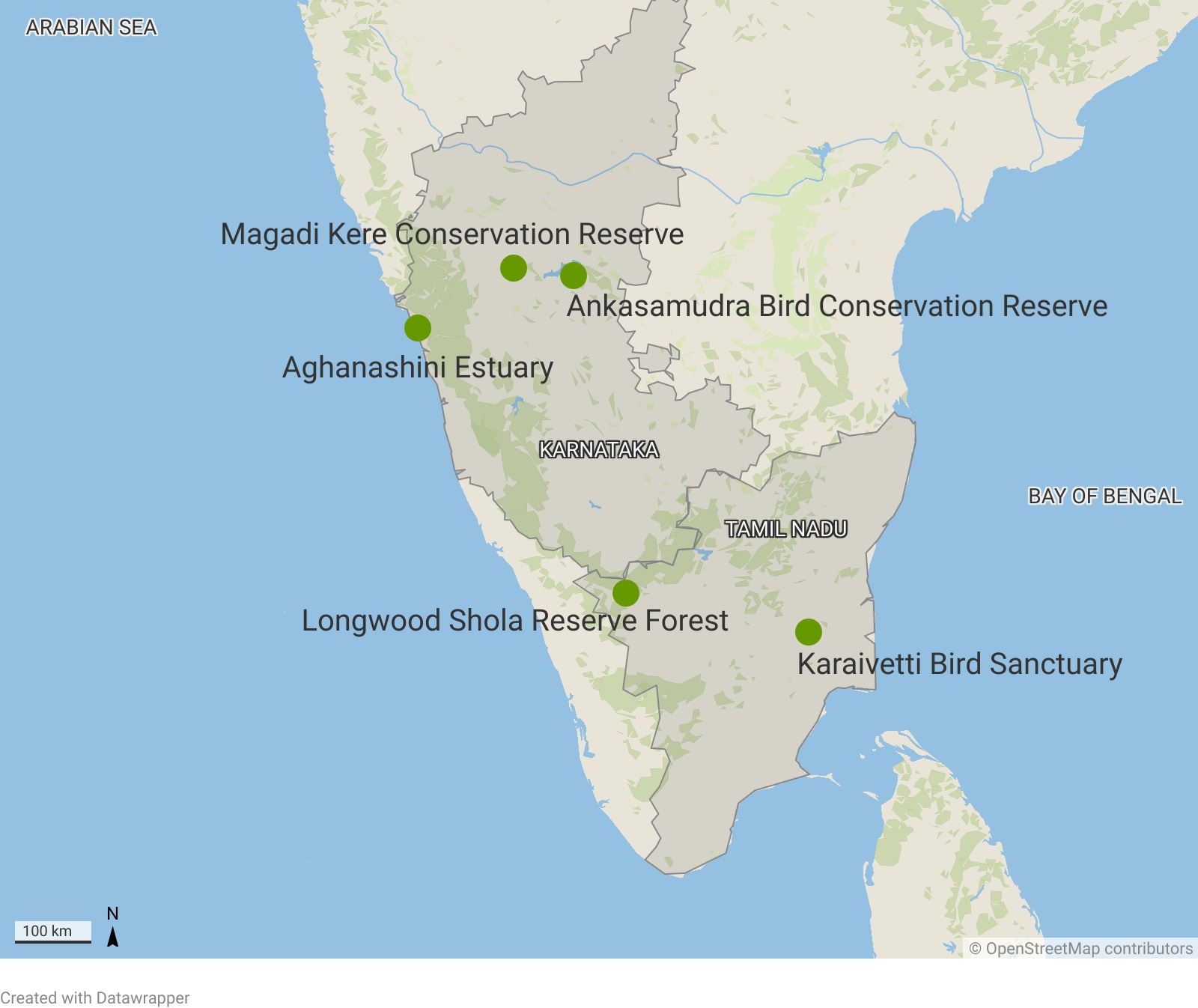
The newly declared sites include Karaivetti Bird Sanctuary and Longwood Shola Reserve Forest in Tamil Nadu, and Magadi Kere Conservation Reserve, Ankasamudra Bird Conservation Reserve and Aghanashini Estuary in Karnataka. The Ramsar tag bestows these ecosystems with international recognition, gives them access to international management practices and increases the possibility for international funding.
“When the government declares a Ramsar site, it also creates a commitment to use it wisely and conserve it. Nearly eight percent of India’s wetlands have been declared Ramsar sites. It shows that there is a pathway to potentially replicate and scale this conservation model in other sites,” said Ritesh Kumar, the director of Wetlands International South Asia (WISA).
The Ramsar Convention sets nine criteria for identifying Wetlands of International Importance. These include sites containing representative, rare or unique wetland types and sites of international importance for conserving biological diversity.
The Karaivetti Birds Sanctuary in Tamil Nadu spans over 453 hectares and “is one of the most important fresh water feeding grounds for migratory water birds in the state of Tamil Nadu,” hosting over 188 bird species, of which 82 are water birds, according to the state government’s website. Apart from water birds, the sanctuary is also an important nesting site for threatened species like the spotted eagle and the tawny eagle.
The Longwood Shola Forest in the Nilgiris is among the “last vestiges of urban shola forest, where everything else has been lost to tea cultivation and other land use changes,” said Pratim Roy, director of Keystone Foundation, an environmental NGO that aims to enhance the quality of life of indigenous communities and the environment. The shola is a high-altitude wetland that acts as a water source for 18 villages downstream and is also considered an Important Bird Area (IBA), hosting several endemic bird species. The Longwood Shola is recognised and protected as a Reserve Forest. “But the international visibility in declaring it a Ramsar site will bring more protection and a greater chance for funding. It’s a very important recognition,” said Roy.
The addition of the two new Ramsar sites in Tamil Nadu makes it the state with the highest number of Ramsar sites in the country, at 16. “Twenty years ago we only had one Ramsar site, and now we have added fifteen more. It shows our commitment. We have a dedicated Wetland Mission with the specific objective to rejuvenate and restore wetlands, and are doing work to manage invasive species and improve visitation to the sites,” said Supriya Sahu, Additional Chief Secretary of Tamil Nadu’s Environment and Climate Change department.
Of the newly declared sites in Karnataka, Aghanashini Estuary is the largest at 4801 hectares. Scientists at the Indian Institute of Science (IISc) have pushed for the Estuary to be a Ramsar site for years. The mangroves along the Aghanashini river “act as a nursery for fishes and prawns and are considered as important fish breeding and spawning areas. Several species of fish visit nutrient rich mangrove area for laying eggs so that the juveniles grow amidst abundance of food before they leave for the sea,” researchers Mahabaleshwar Hegde and Amalendu Jyotishi wrote in a post for Azim Premji University.
The other two sites, Magadi Kere and Ankasamudra Reserve, are both artificial tanks. The former is one of the largest wintering grounds for bar-headed goose in southern India and the latter is home to 210 species of plants, 8 species of mammals, 25 species of reptiles, 240 species of birds and 41 species of fishes, apart from frogs, butterflies and other insects.
The latest declarations take Karnataka’s tally of Ramsar sites to four. According to news reports, the state government believes there are at least 10 other potential Ramsar sites.
In 2022, India added 11 wetlands to its list of Ramsar sites, taking the total number to 75 Ramsar sites, coinciding with 75 years of independence. The latest round has come ahead of World Wetlands Day celebrations in the country. Kumar from WISA said that while announcements were welcome, the management plans for Ramsar Sites must be effectively implemented.
The international recognition hasn’t stopped these wetlands from degrading, being polluted or encroached upon. “Wetlands are not owned by one agency, and they’re not always entitled to legal protection, which makes conserving them a challenge,” said Sahu, adding, “There’s also a general perception that wetlands are not as important as other ecosystems, like forests. Tamil Nadu’s Wetland Mission was created to address these problems.”
In a media interview, minister Yadav said empowering state governments and local level authorities that can better manage wetlands will be high on the agenda. Last year’s Budget launched the Amrit Darohar scheme, which aims to generate livelihoods through wetland management and conservation.
“We need to apply our efforts in making sure the management plans are of a certain standard and implemented. It’s too much to expect governments to do everything, there is a responsibility among citizens, too. We see that change happening slowly, with new partnerships and incentives to collaborate and protect wetlands,” said Kumar.
(Published under Creative Commons from The Third Pole. Read the original article here)
Delhi’s air may be growing more toxic by the day — but on Sunday, authorities appeared to view a peaceful…
The 14th State Level Philatelic Exhibition, MAPPEX-2025, organized by the Madhya Pradesh Postal Circle, was held in Bhopal from November…
South Asia accounts for 50% of the groundwater pumped for irrigation globally. The practice has been critical to ensuring food…
Earlier this week, news came in that ousted Bangladesh Prime Minister Sheikh Hasina has been sentenced to death – by…
At the 14th edition of the Dharamshala International Film Festival, three documentaries stood out for the way they portrayed the…
The Special Intensive Revision of the voters list across 12 Indian states could potentially lead to sharpening of the communal…
This website uses cookies.