‘If PM Modi Is Compromised, Our Foreign Policy Is Compromised’

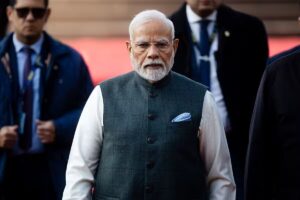
Leader of the Opposition in the Lok Sabha, Rahul Gandhi, has launched a strong critique of the government’s handling of foreign policy, describing it as overly centralised and lacking independence. Gandhi said that India’s foreign policy has become excessively personalised, suggesting that key decisions are being shaped by the leadership style of Prime Minister Narendra Modi rather than institutional processes or long-term national interests (Tomas Cuesta/Getty Images)
As the US–Israel–Iran conflict enters its fourth week, its global reverberations are increasingly shaping political discourse in India. The crisis has not only raised concerns about regional stability in West Asia but has also triggered a fresh round of debate over New Delhi’s foreign policy approach. At the centre of this debate is a sharp political exchange, with the opposition questioning whether India is maintaining its strategic autonomy in an increasingly polarised global environment.
Political Criticism and Questions Over Strategic Autonomy
Leader of the Opposition in the Lok Sabha, Rahul Gandhi, has launched a strong critique of the government’s handling of foreign policy, describing it as overly centralised and lacking independence. Addressing the media within the Parliament complex on March 24, Gandhi argued that India’s foreign policy has become excessively personalised, suggesting that key decisions are being shaped by the leadership style of Prime Minister Narendra Modi rather than institutional processes or long-term national interests.
Gandhi went further, alleging that India’s external engagements are being influenced by global powers, particularly the United States and Israel. According to him, such a posture undermines India’s traditional emphasis on strategic autonomy—a cornerstone of its foreign policy since independence. He contended that if leadership appears “compromised,” it risks weakening the credibility and independence of India’s international stance.
The criticism also touched upon India’s perceived absence in the evolving diplomatic dynamics surrounding the conflict. Gandhi pointed to reports suggesting that other regional players, including Pakistan, may be playing intermediary roles in the crisis. In this context, he argued that India appears sidelined, lacking a clear and assertive voice in shaping outcomes in a region where it has historically maintained significant interests, particularly in energy security and diaspora welfare.
These remarks reflect a broader concern among sections of the political and strategic community—that India’s foreign policy may be drifting away from its traditionally balanced approach. For decades, India has sought to maintain constructive relations with multiple sides in West Asian geopolitics, including Iran, Israel, and Arab nations. Critics now question whether that delicate balancing act is being sustained effectively in the current scenario.
Economic Risks and the Government’s Call for Caution
Beyond questions of diplomatic positioning, the ongoing conflict is also raising alarms about its potential economic consequences for India. Gandhi highlighted the likelihood of rising costs in essential sectors, warning that commodities such as LPG, petrol, and fertilisers could become significantly more expensive if the conflict prolongs or intensifies. Given India’s heavy dependence on energy imports from the region, such disruptions could have a cascading impact on inflation and household expenses.
These concerns are not unfounded. Historically, conflicts in West Asia have led to volatility in global oil prices, directly affecting economies like India’s. A sustained rise in crude oil prices can strain government finances, widen the fiscal deficit, and increase the burden on consumers. Additionally, disruptions in fertiliser supply chains could impact the agricultural sector, further complicating economic stability.
In contrast to the opposition’s critique, the government has adopted a tone of caution and preparedness. In his recent address to the Lok Sabha, the prime minister emphasised the need for unity and resilience in the face of global uncertainty. Drawing parallels with the Covid-19 pandemic, he argued that India must remain vigilant and prepared for prolonged instability. The comparison was intended to underline the importance of collective effort and strategic patience during crises that have far-reaching implications.
However, this analogy has also drawn criticism. Gandhi argued that invoking the pandemic in this context was misplaced, suggesting that it overlooked the scale of suffering experienced during that period. He accused the government of failing to adequately acknowledge past hardships while using them rhetorically to frame current challenges.
The divergence in perspectives highlights a deeper political and strategic divide. On one hand, the government stresses continuity, stability, and measured response, projecting confidence in its ability to navigate global turbulence. On the other, the opposition calls for greater transparency, institutional decision-making, and a reaffirmation of India’s independent voice in global affairs.
As the conflict continues to unfold, its implications for India will likely become more pronounced. The situation presents a complex challenge—balancing diplomatic relationships, safeguarding economic interests, and maintaining domestic political consensus. Whether India can effectively navigate these pressures while preserving its strategic autonomy remains a critical question.
In the coming weeks, much will depend on how the crisis evolves and how India positions itself in response. For now, the debate sparked by recent political exchanges underscores the importance of foreign policy not just as an external engagement tool, but as a subject of domestic accountability and national interest.