How Banks Continue To Ignore Debt Induced Due To Climate Disasters
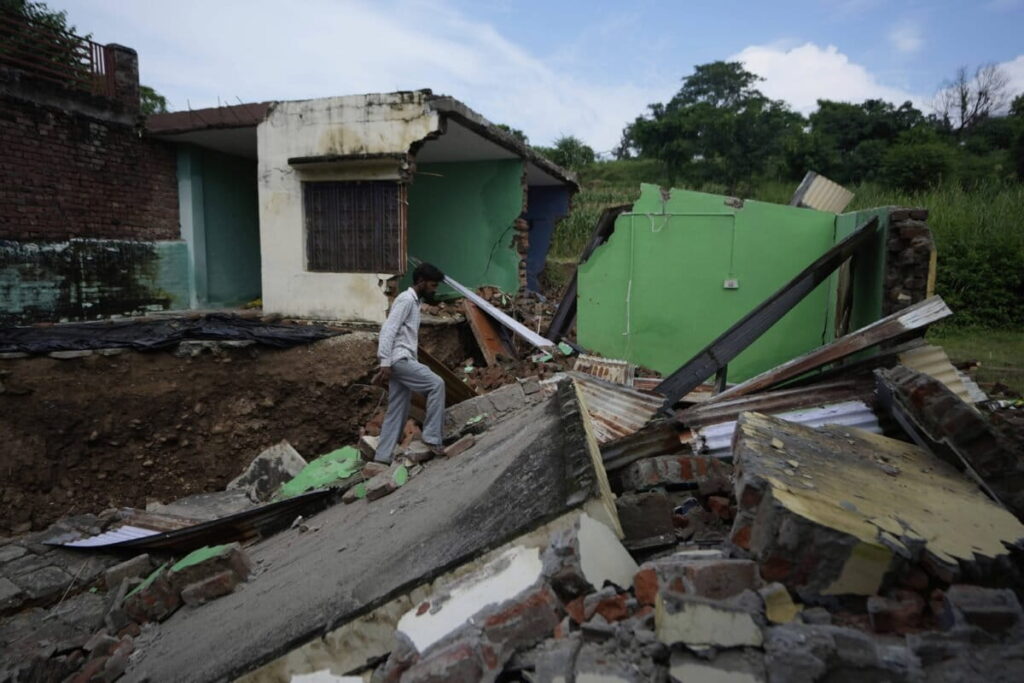
A man looks at the remains of his house, destroyed by landslides triggered by heavy monsoon rains in Kheri village on the outskirts of Jammu in September 2025. Despite frequent extreme weather events hitting the country, Indian banks have not offered loan waivers for individual borrowers or small traders in any state (AP Photo/Channi Anand)
- Over the last seven years, Indian banks have offered little loan relief to extreme weather and disaster survivors.
- The new RBI disaster relief guidelines, set to take effect this year, continue this gap by not mandating waivers or write-offs for climate disaster survivors.
- If banks are to support climate resilience, their credit policies must include debt relief during climate disasters.
As India is convulsed with industrial development-induced climate emergencies — heatwaves, pollution, heavy rains, floods, and more — not a day passes without a climate disaster. The country witnessed 99% of the disaster days in 2025, according to a study by the Centre for Science and Environment (CSE). As people lose lives — 4,419 in 2025 as per the CSE study — livelihoods, property, and health, each episode of disaster inevitably turns into a financial catastrophe.
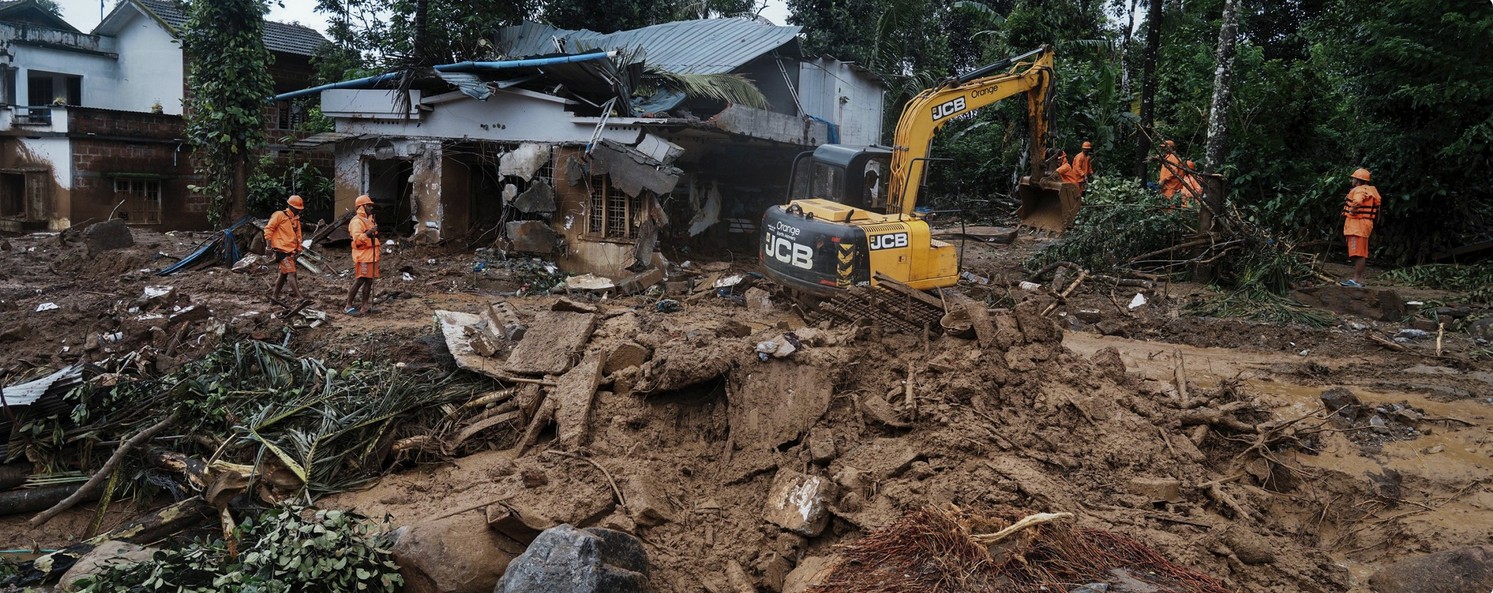
A major aspect of the financial aftermath is the debt obligations on small borrowers — personal, retail, or agricultural — which loom on those who have lost loved ones, assets, and sources of livelihood. What are our banks and financial institutions doing to relieve the financial stress of the disaster-affected?
In the recently concluded winter session of parliament, the Ministry of Finance’s response to Congress MPs’ questions on loan relief provided to individual borrowers and small traders by scheduled commercial banks in the aftermath of floods, landslides, and intense rainfall-related damages from 2019 onwards paints a profoundly disappointing picture.
This is at a time when India is beset with climate disasters. The report Mapping Climatic and Biological Disasters in India, co-published by the National Institute of Disaster Management, states that between 1995 and 2020, India was struck by 1,058 extreme weather events, including floods, cyclones, droughts, heatwaves, and cold waves.
Flooding was the most frequent hazard, making up about one-third of all events. Heatwaves were the next most common at nearly a quarter, while droughts constituted just over one-fifth. Cold waves accounted for around 16% of the total, and cyclones, which had the smallest share, accounted for roughly 5%, the report notes. The Climate Risk Index 2026, released during COP30, estimates that “between 1995 and 2024, India witnessed 430 extreme weather events, leaving 80,000 dead, 1.3 billion affected, and ₹170 billion in losses.”
Loan Waivers As Climate Disaster Relief
Against this backdrop, the Indian bank’s response to the financial devastation borders on indifference if not apathy. From 2019-20 to 2025-26, there is a complete absence of loan waivers for either individual borrowers or small traders in any state or year! This holds across all categories — agriculture, individuals, and small traders. The data shows that for banks, “loan waiver” — the complete cancellation of debt obligation — as a relief measure is effectively non-existent in climate-disaster contexts.
Write-offs, too, are almost entirely absent. With the exception of one instance in Kerala (FY 2023-24), where write-offs amounting to ₹11.7 million were approved for individual borrowers, no write-offs have been reported for small traders in any state. This indicates that write-offs are not being provided for disaster survivors. A write-off occurs when a hard-to-recover loan is removed from a bank’s balance sheet. Technically, the borrower can still be approached by the bank to recollect the written-off loan.
Moratoriums, which are temporary pauses on loan repayment obligations and penalties, dominate all relief measures. Moratorium and loan restructuring shift repayment pressure into the future and do not necessarily resolve borrower distress.
Even for moratoriums, the overall picture is grim. Banks operating in a handful of states, such as Karnataka, Kerala, Tamil Nadu, Himachal Pradesh, Andhra Pradesh, Sikkim, and West Bengal, report occasional relief. The bulk of the states and UTs report ‘nil’ data for the entire period, indicating that loan relief was not provided despite recurring climate disasters nationwide! This points to poor access and implementation of loan relief measures across states.
The data for the Finance Ministry’s answer to the parliamentary question has been collated by the State Level Bankers’ Committee, comprising representatives from banks, the Reserve Bank of India, the National Bank for Agriculture and Rural Development, and the state governments of each state and union territory. The numbers are limited to loans by scheduled commercial banks and do not cover small lending by other financial institutions.
For instance, the provided figures do not cover the bulk of small, personal loans, which emanate from the ecosystem of thousands of loan apps, non-banking financial companies, and microfinance institutions that have mushroomed following the withdrawal of formal banks from small lending. The situation is likely to be far worse in these poorly regulated institutions.
The status is better for loans provided for agriculture and allied activities, such as horticulture, as revealed in another parliamentary question. Loan write-offs due to agricultural losses from floods, landslides, and heavy rains have, in fact, steadily increased, peaking in 2023–24 at ₹244.26 billion. Between 2020–21 and 2024–25, write-offs rose by over 50%, indicating growing stress in agricultural credit. Provisional data for 2025–26 (₹141.22 billion till Sept 2025) suggests write-offs remain significant.
This does not include agriculture-related write-offs by cooperatives, regional rural banks, and payments banks. While the question of agricultural debt and climate disasters warrants further analysis, these amounts are likely inadequate. For contrast, consider this: in one district of Maharashtra, the 2025 rains left crop losses of ₹16.95 billion in their wake, according to government estimates.
For all the tall ‘climate talk’ the RBI and bank managements indulge in from time to time, there’s very little to show for it when it comes to providing debt relief to those hit hardest by climate disasters.
Lagging Regulatory Framework And Poor Intent
This indifference on the part of banks is partly due to inadequate regulatory provisions regarding banks’ responsibilities in disaster situations. Recently, the RBI has sought to address this gap by issuing draft directions on Relief measures in areas affected by natural calamities in January this year, for financial institutions it regulates. These new directions replace the RBI’s 2018 Master Directions on bank relief measures. This is a positive development, as it reiterates the mandate for banks to have policies and procedures to address disasters.
Yet, the directions which will come into force from April 1 this year, retain the weaknesses of earlier such endeavours. They largely mandate ‘restructuring’ of loans rather than waivers or even write-offs. While some discretion has been accorded to banks, the thrust is on moratoriums, and there is a conspicuous absence of an appeals or a grievance redressal mechanism. The eligibility criteria for those who can avail of loan relief in times of disaster remain exclusionary, serving only those with near-perfect loan repayment histories.
Another step backwards is the clause that makes loan relief dependent ‘upon the declaration, by Central / State Governments (in accordance with the framework placed by the concerned Government for this purpose), of a natural calamity or other external event.’ In contrast, the master directions of 2018 recognised the role of district authorities to direct banks to initiate relief measures. With climate disasters striking India with alarming regularity, measures for banks’ responsibility to mitigate their damage are in sore need of revision to address our climate-imperilled present.
But is there sufficient intent in our banks to offer relief to the disaster-affected? The data revealed in the parliamentary questions offers proof to the contrary.
Recently, the High Court of Kerala came down heavily on the Union government and banks for their blatant unwillingness to offer loan waivers to the survivors of the devastating 2024 landslide in Wayanad. On the other hand, the state government-controlled Kerala Bank readily wrote-off the loans of those affected, effectively demonstrating that it was possible for banks to do so without incurring a heavy loss. When community workers and civil society invoked a clause in the Disaster Management Act that recommended loan waivers to seek relief from other banks, the union government promptly revoked that clause.
Finally, in January 2026, in the face of continued indifference from the union government, banks, and the RBI, the Kerala government took on the financial liability for 1620 loans totalling over ₹187.5 million issued to 555 beneficiaries. Undoubtedly, these developments prodded the RBI to come out with new directions for relief measures for ‘natural calamities’.
The figures submitted to the high court peg the total loan amount owed by hundreds of Wayanad survivors to nationalised banks at a meagre ₹353 million. By contrast, public sector banks generously wrote-off loans to the tune of ₹583.59 billion for large industry and services in the financial year 2023-24, in a year when corporate taxpayers were provided tax incentives worth ₹989.99 billion by the union government. What makes corporates and industrialists suitable candidates for write-off largesse drawn from public money, while denying the same to the disaster-affected public? This suggests a partisan approach to our banking system that prioritises the deployment of financial capital for profit-seeking corporations.
Financial Resilience As Key To Climate Resilience
If banks are to play a worthwhile role in climate resilience, they need to prioritise the needs of the majority at the bottom of the economic ladder, who are most vulnerable to the climate emergency. Access to new credit on easy terms, debt relief provisions, and transparent, expansive public-sector banking lie at the heart of climate resilience for common people.