How Advertising And Not Social Media, Killed Traditional Journalism
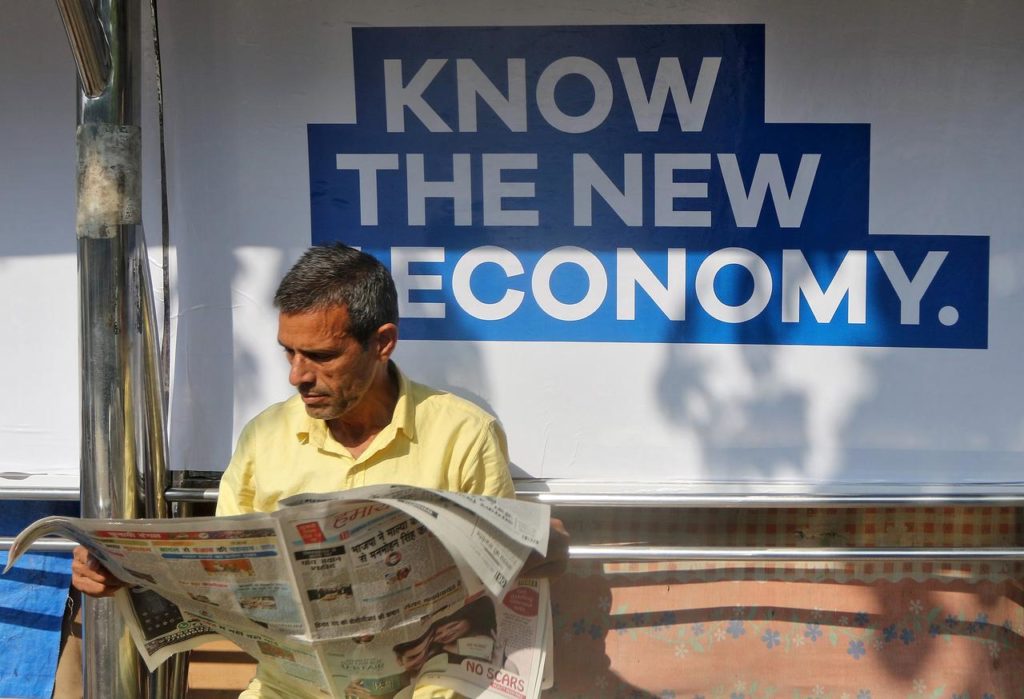
A man reads a newspaper as he waits for public transport at a bus stop in Mumbai (Representational Image)
The debate over the future relationship between news and social media is bringing us closer to a long-overdue reckoning.
Social media isn’t trying to kill journalism; because social media has never really cared about journalism.
Social media is resolutely in the attention business. News propels some attention — perhaps a lot of attention for the few people who care a lot about it — but access to social media has always been far more important as a promotional tool for news outlets than news content has been to social media.
The business of most news outlets has been primarily about attracting attention, not delivering the best or highest quality news.
As a result, social media was always a competitor, though not in the way often imagined.
Data on the shifting share of advertising makes clear the profound change of the last two decades.
Money previously spent on print advertising and direct mail has migrated to search, social media, and online classifieds. Money spent on television advertising has moved as well, albeit more slowly and mostly just in the last decade.
The development of more effective and efficient advertising tools is what killed traditional newspaper operations, not the circulation of news on social media.
The commercial failure of news organisations is not due to their journalism product but because they are no longer nearly so strong a tool for attracting attention for advertisers.
The capabilities of internet distribution broke the business model of the “bundled newspaper” that provided many people with enough value to enable its mass reach.
Once an agglomeration of information (weather, sports scores), news (thin details on the events of the day), and journalism, most people now have specialty apps for information and we are awash in news from radio, television, notifications, and headlines we see in social media feeds.
The expense of journalism could be sustained by the wide reach of a paper attractive to many homes for many different reasons beyond the journalism it contained.
But advertisers became able to text and email regular consumers, social media advertising allows them to target consumers more specifically, and search allows advertisers access to consumers interested in relevant keywords. All these features are more attractive to advertisers.
Unlike the business of newspapers and television, social media is an attention business that does not have the costs of creating the content that attracts attention.
Its business model will always be more profitable than attention businesses that create or license content.
Social media hasn’t done a better job producing or distributing news — but it was never in that business. The business has always been about attracting and selling attention. This too is the case for ad-funded news outlets; they weren’t in the news business, but the attention business.
Shoring up the future of journalism has long required finding a different business model. The days of ad-supported journalism are well and truly gone.
The significant challenge of reorienting the creation of journalism from other revenue has led to decades of misplaced energy spent chasing clicks and engagement that were never a pathway to a sustainable journalism.
Failing to address the core of the problem, as the case with the News Bargaining Code, has just prolonged the inevitable.
The challenge remains the same: find ways to fund the journalism that democratic societies need to stay healthy offering people what they need to go about daily life and participate in their community.
There are now many ways to distribute journalism and help people access it. Funding is really the problem and few governments have been willing to take it on.
Without coordination, dozens of entrepreneurial efforts fail in the clutter of more or less legitimate initiatives and the absence of a sustained effort to re-educate society about how to access reliable information and journalism in today’s world.
Few start by talking to the people they aim to reach about their news and journalism needs and frustrations; instead pushing solutions unusable to those most in need.
Universities, libraries, and education systems that are beacons of expertise have gone untapped and unresourced for new necessary roles. Substantial journalism resources are regularly overlooked: public service media such as Australia’s ABC are an extraordinary asset already in place and already much more than radio and television.
Perhaps we’d all be better off if social media weren’t regarded as a place to access news.
(Originally published under Creative Commons by 360info™. Read the original article here)