Why Global Steelmakers Can Do Much More To Green Their Processes
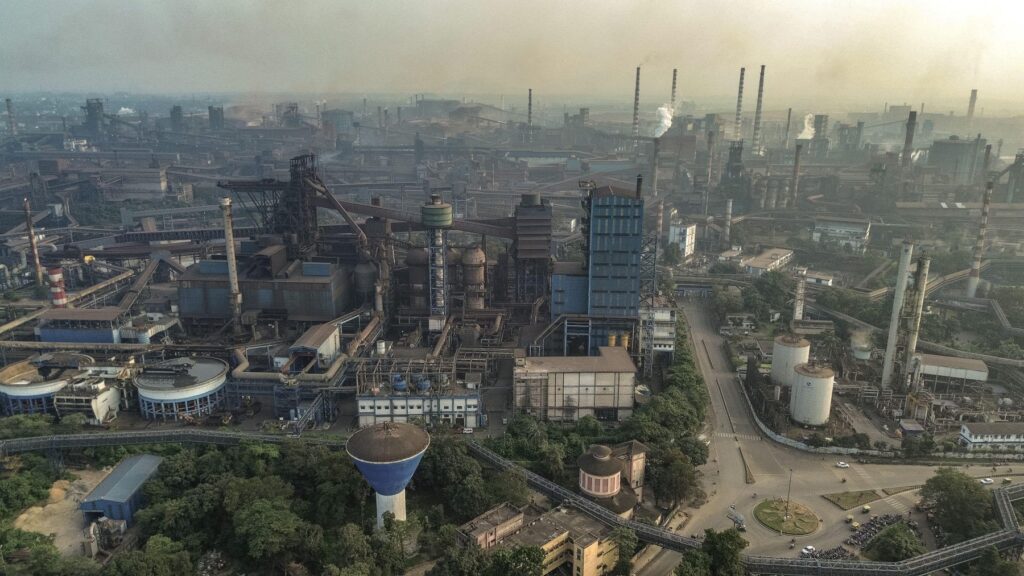
Tata Steel’s largest plant, in Jharkand, east India. The company’s emissions intensity is the highest of the 18 companies evaluated (Image: ZUMA Press / Alamy)
Steelmaking has long relied on coal. That is why making iron and steel drives a tenth of annual CO2 emissions globally. Deep decarbonisation demands structural change in business models and decision making. Yet today’s reality falls far short of what is needed.
A new scorecard created by SteelWatch has assessed whether 18 major steelmakers headquartered in Asia, Europe and the Americas are ready for that transition. Our finding is a clear, and worrying, no.
Assessed on 21 indicators across five categories, including their performance on phasing out coal use and scaling green solutions, not a single company scored above 50 points out of the possible 100. With the majority achieving between 20 and 30, the results illustrate the “transition readiness gap” – the difference between what is needed for a credible near-zero-emissions transition and what companies are actually doing.
Most of the companies assessed in our scorecard have set net-zero targets for 2050, or even before, including all eight of those headquartered in Asia. Yet the scores highlight that structural change is missing to bridge the gap and meet these targets. For the majority of companies, investment continues in long-lived coal-based blast furnaces. Retirement of such facilities, and transition plans, are missing. Coal consumption is not yet on a steady decline.
Meanwhile, company action on green iron barely registers a flicker. Shifting to such iron, which is made using green hydrogen instead of coal, will be essential to tackle the bulk of steel industry emissions. With a total of 25 points available for producing or procuring green iron, as well as the uptake of renewable energy, the average score was less than 1.
Mixed performance for Chinese and Indian steelmakers
Four companies were assessed from the world’s two largest steel-producing nations, China and India. Their scores, ranging from fifth place to last place, reflect the wider dependence on coal for steelmaking in both countries. And yet the diversity in their performance also reveals how companies are making progress in different ways.
Of all 18 companies in the scorecard, India’s Tata Steel has the highest emissions intensity – meaning greenhouse gas emissions per unit of crude steel – and its compatriot JSW Steel has the second highest. In both cases, this is driven by reliance on coal-powered blast furnaces and a low usage of scrap, which can act as a substitute for iron made from ore and help to reduce emissions.
But the two companies also show some areas of stronger performance. JSW Steel scored highest on social and environmental responsibility among all companies assessed. Over the last four years, it has reduced air pollution and improved occupational health and safety. Its emissions intensity has also declined, albeit from high levels.
Both Indian companies also score above average on the certification of their facilities by Responsible Steel, an international standards organisation that assesses a wide range of social and environmental criteria. Signalling strong ambition, though not yet translated into action, Tata Steel is the only producer in the scorecard not headquartered in the EU with an early net-zero target, set for 2045.
JSW Steel’s overall position in our ranking is fifth, with 29.6 points out of 100, while Tata steel sits tenth, with 27.5. Both sit in mid-table along with the majority of steelmakers.
China’s Baosteel, meanwhile, is adjacent to Tata Steel, ranking 11th overall. While the company remains highly coal dependent, it has shown positive trends over recent years in greenhouse emissions intensity, air pollution reductions and occupational safety performance. Scores reflect efficiency improvements that are being implemented across its operations, even though deep structural decarbonisation, such as moving towards phasing out coal use, has not yet taken place.
At the back of the pack sit POSCO and Hyundai Steel from South Korea, Japan’s Nippon Steel, and Hebei Iron and Steel (HBIS) from China. HBIS ranks last overall, due to limited data transparency and continued expansion of coal-based production.
Phasing out coal is the differentiator
A common feature limiting the scores of the Chinese and Indian companies is the absence of a clear timetable for decommissioning blast furnaces or phasing out coal use. This is in contrast to the companies emerging ahead of the pack.
With the highest score of 46.2, the Swedish-Finnish company SSAB’s score reflects its decisive moves away from coal-based iron production, clear blast furnace retirement plans and clearer alignment between future strategy and existing investments. Germany’s Thyssenkrupp comes in second, with some key elements of a transition away from coal-based production. For both companies, implementation is now the challenge: their plans to produce or procure green iron, for example, are not yet operational.
Positive drivers of future change?
SteelWatch’s scorecard is based on publicly reported company data, most of which is reported during 2025 for the 2024 financial year. Only operational investments or those that have passed final investment decisions are counted and scored. This intentionally discounts vague headlines announcing “green steel” innovations that may nor may not translate into emission cuts.
Yet future scores will depend precisely on which positive announcements translate into action, and which early pilot projects go to scale. This will determine how the tightly bunched pack diverges over time.
In China, expansion of the country’s emissions trading scheme, as well as signals suggesting new plans to curb blast furnace overcapacity could become powerful levers for structural shifts. Specifically for Baosteel, the proposed Yangjiang–Zhanjiang hydrogen pipeline could enable commercial-scale steel production using green hydrogen for the direct reduction of iron (DRI) process.
Shifting competitive dynamics, particularly between Europe and China, may also encourage change. The development of the EU’s emissions trading system and carbon border adjustment mechanism (CBAM), which seeks to put a cost on carbon-intensive production, has catalysed conversations on carbon pricing for steel in capitals and parliaments around the world. It has spurred on companies to review their production ventures aimed at supplying the EU market, for example in the Middle East and North Africa.
Now that there are signs of investment in cleaner production in China, the new talk is, of growing competition between China and Europe in green steel. Competitiveness will be increasingly determined by emissions, and hence emissions reductions will be a strategy to maintain market share.
India presents another dynamic. Currently, its coal-based steel production is still expanding – worryingly rapidly – to meet domestic demand. At the same time, innovation and initiative on green hydrogen is growing, with JSW Steel, for example, partnering on a green hydrogen pilot intended to serve its Vijayanagar plant. What matters is when the pace of clean investments starts to outweigh the dirty.
The results of this first scorecard set a sobering baseline but also expectations for where steelmakers need to go. What matters now is companies improving their scores year by year – to deliver a steelmaking transition that enables a stable climate and liveable planet.