‘Face Corrupt Regime Fearlessly’
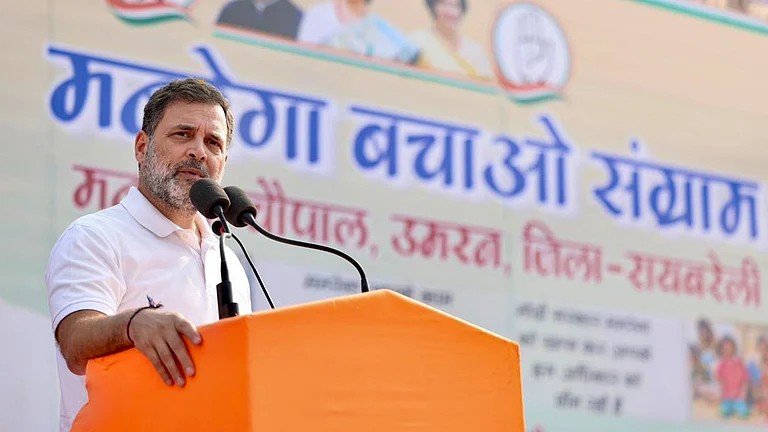
Former Congress president Rahul Gandhi urged party workers to explain to voters what he described as the Modi government’s systematic weakening of the MGNREGA
Congress leader Rahul Gandhi on Wednesday called on district unit presidents from Haryana and Uttarakhand to take on what he described as a “corrupt” ruling regime with courage, discipline and unwavering determination, urging them to function as the Congress party’s frontline warriors at the grassroots.
Addressing District Congress Committee (DCC) presidents from the two states at a training camp in Kurukshetra, Gandhi underlined that the responsibility of rebuilding and strengthening the party rested firmly at the district level. “You have been entrusted with the responsibility of the districts. Fulfil it fearlessly and with dedication,” he told the gathering. “You are the warriors of the Congress, and you must work like warriors.”
The Leader of the Opposition in the Lok Sabha acknowledged that the ruling dispensation posed “formidable challenges”, but asserted that these could be countered through organisational strength and courage. “The challenges before you are big, but they are not impossible. Confront them with courage and take the Congress directly to the people,” he said, according to a statement issued by the Haryana Congress.
Seeking to boost morale among party workers, Gandhi assured the DCC presidents of the party’s complete backing. “No one can suppress your voice, because a strong organisation like the Congress stands with you,” he said, emphasising that district units would play a decisive role in shaping the party’s political future.
Rahul Gandhi was in Kurukshetra on a day-long visit to address the training camp being organised under the Congress’ ‘Sangathan Srijan Abhiyan’ from January 13 to 22. During his address, he said the party leadership would closely monitor the performance of district units and extend guidance wherever required. “We will periodically review your work and support you in strengthening the organisation,” he assured the participants.
The former Congress president also focused on economic issues, particularly rural employment. He urged party workers to explain to voters what he described as the Modi government’s systematic weakening of the Mahatma Gandhi National Rural Employment Guarantee Act (MGNREGA). The BJP-led Centre has replaced MGNREGA with the Viksit Bharat–Guarantee for Rozgar and Ajeevika Mission (Gramin) Act, a move that has drawn sharp criticism and protests from opposition parties.
Gandhi also cautioned party workers against divisive forces, warning against attempts to polarise society along religious and caste lines. Stressing the Congress’ ideological commitment to inclusivity, he said unity in diversity remained the party’s core strength. “Being Congress workers, everyone is equal to us. We must respect every religion and reject all forms of discrimination,” Hariprasad quoted him as saying.
MGNREGA vs VB G-RAM G Act: What’s the Difference?
What is MGNREGA?
MGNREGA is a law that gives rural families a legal right to work.
-
Guarantees 100 days of work every year to every rural household
-
If work is not given within 15 days, the government must pay unemployment allowance
-
Anyone can demand work — it is demand-based, not scheme-based
-
Wages are fixed and paid directly
-
Strong transparency through job cards and social audits
In simple terms: MGNREGA puts cash in people’s hands when they need it most
What is the VB G-RAM G Act?
The VB G-RAM G Act is presented as a new employment and livelihood mission.
-
Talks about jobs + livelihoods + skills
-
Focuses on training, self-employment and enterprises
-
Does not clearly guarantee 100 days of work
-
No clear rule on what happens if work is not provided
-
More targeted, not universal
In simple terms: It promises opportunities, not guaranteed work.
The Key Difference (In One Line)
-
MGNREGA = Right to work
-
VB G-RAM G = Promise of livelihood
Why This Matters to Rural Families
Under MGNREGA:
-
People can demand work during droughts, floods or job loss
-
Women, Dalits and Adivasis benefit the most
-
It acts as a safety net in bad times
Under VB G-RAM G:
-
Help depends on selection, schemes and approvals
-
Less certainty of immediate income
-
Focus shifts away from daily wage support
Opposition’s Concern
Opposition parties say:
-
“A guarantee written in law is being replaced with a government promise”
-
“Skills and livelihoods are good, but they cannot replace assured wages”
-
“Rural India needs both long-term jobs and immediate income security”